1448 – 1471
George of Poděbrady, 1448–1471
George of Poděbrady, then fourteen, probably fights at Lipany on the side of the lords’ league. In 1448, as leader of the Utraquist lords of eastern Bohemia, he marches about 9,000 men from Kutná Hora to Prague and takes the city in a night attack, by the Czech account with the loss of one man. He then governs Bohemia for the young King Ladislaus, and in September 1452 Tábor surrenders to him and accepts the Compacts.
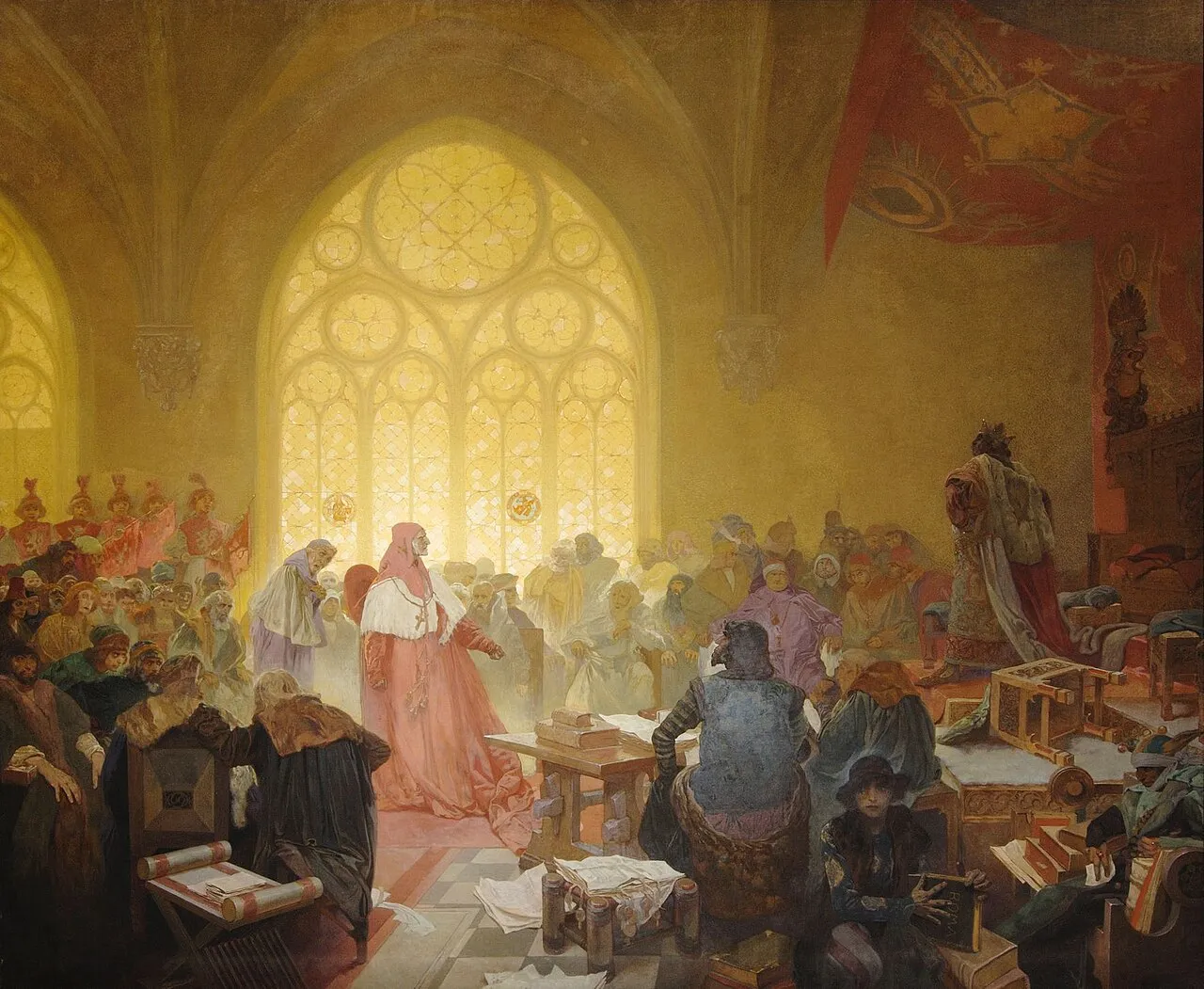 George of Poděbrady and the papal legate Fantinus de Valle in 1462, from Alfons Mucha’s Slav Epic, 1923Wikimedia Commons, Alfons Mucha, Public domain (Mucha Jiri z Podebrad.jpg)
After Ladislaus dies, the estates elect George king on 2 March 1458. In 1457 or 1458 a group who had heard Jan Rokycana preach in Prague settles at Kunvald near Žamberk, on George’s estate of Litice, with Rokycana’s help. Led by Brother Řehoř and following the teaching of Petr Chelčický, they found the Unity of the Brethren. Pope Pius II declares the Compacts void in 1462, and on 23 December 1466 Pope Paul II excommunicates George and declares him deposed.
Matthias Corvinus, king of Hungary, takes up the crusade against him and invades Moravia in spring 1468. George surrounds Matthias’s army at Vilémov in 1469 and lets him go, and on 3 May 1469 the Catholic lords elect Matthias king of Bohemia at Olomouc. George holds Bohemia until his death on 22 March 1471 and is buried in St Vitus Cathedral.
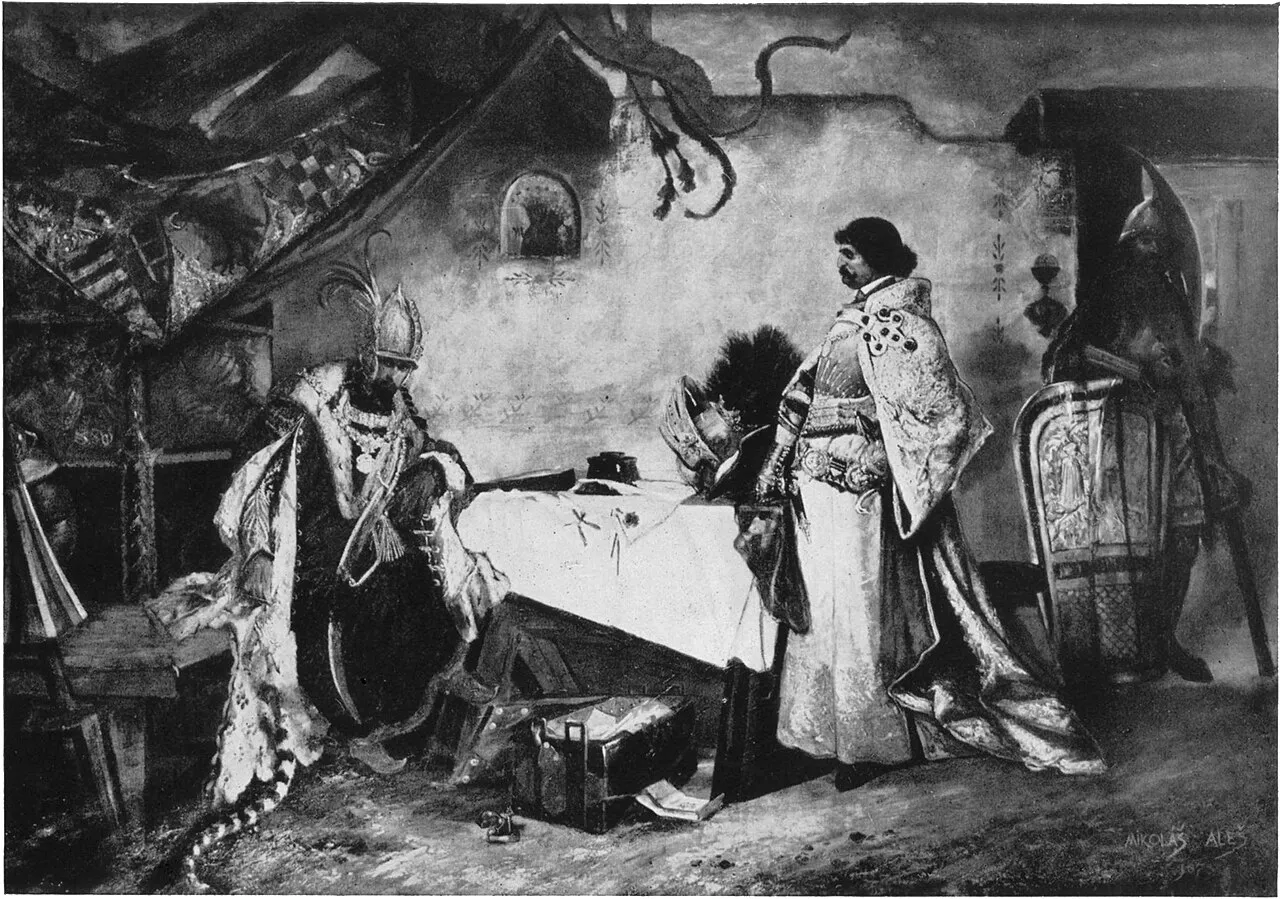 George of Poděbrady and Matthias Corvinus meet after the fighting at Vilémov in 1469, picture by Mikoláš AlešWikimedia Commons, Mikoláš Aleš, Public domain (Mikuláš Aleš, King George of Poděbrad and Matthew Corvinus.jpg)
Sources
- Frederick G. Heymann, George of Bohemia, King of Heretics (1965).
- Otakar Odložilík, The Hussite King: Bohemia in European Affairs, 1440–1471 (1965).
- František Šmahel, Die Hussitische Revolution (2002), vol. 3.
Prev: The Compacts and Sigismund, 1436–1437Next: Žižka remembered