1410–1419
Grunwald and the king’s court, 1410–1419
Poland and Lithuania go to war with the Teutonic Order in Prussia in 1409, and both sides hire mercenaries in Bohemia, Moravia and Silesia. The Moravian Jan Sokol of Lamberk recruits Czechs and Moravians for King Władysław II Jagiełło, and at the end of May 1410 his men fortify the abbey of Koronowo. Before 24 June they join the king’s army at Wolbórz, which crosses the Vistula at Czerwińsk by 30 June. On 15 July the army defeats the Order between Grunwald and Tannenberg, with most Czechs and Moravians in the banner of St George, and Grand Master Ulrich von Jungingen is killed.
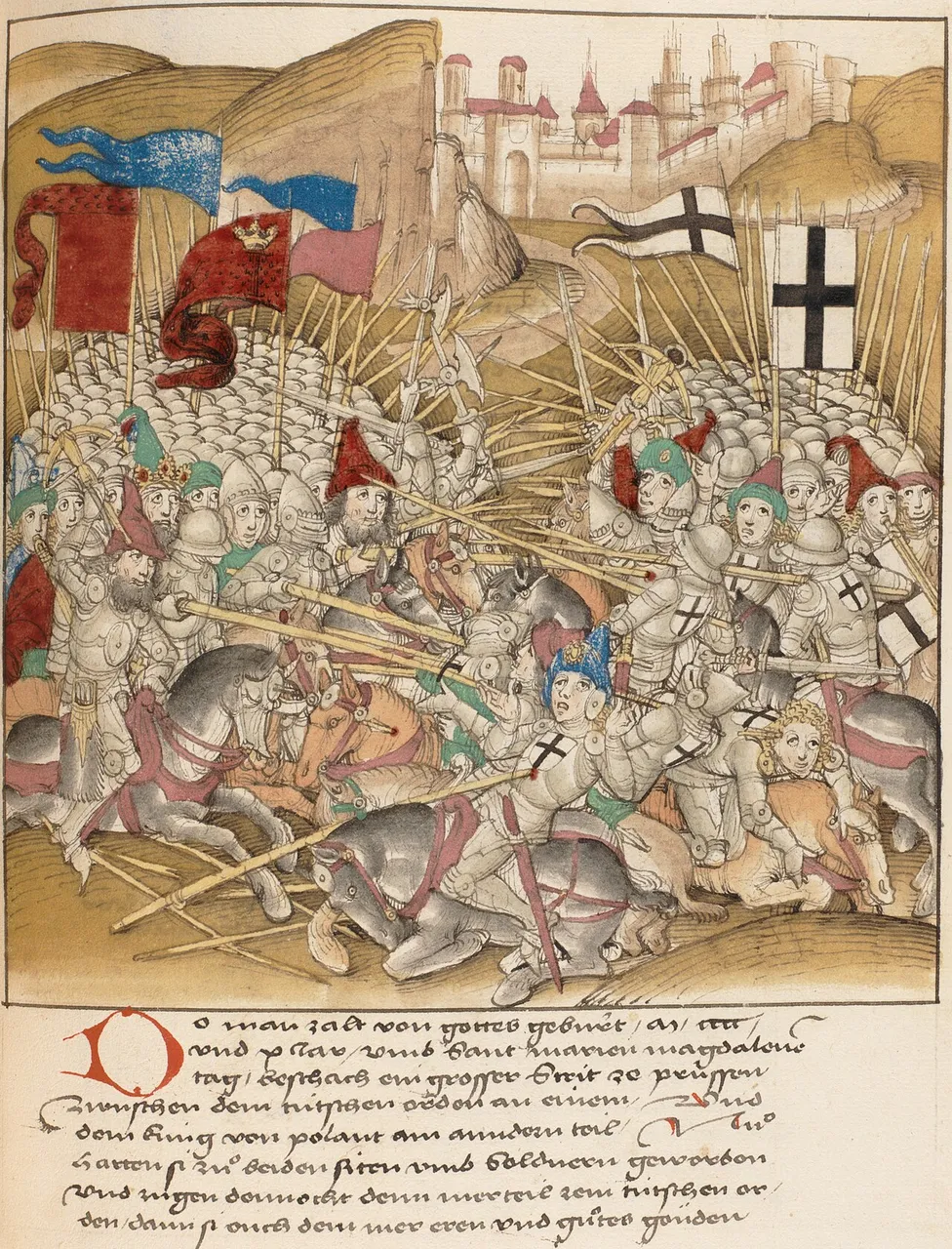 The battle of 1410 between the Teutonic Order and Poland in Diebold Schilling’s Spiezer Chronik, 1484–1485Wikimedia Commons, Diebold Schilling the Elder, Public domain (Battle of Tannenberg.jpg)
Jan Długosz, writing his chronicle in the later 15th century, records that on 23 September 1410 the king gives the captured castle of Radzyń to Sokol, with Poles and Czechs in its garrison, “among them Žižka, a Czech, later the famous leader of the Czech armies”. Žižka’s part in the battle itself rests on tradition, which Jan Matejko follows when he paints him on the field in 1878.
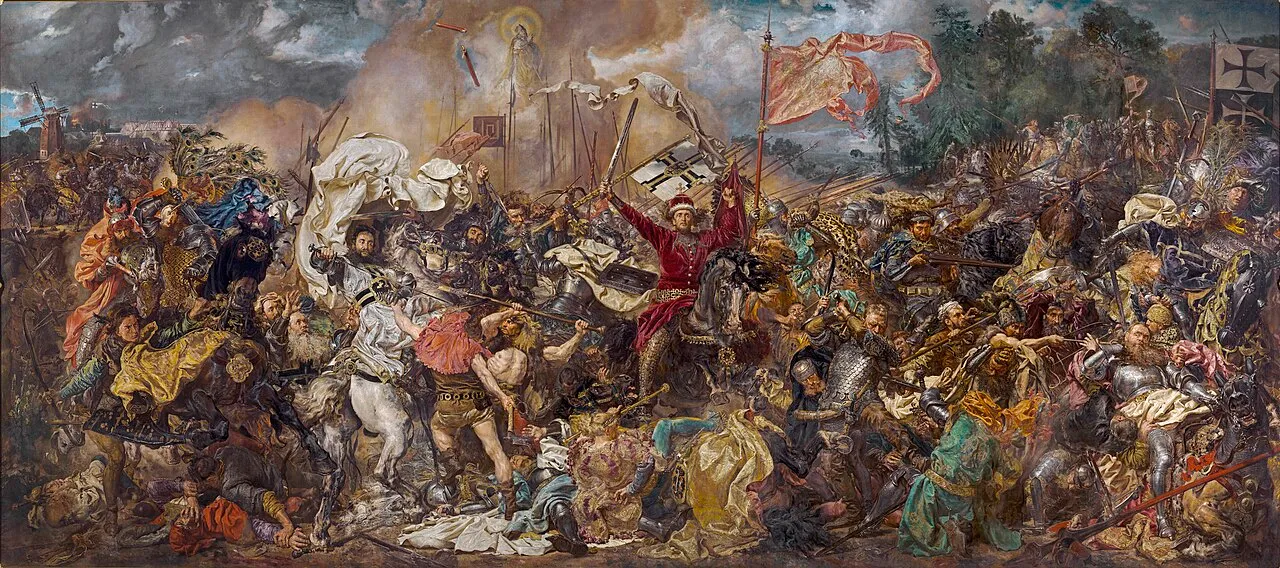 Jan Matejko, The Battle of Grunwald, 1878, National Museum in WarsawWikimedia Commons, Jan Matejko, Public domain (Matejko Battle of Grunwald.jpg)
On 7 November 1414 Janek the One-eyed, King Wenceslas’s doorman, buys a house in Na Příkopě street in Prague, and Czech historians take him for Žižka. He sells it in 1416, when the court book calls him a squire of the king’s court. Laurence of Březová calls Žižka a courtier of the king in 1419. Later accounts make him chamberlain to Queen Sophia, which no record of the time confirms.
Sources
- Sven Ekdahl, Die Schlacht bei Tannenberg 1410: Quellenkritische Untersuchungen, vol. 1 (1982).
- Jan Długosz, Annales seu cronicae incliti regni Poloniae, book 11 (1406–1412).
- Petr Čornej, Jan Žižka: Život a doba husitského válečníka (2019).
Prev: Jan Žižka of Trocnov, c. 1360–1409Next: Hus and the Bethlehem Chapel, 1402–1409