March – 14 August 1431
Domažlice, 1431
Cardinal Giuliano Cesarini, the pope’s legate, comes to the diet at Nuremberg on 4 March 1431 and wins Sigismund and the princes for a new crusade. Sigismund names Frederick of Brandenburg its commander and stays away. The army gathers at Weiden in the Upper Palatinate, while Albert of Austria is to attack through Moravia. The Hussite unions and towns gather near Plzeň at the end of June under Prokop the Great, with Sigismund Korybut as a guest, but run short of food and fall back inland.
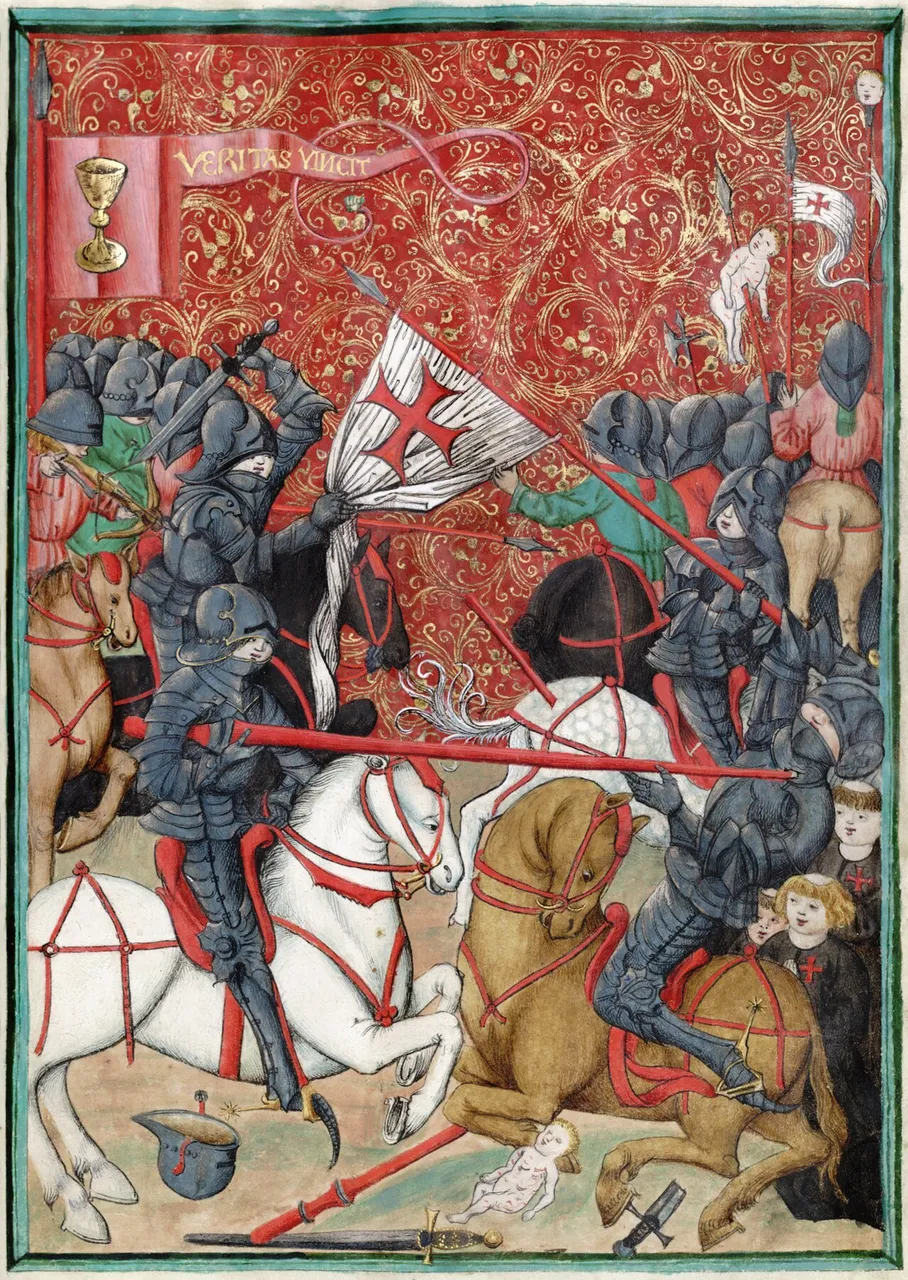 Hussites with the chalice banner fight crusader knights, an illustration of the Jena Codex, fol. 56a, late 15th centuryWikimedia Commons, unknown author, Public domain (Hussitenkriege.tif)
The crusaders cross the border on 1 August and lay siege to Tachov, burning the villages around it, and on 8 August turn to Kladruby. There they hear that the Hussites are gathering near Beroun, and they march south and lay siege to Domažlice. The Hussite army covers the 75 km from Beroun to Chotěšov on 12 and 13 August and early on 14 August marches on Domažlice. The Old Czech Annals give the crusaders 130,000 men and the Hussites 40,000, and Bartošek of Drahonice counts 9,000 wagons with the crusade army.
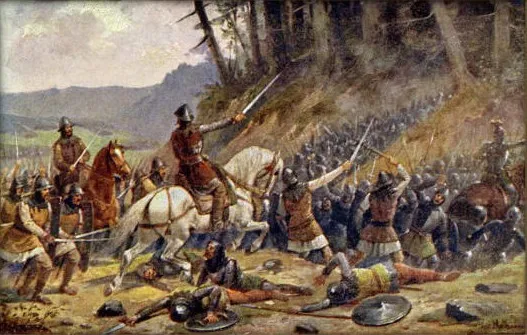 The battle of Domažlice, painting by Josef MathauserWikimedia Commons, Josef Mathauser, Public domain (Josef Mathauser - Bitva u Domažlic.jpg)
On 14 August the crusaders flee before the battle. The Old Czech Annals write that they run into the Bavarian forests with their wagons while the Hussites are still a mile away, before they have seen them. By the Czech accounts Frederick of Brandenburg pulls his troops back towards Kdyně to hold the road over the Všeruby pass, and the Saxons, who have not been told, take the move for flight and panic. Tradition adds that the crusaders run on hearing the Hussite hymn and the rumble of the wagons. A wagon fort of foot with Cesarini’s Italian guard holds the road by Rýzmberk castle for a while. The Hussites take about 2,000 wagons and 300 guns, and Cesarini escapes disguised as a soldier, leaving behind his hat, his gold cross and the papal bull.
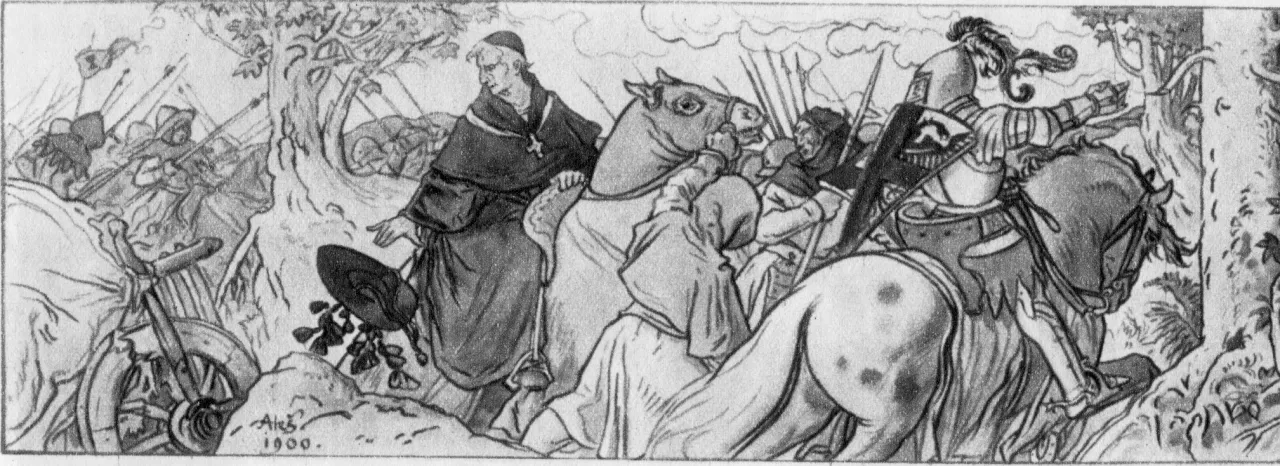 Cardinal Cesarini in flight at Domažlice, drawing by Mikoláš Aleš, about 1900Wikimedia Commons, Mikoláš Aleš, Public domain (U Domažlic.gif)
Sources
- Frederick G. Heymann, “The Crusades against the Hussites”, in Harry W. Hazard (ed.), A History of the Crusades, vol. 3 (1975), pp. 635 to 639.
- Thomas A. Fudge, The Crusade against Heretics in Bohemia, 1418–1437 (2002).
- Old Czech Annals, Bartošek of Drahonice and Laurence of Březová, after the Czech Wikipedia article Bitva u Domažlic.
Prev: Upper Hungary, 1430–1432Next: Brandenburg and Silesia, 1432