May – August 1348
Siena and central Italy, May 1348
From Florence the plague comes south to Siena in May 1348. Agnolo di Tura, a shoemaker and tax collector who keeps a chronicle of the city, writes that great pits are dug across the town and piled deep with the dead, day and night, and that new pits are dug as soon as the old ones are full. His wife Nicoluccia and their five children die: “And I, Agnolo di Tura, called the Fat, buried my five children with my own hands.”
In 1339 Siena began to build a new cathedral, so large that the old church would have become only its transept. The plague stops the work in 1348. The walls of the unfinished nave still stand beside the cathedral.
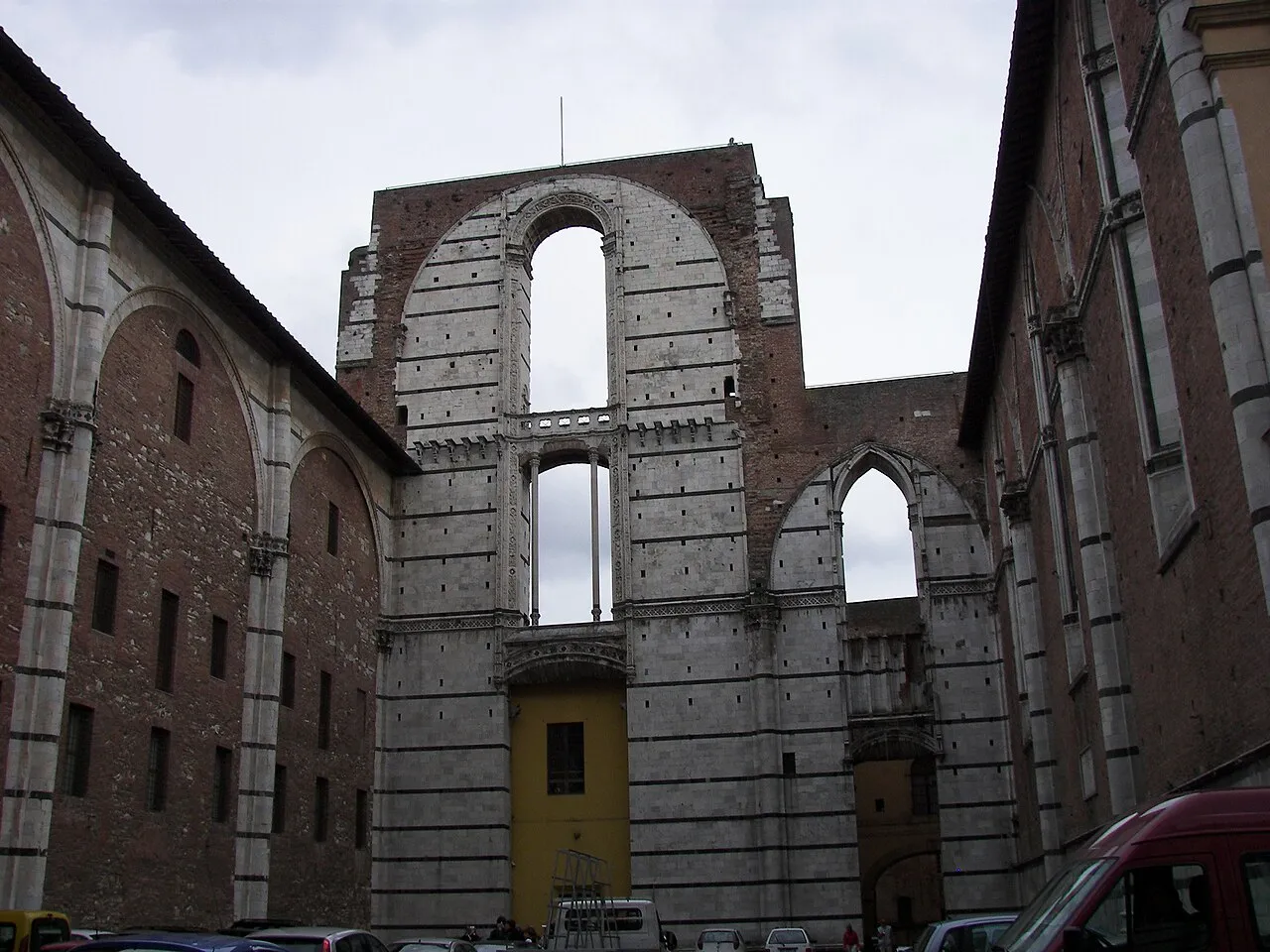 The unfinished nave of Siena Cathedral, left standing when the work stopped after 1348Wikimedia Commons, Wknight94, CC BY-SA 3.0 (Unfinished nave of Siena Cathedral.jpg)
In 1338–1339 Ambrogio Lorenzetti painted the frescoes of good and bad government in the town hall, which show the city and its countryside in peace and in war. He makes his will on 9 August 1348 and dies soon after, probably of the plague, as does his brother Pietro, also a painter.
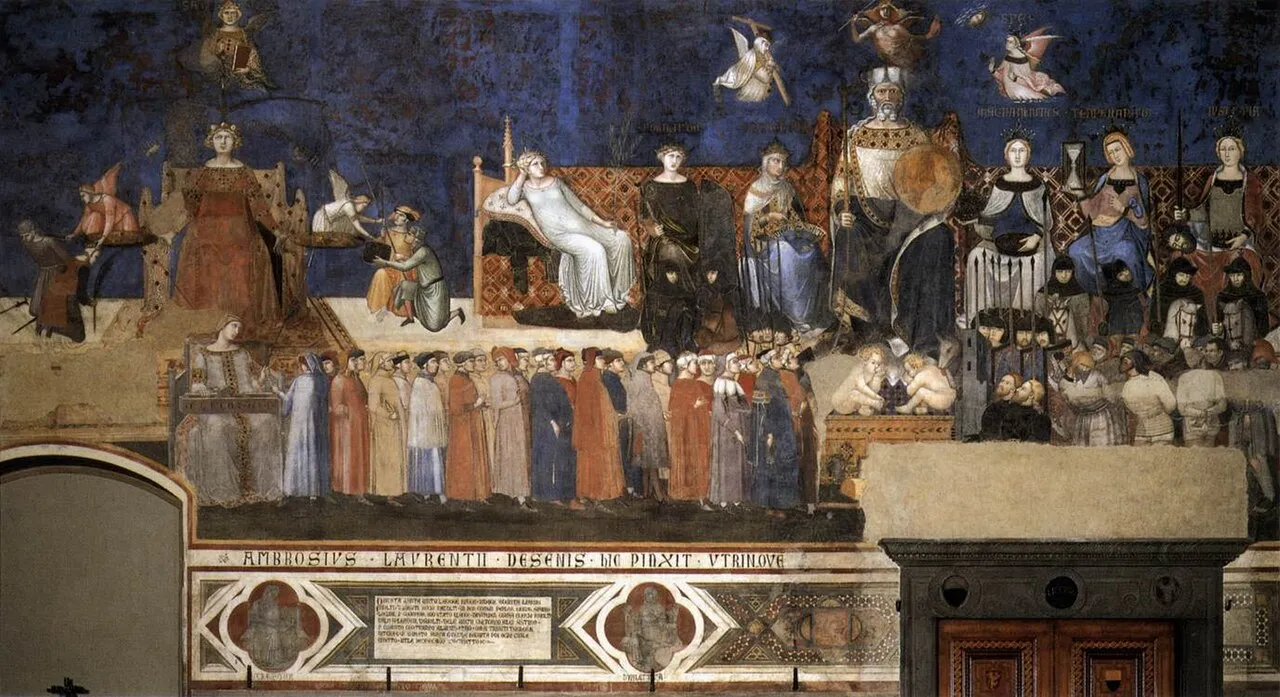 The Allegory of Good Government in the town hall of Siena, painted by Ambrogio Lorenzetti in 1338–1339Wikimedia Commons, Ambrogio Lorenzetti, Public domain (Ambrogio Lorenzetti - Allegory of the Good Government - WGA13484.jpg)
From Siena the plague spreads through the hill towns of Tuscany and Umbria. Perugia and Orvieto have it in April and May 1348. At Orvieto the historian Élisabeth Carpentier has followed the epidemic and its aftermath through the town’s own records. Rome, where no pope has lived for almost forty years, has the plague by August 1348.
Sources
- Agnolo di Tura del Grasso, Cronaca senese (about 1350), translated in William M. Bowsky, The Black Death: A Turning Point in History? (1971).
- William M. Bowsky, “The Impact of the Black Death upon Sienese Government and Society”, Speculum 39 (1964), 1–34.
- Élisabeth Carpentier, Une ville devant la peste: Orvieto et la peste noire de 1348 (1962).
- Ole J. Benedictow, The Complete History of the Black Death (2021).
Prev: Mallorca and Catalonia, April – May 1348Next: Naples and the Hungarian army, May 1348