Late 1349 – 1350
Scotland, 1349–1350
In summer 1349 the plague ravages the north of England, and the Scots take it for God’s punishment of their old enemy. Their king, David II, has been a prisoner in England since his defeat at Neville’s Cross in 1346. Henry Knighton, a canon of Leicester, writes that the Scots swore “by the foul death of England” and gathered an army in the forest around Selkirk late in 1349 to invade the stricken kingdom.
The plague strikes the camp before the army can march. By Knighton’s account about 5,000 men die within a short time, and the rest decide to go home. The English follow them and kill many on the way. The men who reach home carry the disease back to their towns and villages, and in 1350 it spreads through the Lowlands and north across the Forth.
John of Fordun, a priest of Aberdeen who wrote a chronicle of the Scots about 35 years later, puts the great plague in Scotland in 1350. He writes that the flesh of the sick swelled and that they lived barely two days. In his account it struck the common people more than the lords, and it killed a third of mankind.
Few Scottish records survive from these years, so historians have little to test his figure against. For England they can check the chroniclers against tax lists and bishops’ registers.
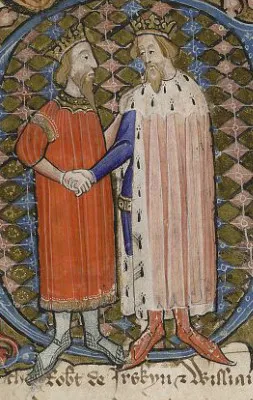 David II of Scotland, left, with Edward III of England in a manuscript made in England between 1386 and 1399Wikimedia Commons, unknown painter, Public domain (David II, King of Scotland and Edward III, King of England (British Library MS Cotton Nero D VI, folio 66v).jpg)
Sources
- Henry Knighton, Chronicon (about 1390), in Rosemary Horrox, The Black Death (1994).
- John of Fordun, Chronica gentis Scotorum (about 1385), tr. W. F. Skene, John of Fordun’s Chronicle of the Scottish Nation (1872).
Prev: Tournai, Flanders and northern France, 1349Next: Alfonso XI at Gibraltar, March 1350