1352 – 1353
Pskov, Novgorod and Moscow, 1352–1353
The plague reaches the Russian lands last, from the Baltic in the west. In spring 1352 it breaks out in Pskov, a merchant town on the road between Novgorod and the German towns of Livonia. Ole Benedictow thinks that it came from there, from the area of today’s Latvia. The Pskov chronicle describes a quick death: those who cough up blood die within three days. Many people take monastic vows and wait for death in a monastery, and others give their property to the church or the poor.
Pskov calls on Vasily Kalika, the archbishop of Novgorod and Pskov, to bless the town. He leads processions and holds services until the dying slows. On his way home down the Shelon river he falls ill, and he dies on 3 July 1352 at the monastery of St Michael at the mouth of the Uza. The plague reaches Novgorod in August 1352, and the chronicles of both towns say that hundreds die every day.
From Novgorod it spreads, in the chroniclers’ words, through “all the Russian land”, south along the trade routes and north to Beloozero. So many die at Beloozero that the survivors move the town to a new site on the south shore of the lake, where Belozersk stands today.
In spring 1353 the plague reaches Moscow. Theognostus, the metropolitan of Kyiv and all Rus’, who has his seat in Moscow, dies on 11 March. Grand Prince Simeon, called the Proud, takes monastic vows before his death on 27 April, aged 35. His two infant sons, Ivan and Semyon, have died in March, and his brother Andrei dies six weeks after him. Simeon’s will is thought to be the oldest Russian document written on paper. His brother Ivan II succeeds him.
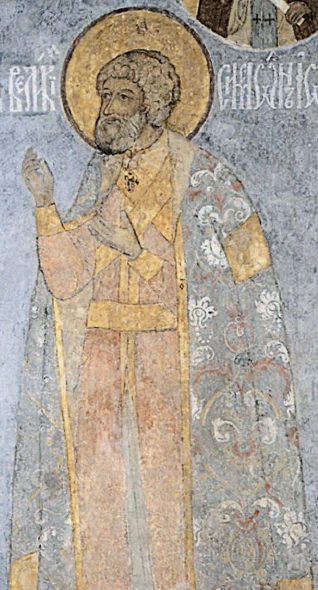 Simeon the Proud in a fresco of 1652 in the Archangel Cathedral of the Moscow Kremlin, where he is buriedWikimedia Commons, unknown painter, CC BY-SA 4.0 (Фреска с изображением Симеона I Гордого.png)
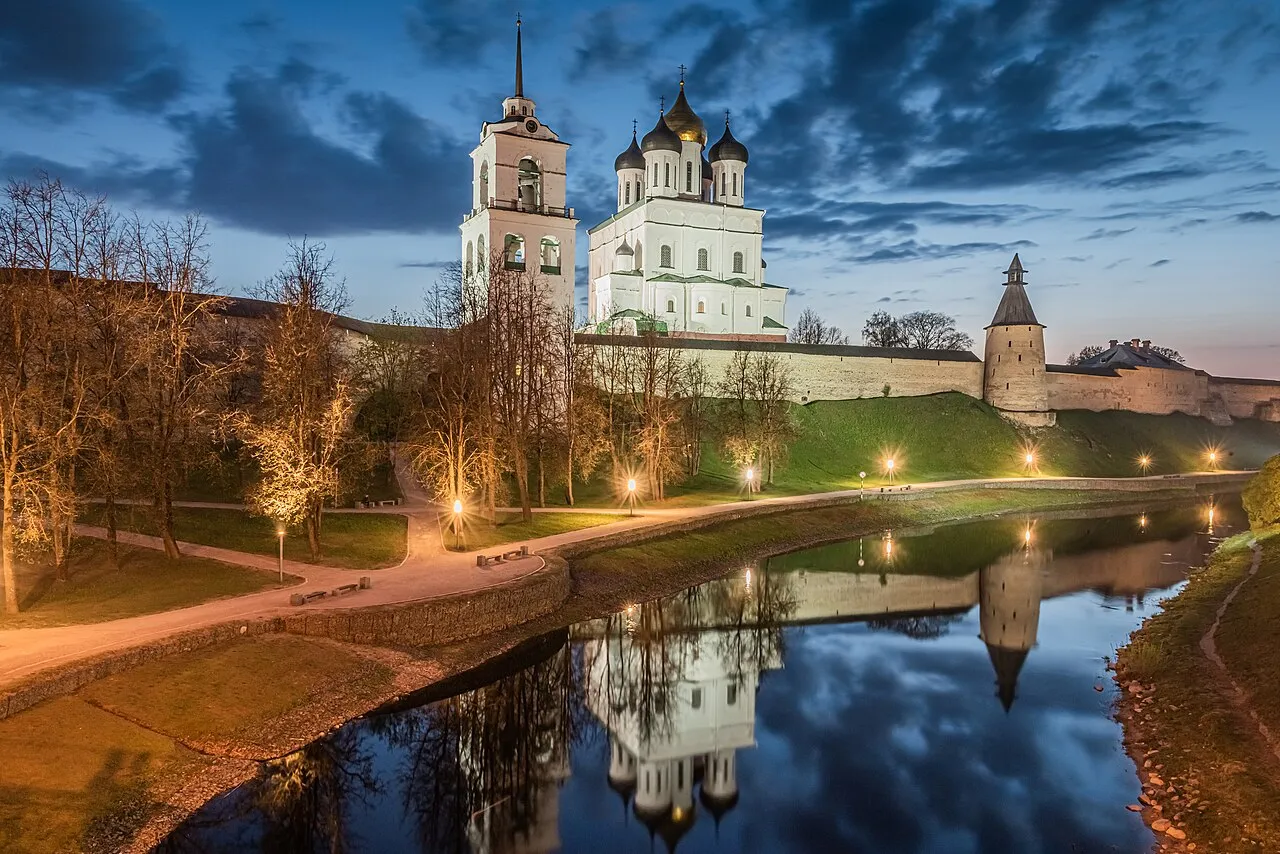 The Krom, the walled heart of Pskov, where the Pskova river meets the Velikaya. The cathedral inside was rebuilt in the 1690s.Wikimedia Commons, Александр Байдуков, CC BY-SA 4.0 (Pskov. The ensemble of the Pskov Kremlin.jpg)
Sources
- Pskov First Chronicle and Novgorod First Chronicle, entries for 1352.
- Testament of Grand Prince Simeon Ivanovich (1353).
- John Fennell, The Emergence of Moscow, 1304–1359 (1968).
- Lawrence N. Langer, “The Black Death in Russia: Its Effects Upon Urban Labor”, Russian History 2 (1975).
- Ole J. Benedictow, The Complete History of the Black Death (2021).
Prev: Lübeck, Denmark and Sweden, 1350Next: Counting the dead