1361 – 1375
The plague returns, 1361–1375
The plague comes back. In England the second pestilence strikes in 1361 and 1362 and may kill about a fifth of the people. Chroniclers call it the mortality of children, because it kills so many of the young who have been born since 1348. It also takes the great: Henry of Grosmont, Duke of Lancaster and Edward III’s leading general, dies at Leicester on 23 March 1361, probably of the plague. The historian Philip Slavin argues that this second wave did more lasting harm to England’s population and economy than the Black Death itself.
In 1361 the plague also strikes the papal court at Avignon. A life of Pope Innocent VI counts about 6,000 dead there between Easter and the end of July, among them about a hundred bishops and eight or nine cardinals. In Tuscany it kills a fifth of the people of Pisa, Pistoia and Florence between 1361 and 1363.
A third wave follows in 1369, and in London and Tuscany it kills between a tenth and a seventh of the people. A fourth comes in 1374 and 1375. Each kills fewer than the Black Death, but together they keep the population of Europe from recovering for more than a century.
Rulers try harder to keep the sick apart from the healthy. In 1374 Bernabò Visconti, lord of Milan, orders that everyone in Reggio Emilia who falls ill of the plague be taken out of the town into the fields, to recover or die there. Three years later Ragusa goes further.
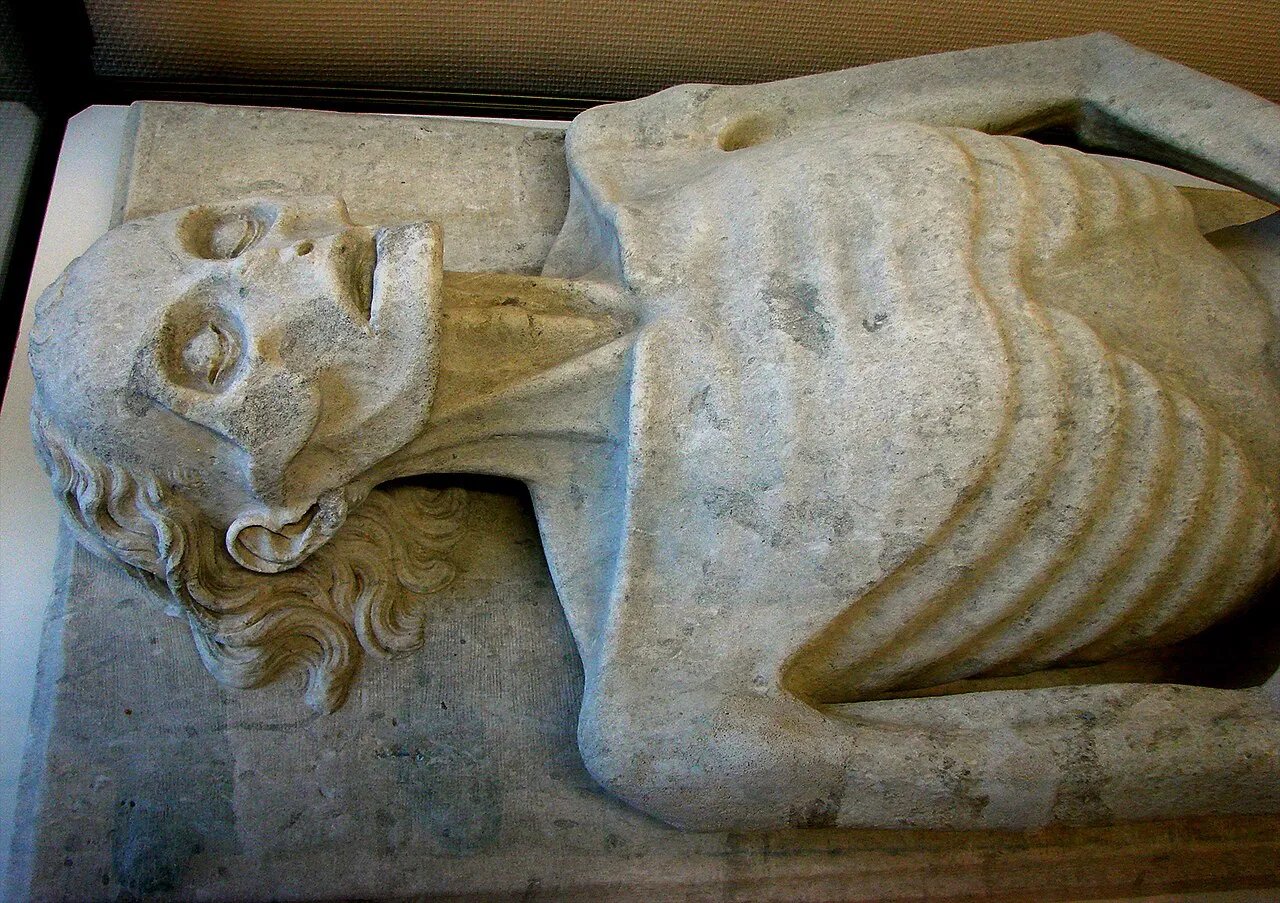 The tomb of Guillaume de Harcigny, doctor to Charles VI of France, carved in 1394 as a wasted corpse, the oldest such tomb kept in FranceWikimedia Commons, Vassil, Public domain (Gisant Guillaume de Harcigny Musée de Laon 280208 1.jpg)
Sources
- Étienne Baluze, Vitae paparum Avenionensium (1693), the lives of Innocent VI.
- John Hatcher, Plague, Population and the English Economy, 1348–1530 (1977).
- Philip Slavin, “Plague Strikes Back: The Pestis Secunda of 1361–62 and Its Demographic Consequences in England and Wales”, Journal of Medieval and Early Modern Studies 54 (2024).
- Paul S. Sehdev, “The Origin of Quarantine”, Clinical Infectious Diseases 35 (2002).
Prev: Wages, labour laws and revolts, 1349–1381Next: Ragusa’s thirty days, 1377