1377 – 1468
Ragusa’s thirty days, 1377
Ragusa (today Dubrovnik) is a small merchant republic on the Adriatic, under the protection of the king of Hungary since 1358. Its ships trade with the Balkans, Italy and the Levant, and the plague keeps coming back with them. In July 1377 its Great Council passes a law that nobody coming from a place struck by plague may enter the city or its territory. Ships, crews, merchants and goods from such places must first wait for a month on the islet of Mrkan or in the town of Cavtat, outside the city. Only those who stay healthy through the month may come in. The law is copied into the city’s book of statutes, the Liber viridis, which survives in the State Archives in Dubrovnik.
Keeping the sick apart is older. The historian of medicine Mirko Grmek showed that Ragusa was the first state to hold arrivals apart for a fixed time before letting them in. Its waiting time of thirty days is called the trentino. Marseille takes up the system in 1383, by the account of the historian François de Lannoy, and most of the Italian ports follow.
Venice goes further. In 1423 its Senate turns the island of Santa Maria di Nazareth in the lagoon into a hospital for the plague sick and a station where crews and goods wait before they enter the city. The island is later called the Lazzaretto Vecchio, the old lazaretto, after Venice opens a second one in 1468. The waiting time grows to forty days, the quarantena in the Venetian language, which gives the word quarantine. Since 2004 archaeologists have found more than 1,500 skeletons of plague victims on the island. Ragusa builds its own lazaretto outside its eastern gate between 1590 and 1642.
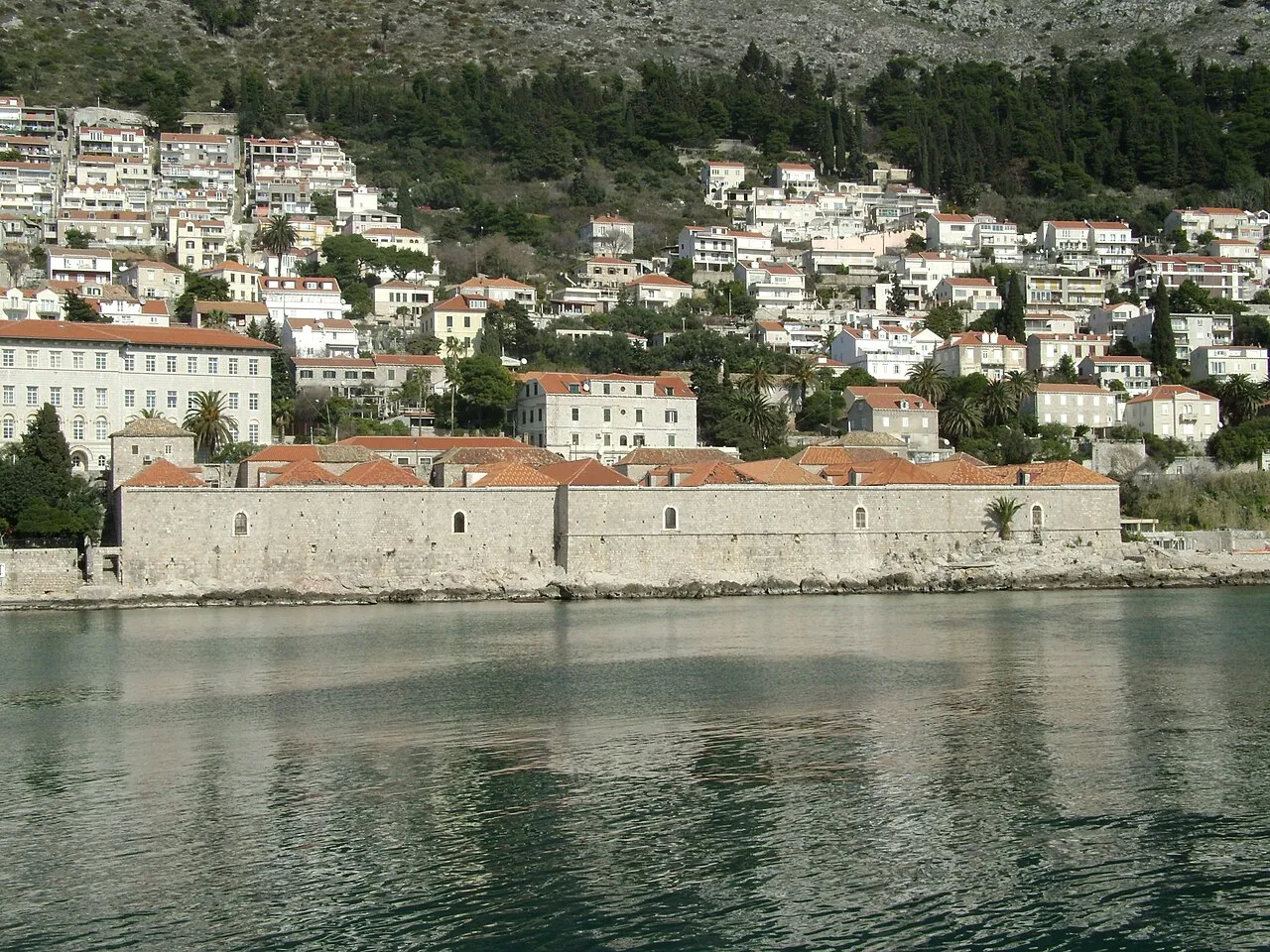 The Lazareti, the quarantine houses that Ragusa built outside its Ploče gate between 1590 and 1642Wikimedia Commons, Lasta, Public domain (Lazareti LS1.JPG)
Sources
- Liber viridis of Dubrovnik, decree of July 1377.
- Zlata Blažina Tomić and Vesna Blažina, Expelling the Plague: The Health Office and the Implementation of Quarantine in Dubrovnik, 1377–1533 (2015).
- Gian Franco Gensini, Magdi H. Yacoub and Andrea A. Conti, “The concept of quarantine in history: from plague to SARS”, Journal of Infection 49 (2004).
- Mirko D. Grmek, “Le concept d’infection dans l’Antiquité et au Moyen Âge, les anciennes mesures sociales contre les maladies contagieuses et la fondation de la première quarantaine à Dubrovnik (1377)”, Rad JAZU 384 (1980).
- François de Lannoy, Pestes et épidémies au Moyen Âge (2016).
- Jane L. Stevens Crawshaw, Plague Hospitals: Public Health for the City in Early Modern Venice (2012).
Prev: The plague returns, 1361–1375Next: London 1665 and Marseille 1720