August – December 1348
Paris, autumn 1348
Jean de Venette, a Carmelite friar of Paris, wrote that in August 1348 a large and very bright star was seen in the evening sky over Paris, and that people took it for a sign of what was coming. His chronicle is the fullest account of the plague in the city. The plague is already at Rouen, down the Seine, by June. By Jean’s account it first appears near Paris in June 1348, at Roissy, a village north-east of the city. In Paris it is worst in the autumn and winter of 1348, and it lasts about a year.
The city’s great hospital, the Hôtel-Dieu, stands beside the cathedral of Notre-Dame. So many died there, Jean wrote, that for a long time more than five hundred bodies were carried out each day in carts to the cemetery of the Holy Innocents. He praised the sisters of the Hôtel-Dieu, who nursed the sick without fear of death, and many of whom died of it. Many priests, by his account, were afraid and stayed away, and left the care of the dying to bolder friars and monks.
King Philip VI leaves Paris while the plague is there. He asks the masters of the faculty of medicine at the university for a report on the causes of the plague, and they deliver it in October 1348. The next chapter returns to their report.
When the plague had passed, Jean wrote, people married quickly and many children were born. But the world was no better for it. People were greedier than before, and he claimed that the children born after the plague had only twenty or twenty-two teeth, where before people had thirty-two.
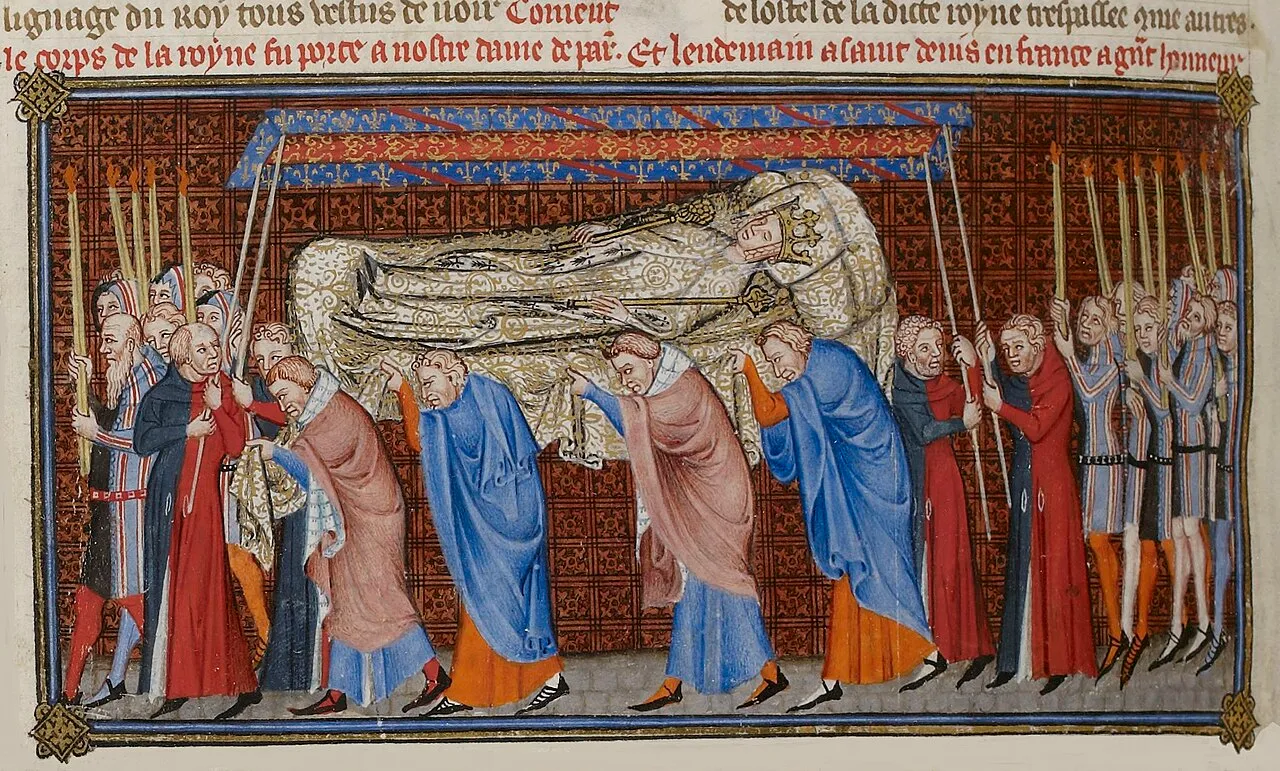 The body of Queen Joan of Bourbon carried to Notre-Dame in Paris in 1378, in the Grandes Chroniques de France made for Charles VWikimedia Commons, Master of the Livre du Sacre, public domain
Sources
- Jean de Venette, The Chronicle of Jean de Venette, ed. Richard A. Newhall, trans. Jean Birdsall (1953).
- Rosemary Horrox (ed.), The Black Death (1994).
- Ole J. Benedictow, The Complete History of the Black Death (2021).
Prev: Bordeaux and the Atlantic coast, August – September 1348Next: The poison accusation, September 1348