May – June 1348
Naples and the Hungarian army, May 1348
In November 1347 King Louis I of Hungary sets out from Visegrád to avenge his brother Andrew, who was murdered at Aversa in 1345. Louis blames Andrew’s wife, Queen Joanna I of Naples. His army enters her kingdom on 24 December, and on 15 January 1348 Joanna sails for her county of Provence. At Aversa, on 23 January, Louis has her cousin Charles of Durazzo beheaded on the spot where Andrew died. In February he enters Naples.
The plague reaches Naples in the spring of 1348, and Louis’s soldiers begin to die. In May he leaves for home, with his mercenaries left behind in the kingdom’s castles. He crosses the kingdom to Barletta on the Adriatic, sails to Vrana on the Dalmatian coast and rides on to Buda.
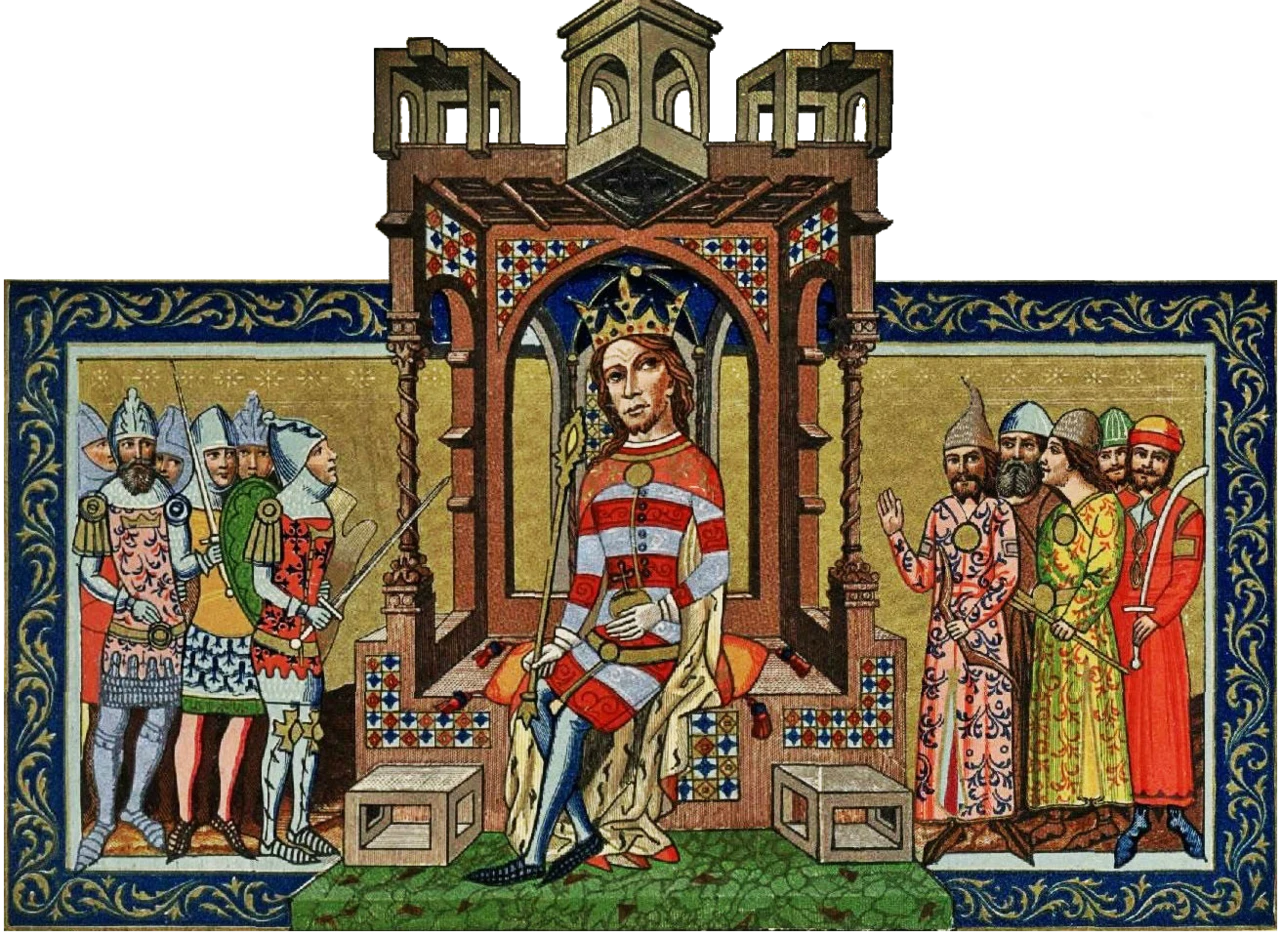 Louis I of Hungary enthroned among his nobles in the Illuminated Chronicle, about 1360Wikimedia Commons, Márk Kálti, Public domain (Miniatures of Louis I (Chronicon Pictum).png)
Historians long held that his army carried the plague into Hungary. András Vadas, who has studied the Hungarian sources, points out that no source of the time says so. The plague reached the Dalmatian ports early in 1348, and it may have come into Hungary from there.
Joanna meanwhile is in Provence and needs money to win back her kingdom. On 9 June 1348 she sells Avignon, which she holds as countess of Provence, to Pope Clement VI for 80,000 florins. When she hears that Louis has gone, she sails home and reaches Naples on 17 August 1348. Louis’s garrisons soon lose most of what he won.
Sources
- András Vadas, “The Black Death in the Kingdom of Hungary: Sources, Limitations, Interpretations”, Historical Studies on Central Europe 4 (2024), 9–29.
- Pál Engel, The Realm of St Stephen: A History of Medieval Hungary, 895–1526 (2001).
- Elizabeth Casteen, From She-Wolf to Martyr: The Reign and Disputed Reputation of Johanna I of Naples (2015).
- Ole J. Benedictow, The Complete History of the Black Death (2021).
Prev: Siena and central Italy, May 1348Next: Bologna, Padua and the Alps, June 1348