November 1347 – January 1348
Marseille and the Rhône, November 1347 – January 1348
In November 1347 ships from the east bring the plague to Marseille, the chief port of Provence, a county ruled by Queen Joanna I of Naples. The merchants of Marseille trade with Genoa, Sicily and the Levant, and the sickness comes in with their galleys.
From the harbour the plague moves inland, to Aix-en-Provence and up the Rhône to Arles. By January 1348 it is in Avignon, about 100 km from the sea. On the roads it needs about two months for that distance, less than 2 km a day. Ships have carried it from Sicily to Provence within weeks.
Avignon has been the seat of the popes since 1309. Its streets are crowded with clergy, envoys, merchants and pilgrims, and the sickness spreads fast among them. Louis Heyligen, a Flemish musician in the household of Cardinal Giovanni Colonna, writes from Avignon on 27 April 1348 that half the people have died. The pope has bought a field for a new cemetery, and Heyligen counts 11,000 bodies buried there in about six weeks.
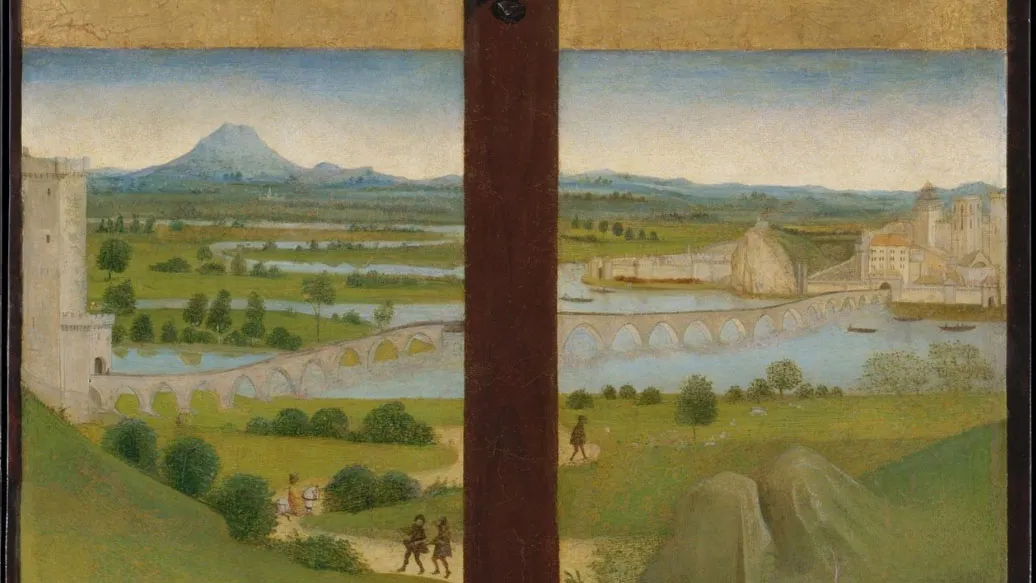 Avignon and the Saint-Bénézet bridge over the Rhône on the Perussis altarpiece, painted in 1480Wikimedia Commons, circle of Nicolas Froment, Public domain (Perussis altarpiece 1480 avignon bridge detail.jpg)
In the same months ships bring the plague to the islands of Corsica and Sardinia. Corsica belongs to Genoa and most of Sardinia to the Crown of Aragon, and both lie on the sea lanes of the western Mediterranean. Both islands have the sickness early in 1348.
Sources
- Louis Heyligen, letter from Avignon, 27 April 1348, in Rosemary Horrox, The Black Death (1994).
- Ole J. Benedictow, The Black Death 1346–1353: The Complete History (2004).
- Ole J. Benedictow, The Complete History of the Black Death (2021).
Prev: Messina, October 1347Next: Genoa and Pisa, winter 1347–1348