1665 – 1722
London 1665 and Marseille 1720
The plague keeps returning to Europe for more than three centuries after 1353. Two of the last great outbreaks in western Europe strike London in 1665 and Marseille in 1720.
In London three cases are recorded in April 1665, and the government orders the houses of the sick shut up with their families inside. A red cross and the words “Lord, have mercy upon us” mark the door. By July the plague is raging in the City, and the king and his court leave for Salisbury and then Oxford. “Lord! How empty the streets are and how melancholy”, Samuel Pepys writes in his diary. The bills of mortality count 97,306 burials in 1665, 68,596 of them of the plague. Many families hide a plague death, so the true number is higher: historians estimate about 100,000 dead in 18 months, almost a quarter of Londoners. In the Derbyshire village of Eyam, where the plague comes with a parcel of cloth from London, the villagers shut themselves off from their neighbours, and about a third of them die.
In May 1720 the merchant ship Grand-Saint-Antoine reaches Marseille from Sidon with silk and cotton. A Turkish passenger, several of the crew and the ship’s surgeon have died on the way, and Livorno has turned the ship away. The town’s merchants want its cargo for the fair at Beaucaire and press the authorities to lift its quarantine. A few days later the plague breaks out in the town. About 50,000 of Marseille’s 90,000 people die in two years, and another 50,000 in the rest of Provence. The Parlement of Aix forbids all contact with Marseille on pain of death, and a dry stone wall, the Mur de la peste, is built across the Vaucluse plateau to hold the plague back.
It is the last great plague of western Europe. Moscow suffers one in 1771, and the plague returns to the Ottoman lands until the 19th century, when the second pandemic, which began with the Black Death, fades out.
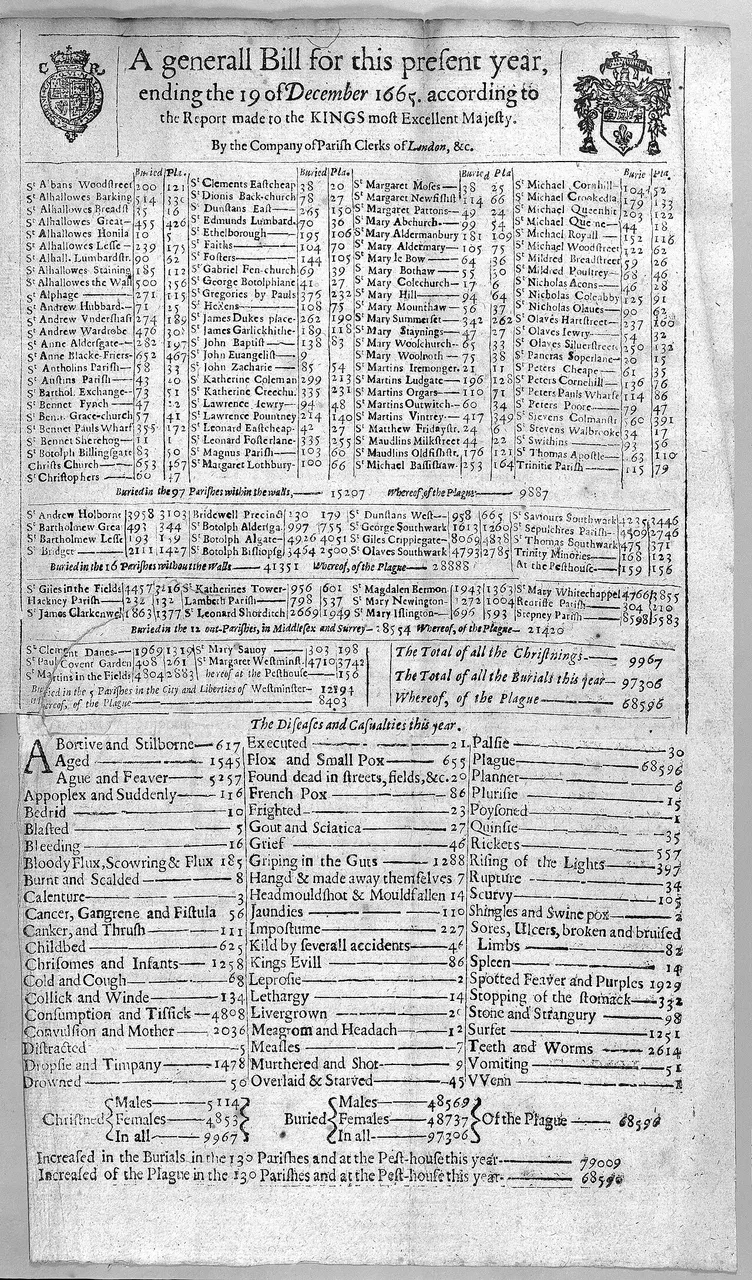 London’s general bill of mortality for 1665, which counts 97,306 burials, 68,596 of them of the plagueWikimedia Commons, Wellcome Collection, CC BY 4.0 (Death for the year 1665 Wellcome L0000352.jpg)
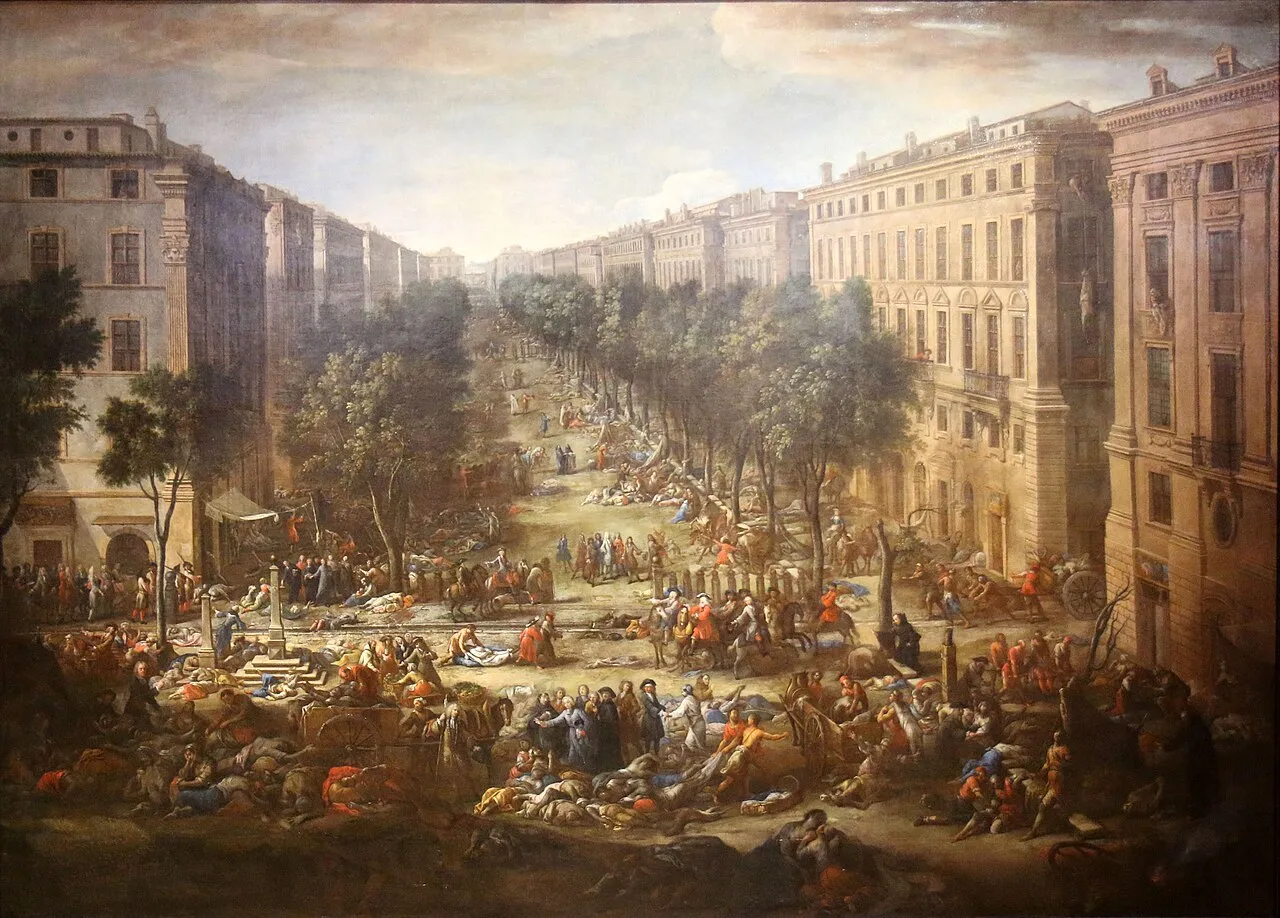 The Cours Belsunce in Marseille during the plague of 1720, painted in 1721 by Michel Serre, who lived through itWikimedia Commons, Michel Serre, Public domain (Michel Serre-Peste-Cours Belsunce.jpg)
Sources
- A generall Bill for this present year, ending the 19 of December 1665 (London, 1665).
- A. Lloyd Moote and Dorothy C. Moote, The Great Plague: The Story of London’s Most Deadly Year (2004).
- Jean-Baptiste Bertrand, Relation historique de tout ce qui s’est passé à Marseille pendant la dernière peste (1721).
- Charles Carrière, Marcel Courdurié and Ferréol Rebuffat, Marseille ville morte: la peste de 1720 (1968).
Prev: Ragusa’s thirty days, 1377