August 1348 – 1349
Ireland, 1348–1349
The plague crosses the Irish Sea in the summer of 1348. It comes ashore at Dalkey or Howth, near Dublin, and in August it is in Drogheda and Dublin. John Clyn, a Franciscan friar of Kilkenny, counts 14,000 dead in Dublin between the start of August and Christmas. By his count 25 friars of his order die at Drogheda and 23 at Dublin before Christmas.
The plague reaches Kilkenny by the winter and is at its worst there in Lent 1349. Clyn records that eight Dominican friars of the town die between Christmas and 6 March. He writes of himself as “waiting among the dead for death to come”, and he leaves blank pages at the end of his annals: “I leave parchment for continuing the work, in case anyone should still be alive in the future.” His last entry, written after 17 June 1349, mourns his friend Fulk de la Freigne. Whether Clyn dies of the plague is not known.
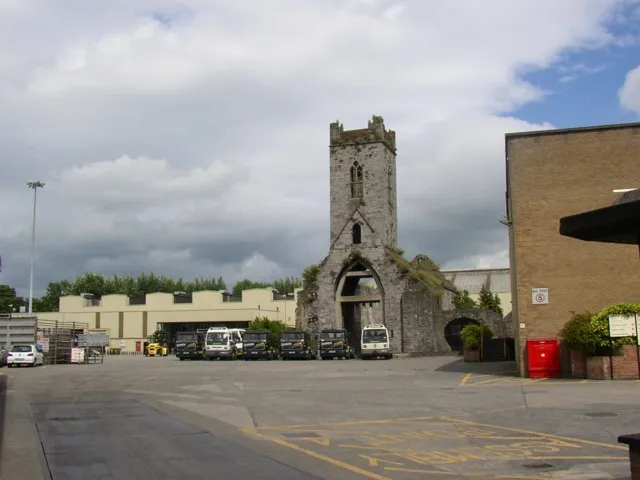 The tower of the Franciscan friary at Kilkenny, where John Clyn kept his annals, today in the yard of a breweryHumphrey Bolton, Wikimedia Commons, CC BY-SA 2.0
The English chronicler Geoffrey le Baker writes that the plague kills the English settlers of Ireland in great numbers, while the native Irish in the mountains and uplands are barely touched. The settlers live close together in the towns and ports that trade with England, and many Gaelic Irish live scattered across the hills. The historian Maria Kelly agrees that the colony suffered more than Gaelic Ireland. The Irish annals record the plague in a few lines, so the losses in Gaelic Ireland are hard to measure.
Sources
- John Clyn, The Annals of Ireland, ed. and trans. Bernadette Williams (2007).
- Geoffrey le Baker, Chronicon (about 1360), trans. in Rosemary Horrox (ed.), The Black Death (1994).
- Maria Kelly, A History of the Black Death in Ireland (2001).
- Maria Kelly, “‘Unheard-of mortality’: the Black Death in Ireland”, History Ireland.
Prev: England, 1349Next: The flagellants, summer – autumn 1349