June 1348 – November 1349
Ibn Battuta goes home, 1348–1349
Ibn Battuta of Tangier has been travelling for 24 years when the plague finds him in Syria. In 1348, at Damascus, he learns that his father died 15 years earlier. He hears of terrible deaths at Gaza, and in July he is back at Damascus, where 2,400 people die each day. He goes on through Jerusalem to Gaza, which he finds emptied, and on to Cairo, where he is told that 21,000 people died there in a single day.
From Cairo he goes up the Nile and across the desert to the Red Sea port of Aydhab, takes ship to Jeddah and reaches Mecca in November 1348. He stays for the pilgrimage of February 1349, his last, and then goes back with the Syrian caravan by Medina, Jerusalem and Gaza to Cairo. The pilgrims carry the plague to Mecca itself, in 1348 or 1349 by different accounts.
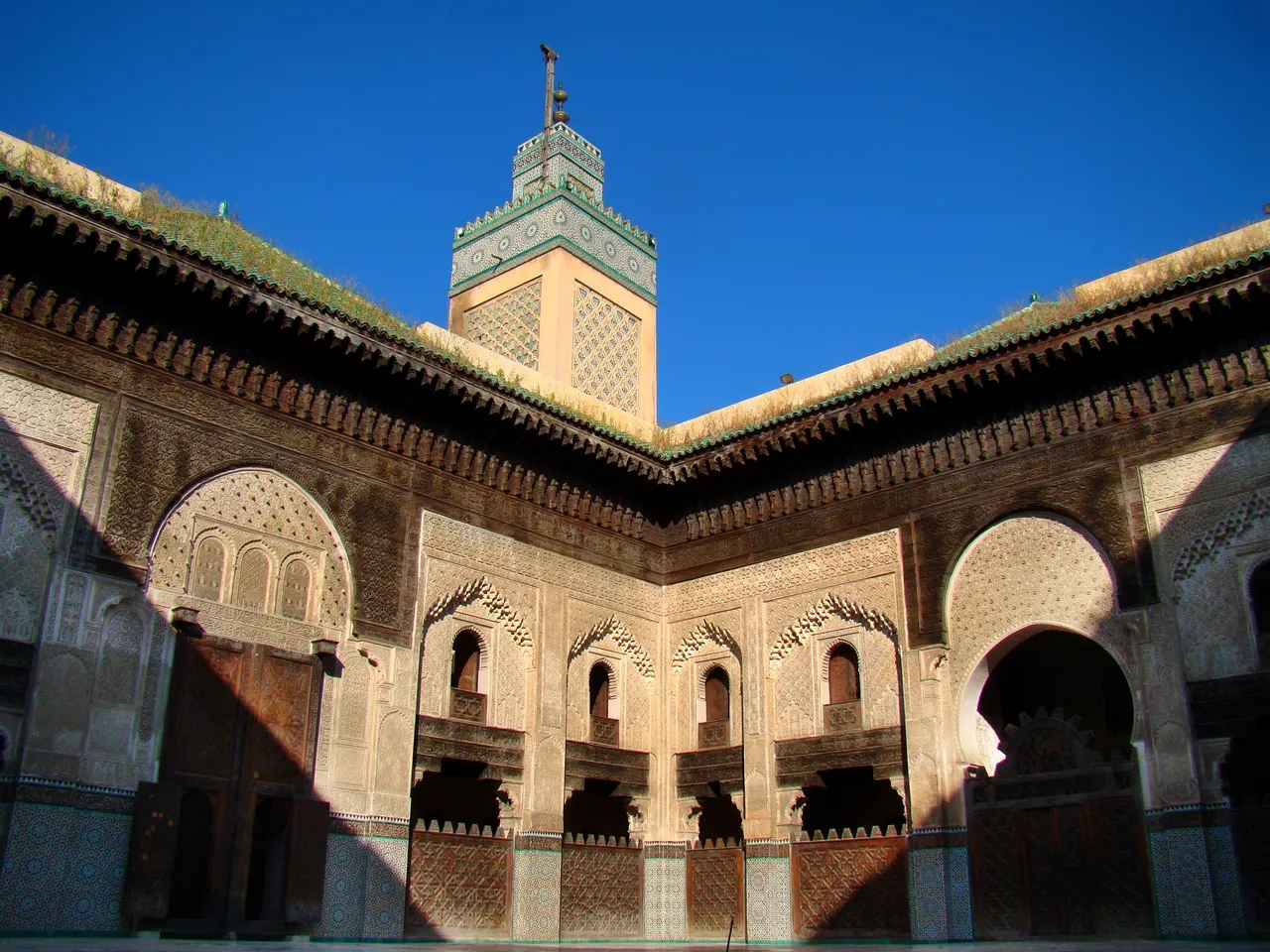 The Bou Inania madrasa at Fez, built in 1350–1355 by the Marinid sultan Abu InanBjørn Christian Tørrissen, Wikimedia Commons, CC BY-SA 3.0
In 1349 Ibn Battuta sails from Egypt on a small Tunisian ship, lands on the island of Jerba and goes on to Tunis, where he stays about 36 days. A Catalan ship takes him by way of Sardinia to the coast of Algeria, and he goes on overland by Tlemcen to Taza. There the news meets him: “In the town of Taza I learned the news of my mother’s death of the plague, may God the Most High have mercy on her.” He reaches Fez on 13 November 1349 and enters the service of the Marinid sultan Abu Inan. Then he goes to Tangier to visit his mother’s tomb.
Sources
- Ibn Battuta, The Travels of Ibn Battuta, A.D. 1325–1354, trans. H. A. R. Gibb and C. F. Beckingham, vol. 4 (1994).
- Ross E. Dunn, The Adventures of Ibn Battuta (1986).
- Michael W. Dols, The Black Death in the Middle East (1977).
Prev: Bergen and Norway, autumn 1349Next: Tournai, Flanders and northern France, 1349