1339 – 1346
Across the Golden Horde, 1339–1346
For eight years after 1338 no source records the plague, and its road west is unknown. The map draws it along the caravan road that links the Chüy valley, through Otrar and Urgench, with the Volga.
In 1342 Jani Beg becomes khan of the Golden Horde, after he has two of his brothers killed. He rules from Sarai, a city of mosques, palaces, markets and workshops on the lower Volga, where merchants from Egypt, Iraq, Italy and Rus trade.
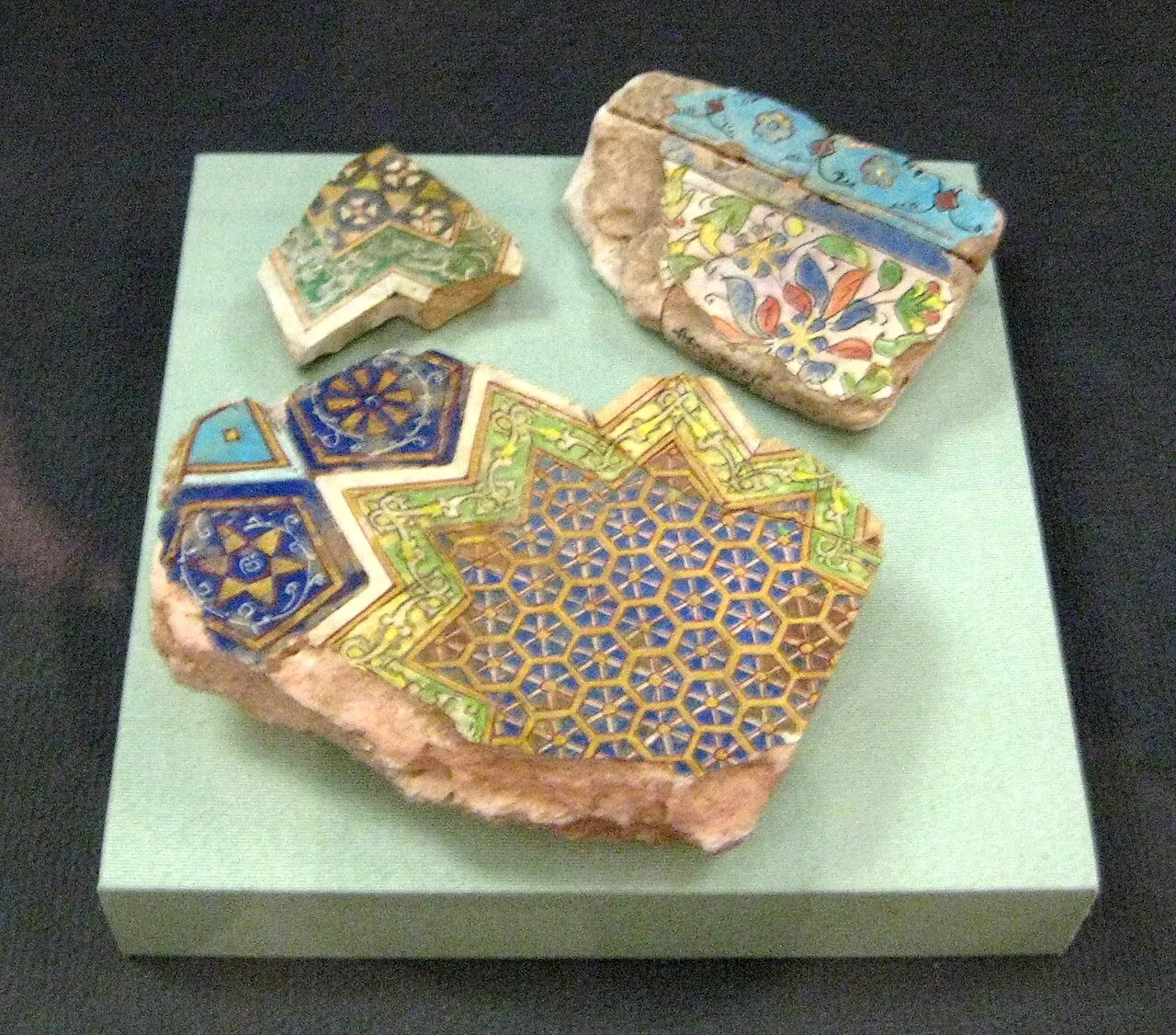 Glazed tiles from a palace of the khans of the Golden Horde at SaraiWikimedia Commons, shakko, CC BY-SA 3.0
In 1346 the plague appears in his lands. A Russian chronicle records under that year that God’s punishment fell on the people of the eastern lands, in the towns of Ornach, which is probably Urgench, Khaztorokan, which is Astrakhan, Sarai and Bezdezh. It names the peoples who died there: Muslims, Tatars, Armenians, Abkhaz, Jews, Italians, whom it calls Fryazi, and Circassians. In 1348 the Arab scholar Ibn al-Wardi writes at Aleppo that the plague reached the land of Özbeg, as Arabs call the Golden Horde, in October and November 1346, and that it emptied villages and towns there.
The historian Uli Schamiloglu sees the plague as a turning point for the Golden Horde. Its towns lose much of their people, its trade shrinks, and from 1359, two years after Jani Beg’s death, the Horde falls into twenty years of civil war.
In 1346 Jani Beg’s army is in the Crimea, besieging the Genoese port of Caffa, and the plague reaches it there.
Sources
- Nikon Chronicle, under the year 6854 (1346), in Polnoe sobranie russkikh letopisei, vol. 10.
- Ibn al-Wardi, Risalat al-naba’ ‘an al-waba’ (1348), trans. Michael W. Dols, in Near Eastern Numismatics, Iconography, Epigraphy and History, ed. Dickran K. Kouymjian (1974), 443–455.
- Uli Schamiloglu, “The Impact of the Black Death on the Golden Horde: Politics, Economy, Society, Civilization”, Golden Horde Review 5 (2017), 325–343.
- Ole J. Benedictow, The Complete History of the Black Death (2021).
Prev: The gravestones of the Chüy valley, 1338–1339Next: The siege of Caffa, 1346