March – June 1348
Florence, spring 1348
The plague reaches Florence from Pisa and the coast in March 1348 and lasts until July. Florence is one of the largest cities of Europe. In the 1330s the chronicler Giovanni Villani put its people at about 90,000, reckoning from the bread that the city ate each day.
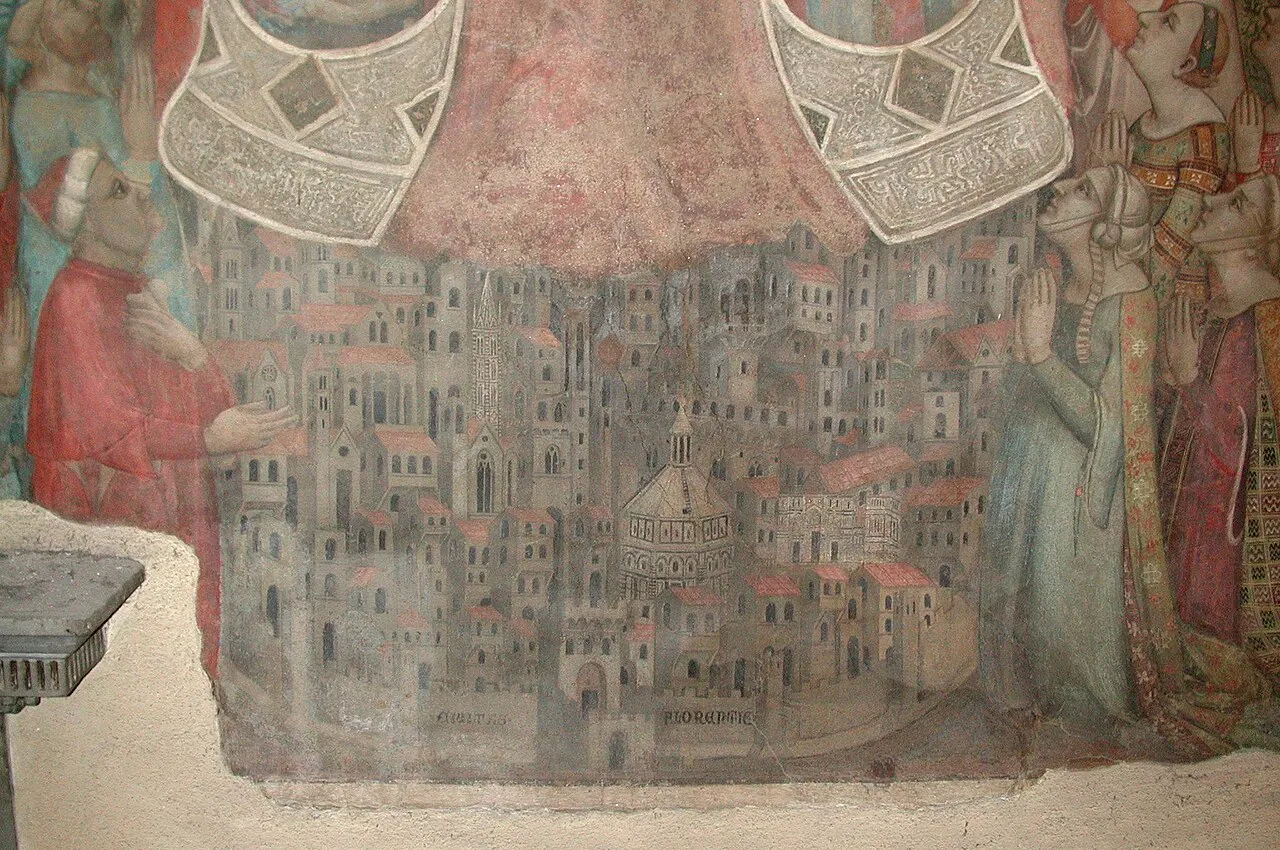 Florence on a fresco of 1342 in the Loggia del Bigallo, the oldest known view of the cityWikimedia Commons, unknown painter, Public domain (Madonna bigallo, firenze view.jpg)
Giovanni Boccaccio lives through the plague in Florence and describes it at the opening of the Decameron, which he writes in the years after. The sick break out in swellings in the groin or the armpit, some as large as an apple, then in black or purple spots, and most of them die within three days. Fear breaks the bonds of families, he writes, so that “fathers and mothers were found to abandon their own children, untended, unvisited, to their fate, as if they had been strangers.” He puts the dead at more than 100,000 between March and July, more than the city holds.
The chronicler Marchionne di Coppo Stefani tells how every church digs deep trenches for the dead. Each night the bodies of the day are laid in and covered with a little earth, and the next bodies are laid on top of them, layer upon layer, in the way that cheese is layered in lasagne.
Villani keeps his chronicle of the city to the end. His last chapter tells of the plague and breaks off in the middle of a sentence: “And this plague lasted until …” He dies of it in 1348 with the date unwritten, and his brother Matteo carries the chronicle on.
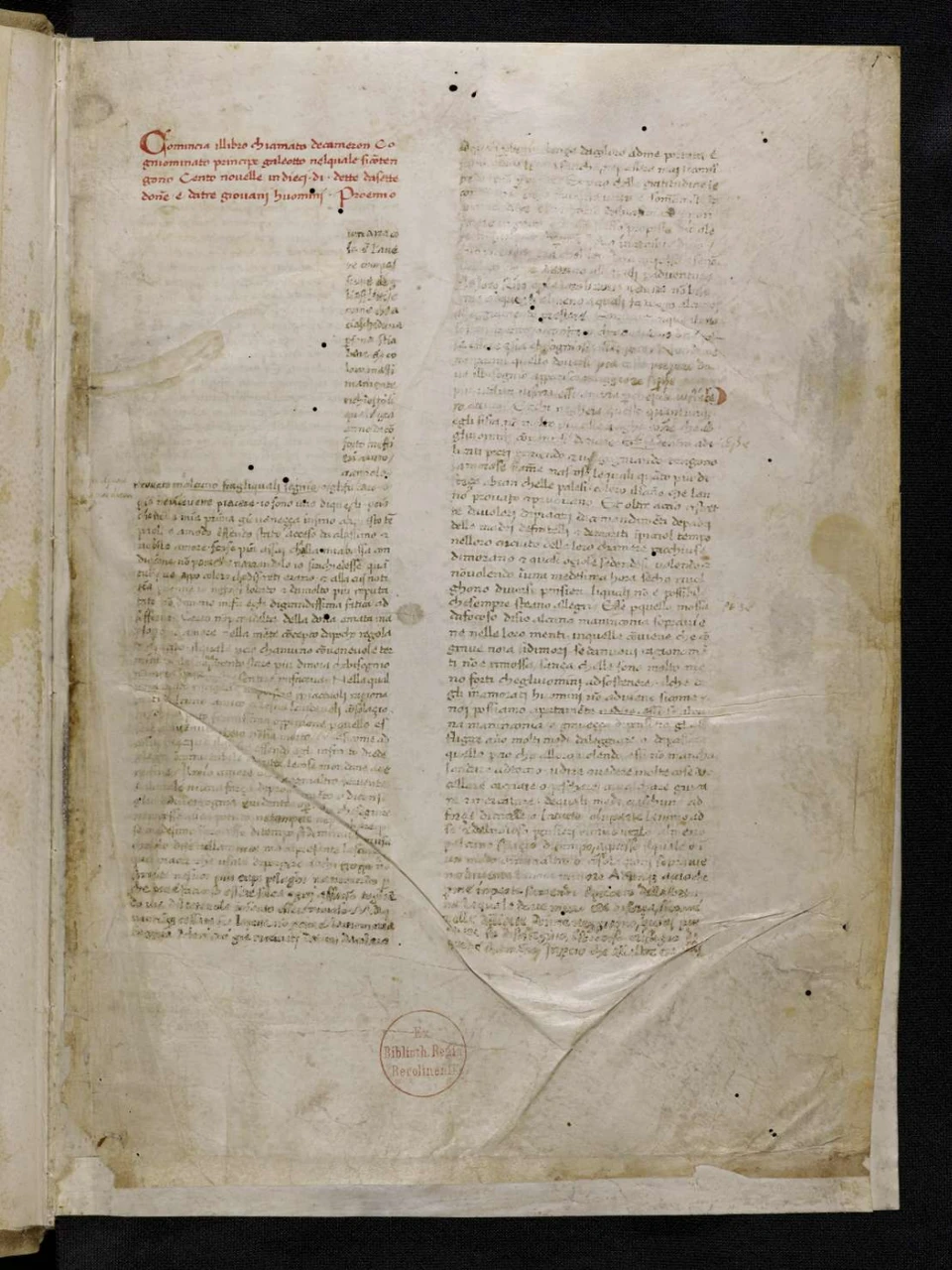 The first page of the Decameron in Boccaccio’s own hand, about 1370Wikimedia Commons, Giovanni Boccaccio, Public domain (Boccaccio, Giovanni Decameron Ms. Ham. 90 1370 1 r.png)
Sources
- Giovanni Boccaccio, Decameron (about 1349–1353), introduction to the first day, translated by J. M. Rigg (1903).
- Marchionne di Coppo Stefani, Cronaca fiorentina (about 1380), rubric 643.
- Giovanni Villani, Nuova Cronica (to 1348), and Matteo Villani, Cronica (from 1348).
- Ole J. Benedictow, The Complete History of the Black Death (2021).
Prev: Languedoc, February – March 1348Next: Tunis and the Maghreb, April 1348