August – December 1349
Tournai, Flanders and northern France, 1349
Gilles Li Muisis, abbot of St Martin’s at Tournai, is about 77 when the plague reaches his town. His chronicle runs to 1349. By his account the plague comes to Tournai in August 1349, in the weeks when the flagellants arrive, and lasts until November. The miniatures that Pierart dou Tielt paints for his chronicle show the townspeople carrying coffins to new graves.
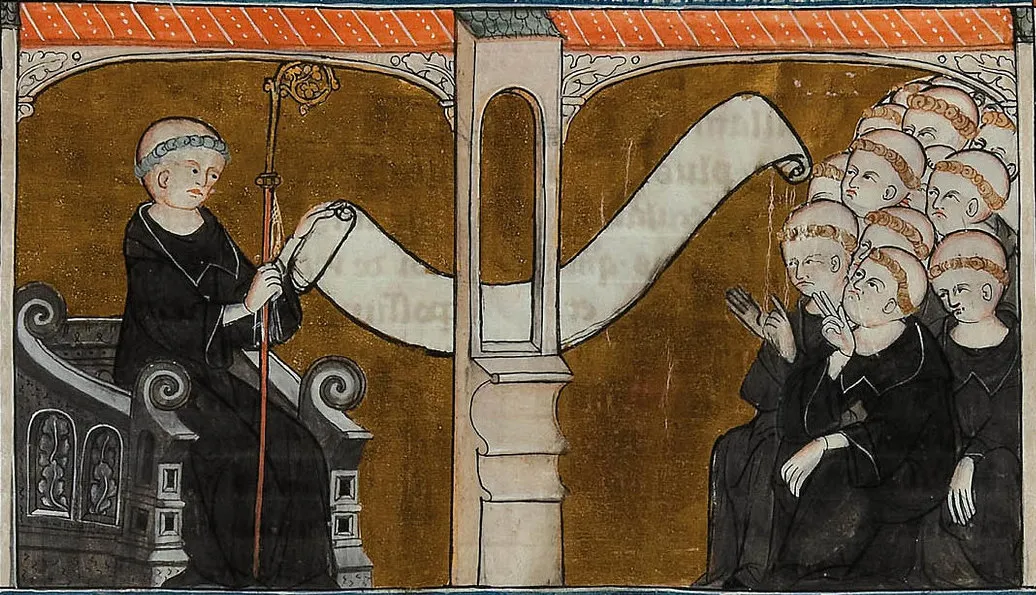 Gilles Li Muisis, abbot of St Martin’s at Tournai, speaks to his monks, in a manuscript of his writings of the 14th centuryPublic Library of Kortrijk, Fonds Goethals-Vercruysse, cod. 135, Wikimedia Commons, public domain
The magistrates of Tournai see the plague as God’s punishment for sin. They ban gambling and order couples who live together unmarried to marry or to part. Their register of bans burned in the bombardment of the city in May 1940, and it is known from transcriptions made in the 19th century by the archivist Frédéric Hennebert. The historians Claire Billen and Marc Boone note that the town’s leaders stay in the city through the epidemic.
The plague reaches Hainaut and Flanders in the summer of 1349. Further north, in Brabant and Holland, its progress cannot be traced. Historians long held that the Low Countries escaped lightly. Joris Roosen and Daniel Curtis, using the death duties of the county of Hainaut, find that the Black Death killed many there, women more than men. In Holland the draining of the wetlands stops at this time, perhaps because fewer people now need new land.
In the autumn the plague reaches the French court. Bonne of Luxembourg, the wife of John, Duke of Normandy and heir to the throne, dies at Maubuisson near Pontoise on 11 September 1349, aged 34. Queen Joan of Burgundy, the wife of Philip VI, dies in Paris on 12 December 1349.
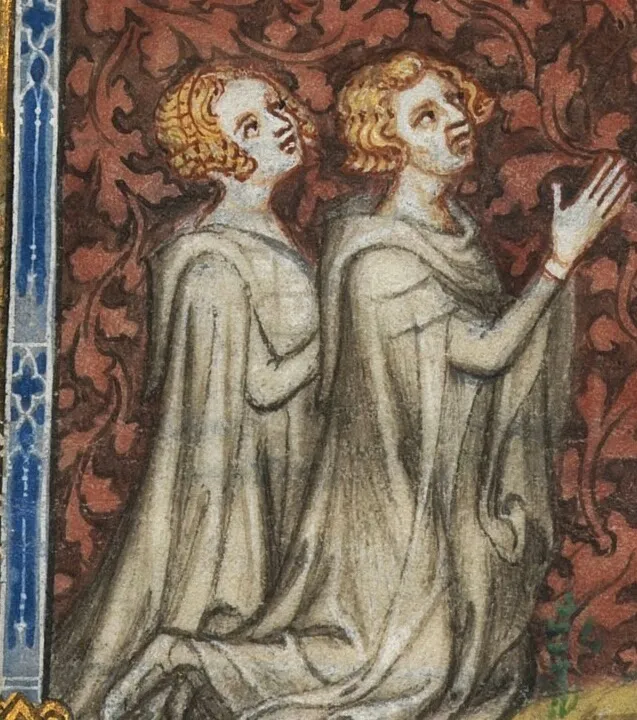 Bonne of Luxembourg and her husband John, Duke of Normandy, in the psalter made for her shortly before her death in 1349Metropolitan Museum of Art, The Cloisters, Wikimedia Commons, public domain
Sources
- Gilles Li Muisis, Chronicle (about 1350), trans. in Rosemary Horrox (ed.), The Black Death (1994).
- Bans et édits pour la ville de Tournai en temps de peste (1349–1351): les transcriptions de Frédéric Hennebert (2021).
- Claire Billen and Marc Boone, Gouverner Tournai en temps de peste (lecture, Fondation universitaire, 2021).
- Joris Roosen and Daniel R. Curtis, “The ‘light touch’ of the Black Death in the Southern Netherlands: an urban trick?”, Economic History Review 72 (2019), 32–56.
- Daniel R. Curtis, “Plague and epidemic disease in the northern parts of the Low Countries, 1349–1450”, TSEG.
Prev: Ibn Battuta goes home, 1348–1349Next: Scotland, 1349–1350