June – December 1349
The flagellants, summer – autumn 1349
In 1349 bands of penitents come out of Austria and Hungary and move west into the Empire. They walk from town to town behind crosses and banners. Twice a day they strip to the waist in a square or a churchyard and beat themselves with whips tipped with iron. A man who joins swears to obey the master of his band for 33 and a half days, one day for each year of Christ’s life. From Vienna their processions spread through Bavaria and Franconia to the Rhine. Fritsche Closener describes their rites at Strasbourg that summer. In August they reach Flanders, and Gilles Li Muisis, abbot of St Martin’s at Tournai, writes that on the feast of the Assumption, 15 August, “there came from the town of Bruges about 200 men.”
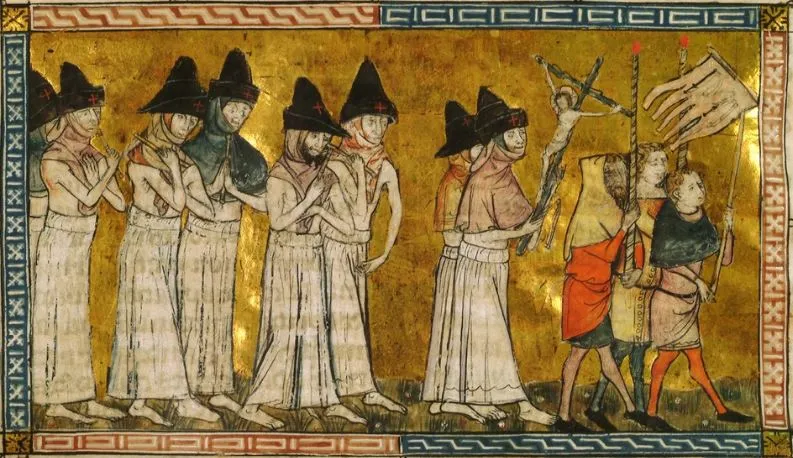 Flagellants at Tournai in 1349, in the chronicle of Gilles Li Muisis, painted by Pierart dou Tielt about 1353Royal Library of Belgium, MS 13076-77, Wikimedia Commons, public domain
The killings of Jews go on through the year. In late June 1349 Charles IV, king of the Romans, pledges the Jews of Frankfurt to the town and promises that it will go unpunished if the Jews there are killed. In July the Jews are killed and their houses burned. At Mainz, on 24 August, the Jews hold off their attackers at first, but the townsmen overwhelm the Jewish quarter and kill them. At Cologne the Jews burn themselves in their houses in the night of 23 to 24 August. Charles IV allows Nuremberg to build its new market square on the site of the Jewish quarter. On 5 December at least 562 Jews of Nuremberg are killed, and the Frauenkirche that Charles founds rises over the ruins of their synagogue.
Historians long blamed the flagellants for these killings. Recent research, as the Jewish Museum Frankfurt sums it up, finds that in most towns the bands came after the killings, which the councils had planned.
On 20 October 1349 Clement VI condemns the flagellants in a bull and orders the bishops to suppress them, and the movement fades within months. By 1351 most Jewish communities of the Empire have been destroyed, and many of the survivors move east to Poland, where Casimir III gives them refuge.
Sources
- Fritsche Closener, Strassburgische Chronik (1362).
- Gilles Li Muisis, Chronicle (about 1350), Royal Library of Belgium, MS 13076-77.
- Clement VI, Inter sollicitudines (20 October 1349).
- Germania Judaica, vol. 2, ed. Zvi Avneri (1968).
- František Graus, Pest – Geissler – Judenmorde: Das 14. Jahrhundert als Krisenzeit (1987).
- Anna Foa, The Jews of Europe after the Black Death (2000).
- Jewish Museum Frankfurt, “The pogrom of 1349”, metahubfrankfurt.de.
Prev: Ireland, 1348–1349Next: Bergen and Norway, autumn 1349