April – September 1349
England, 1349
By March 1349 the plague has spread across the south of England. Through the spring it moves north into East Anglia, where it reaches Norwich, and west from Bristol into Wales. A second front opens when it arrives by ship in the Humber, and in May it reaches York. In June, July and August it ravages the north, and by the end of the summer it has covered the whole kingdom. In December 1349 it dies down.
The registers of the bishops show how many priests die. A bishop records each new priest he places in a parish, so a run of new appointments marks the deaths of the old ones. From these registers the historian Josiah Russell puts the deaths among the clergy at 30 to 40 per cent, and in parts of the diocese of York the rate may reach 48 per cent. In January 1349 Ralph of Shrewsbury, bishop of Bath and Wells, writes to his clergy that a dying man who can find no priest may confess to a layman, or even to a woman.
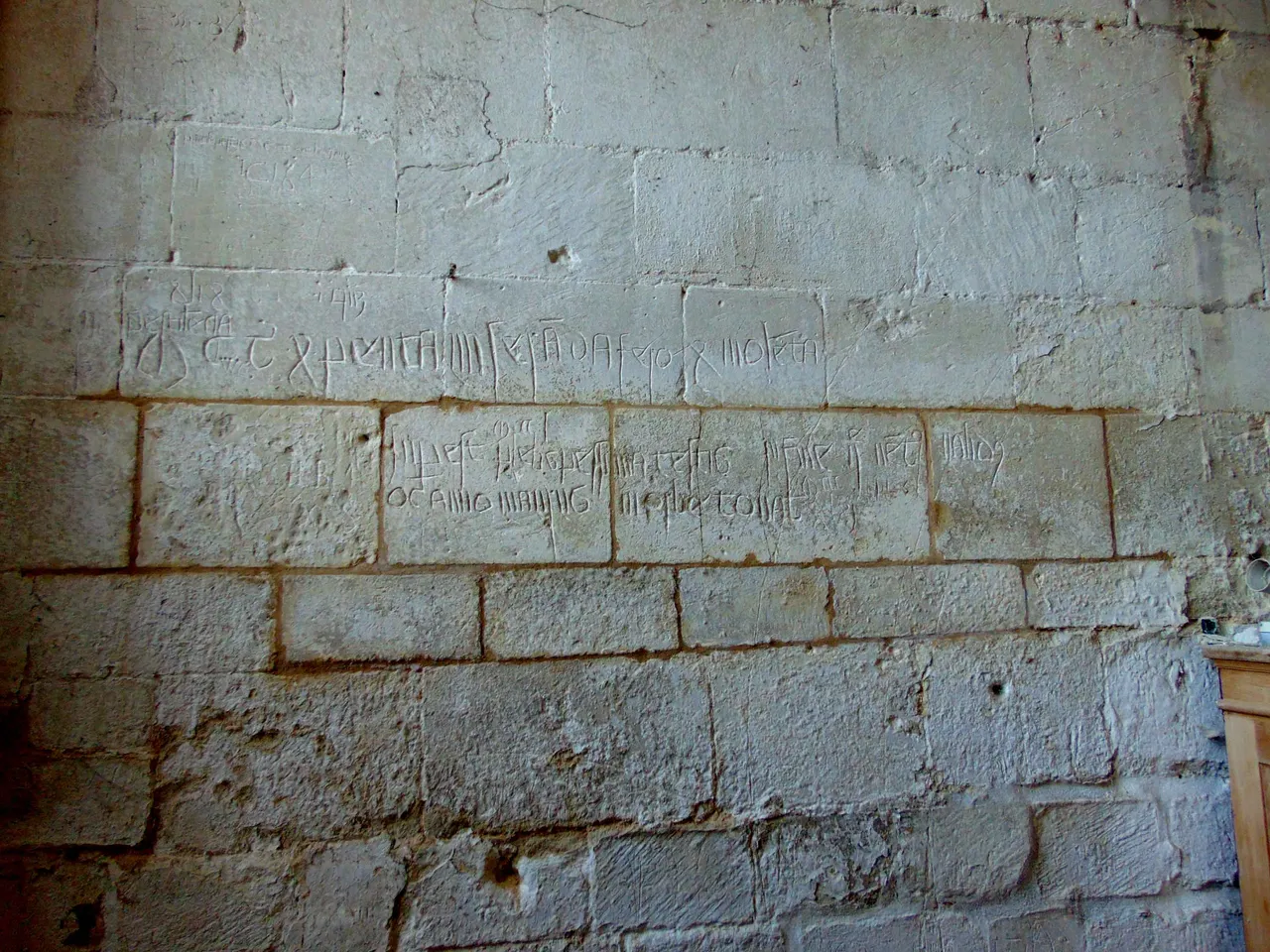 Words cut into the tower wall of St Mary’s church at Ashwell in Hertfordshire. They begin with the year 1350 and call it wretched, wild and violent, with the dregs of the people left to witness it.Medievalg, Wikimedia Commons, CC BY-SA 3.0
The plague kills two archbishops of Canterbury within fourteen weeks. John de Ufford, whom the pope appointed in 1348, is old and infirm, and he dies on 20 May 1349 before he can be consecrated. Thomas Bradwardine, an Oxford theologian and Edward III’s confessor, is consecrated on 19 July and dies on 26 August 1349.
At Thornton Abbey in Lincolnshire, archaeologists find in 2013 a mass grave in the cemetery of the abbey’s hospital. It holds at least 48 people, 27 of them children. Hugh Willmott and his colleagues found Yersinia pestis DNA in their teeth and dated the burial to the middle of 1349. It is the first mass grave of the Black Death found in the English countryside.
Sources
- Rosemary Horrox (ed.), The Black Death (1994).
- Philip Ziegler, The Black Death (1969).
- John Hatcher, Plague, Population and the English Economy, 1348–1530 (1977).
- Hugh Willmott and others, “A Black Death mass grave at Thornton Abbey: the discovery and examination of a fourteenth-century rural catastrophe”, Antiquity 94 (2020), 179–196.
- Ole J. Benedictow, The Complete History of the Black Death (2021).
Prev: Vienna and the Danube, spring 1349Next: Ireland, 1348–1349