The disease
Bacterium, flea and rat
The Black Death is plague, caused by the bacterium Yersinia pestis. Ancient DNA taken from the teeth of its dead, in London and many other places, has proved it. The bacterium lives among wild burrowing animals, and fleas carry it from one animal to the next. Such natural homes of plague still exist in the Tian Shan, where marmots carry it, in the deserts around Lake Balkhash and the Kyzylkum, where great gerbils carry it, and in the steppes north of the Caspian Sea.
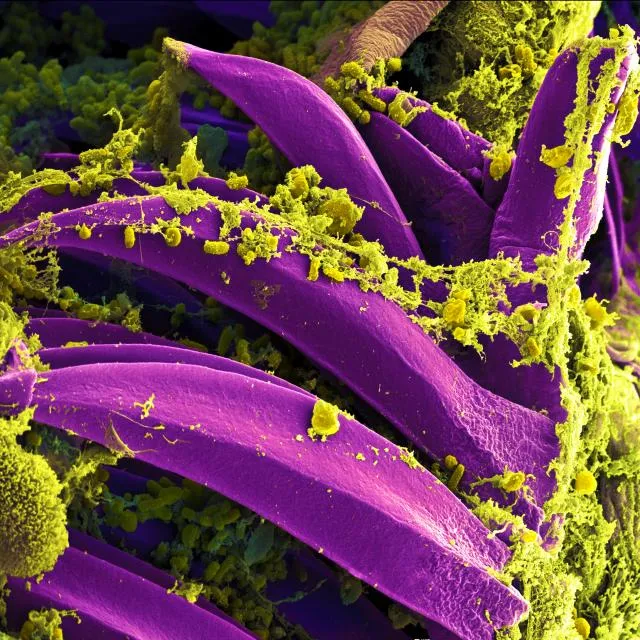 Yersinia pestis, the plague bacterium, on the spines in the gut of a rat flea, under a scanning electron microscopeWikimedia Commons, NIAID, public domain
When many of the animals die, their fleas look for new hosts. Black rats live in houses, barns and ships, close to people, and their fleas bite people too. The historian Ole Benedictow holds that rats and their fleas carried the Black Death. A study by Katharine Dean and others in 2018 argues that human fleas and lice passed it from person to person.
The disease takes three forms. In the bubonic form the bacteria travel from a flea bite to the nearest lymph nodes, which swell into painful lumps, the buboes, in the groin, the armpit or the neck. Without treatment 30 to 60 in every 100 of the sick die, by the figures of the World Health Organization. In the septicaemic form the bacteria fill the blood, and in the pneumonic form the lungs. A pneumonic patient coughs the bacteria into the air and infects people nearby. Both forms kill nearly everyone who goes untreated, often within a few days. Today antibiotics cure plague when they are given early.
The plague travels with people, their grain and their baggage. Over land it moves a few kilometres a day. A ship carries infected rats, fleas and sick sailors from one port to the next in days, so that the plague reaches distant coasts long before the lands between them.
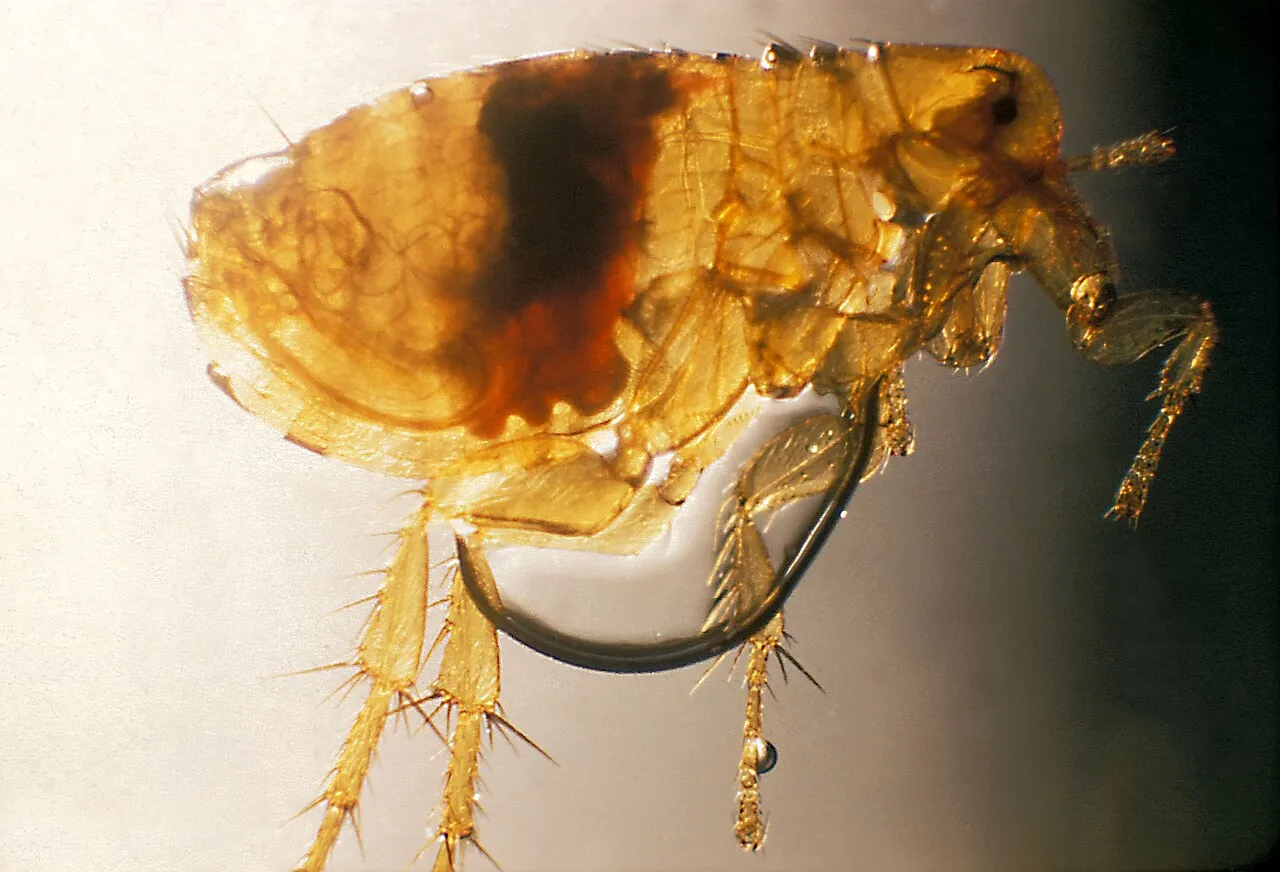 A rat flea, Xenopsylla cheopis, 28 days after it fed on an infected mouse. The dark mass is the plague bacteria that block its gut, so that it bites again and again.Wikimedia Commons, CDC, Dr. Pratt, 1948, public domain
Sources
- World Health Organization, “Plague”, fact sheet (2022).
- Ole J. Benedictow, The Complete History of the Black Death (2021).
- Maria A. Spyrou et al., “The source of the Black Death in fourteenth-century central Eurasia”, Nature 606 (2022), 718–724.
- Monica H. Green, “The Four Black Deaths”, American Historical Review 125 (2020), 1601–1631.
Prev: Eurasia in 1340Next: The gravestones of the Chüy valley, 1338–1339