1338 – 1339
The gravestones of the Chüy valley, 1338–1339
The Chüy valley runs along the foot of the Tian Shan, near today’s Bishkek and Tokmok in Kyrgyzstan. In the 13th and 14th centuries a Christian community of the Church of the East lives here, on the caravan road to China. Most of its people bear Turkic names. They bury their dead under river stones carved with a cross and an inscription in Syriac script, dated by the Seleucid era and the Turkic years of the twelve animals.
In 1885 and 1886 Russian settlers and officials find hundreds of these stones in two cemeteries, at Kara-Djigach near Bishkek and at Burana near Tokmok, west of Lake Issyk-Kul. Graves are opened, and stones and skeletons go to St Petersburg. There the orientalist Daniel Chwolson reads the inscriptions, and he publishes them from 1886 to 1897.
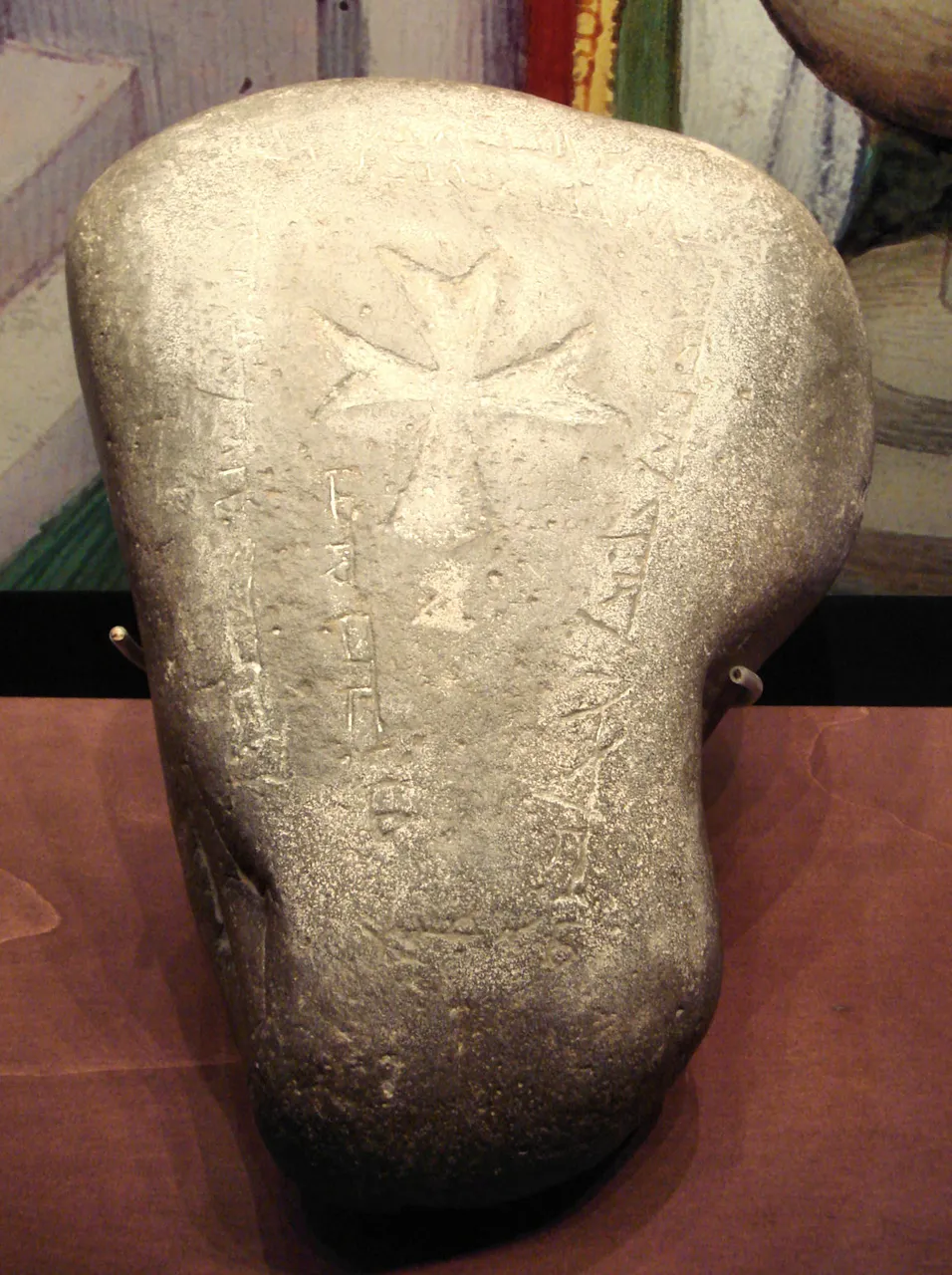 A gravestone of the Church of the East from the Issyk-Kul region, dated 1312. It is a river stone carved with a cross and an inscription in Syriac script.Wikimedia Commons, PHGCOM, CC BY-SA 3.0
Of the 467 stones that carry a precise date, 118 belong to the years 1338 and 1339. Ten of them give the cause of death as mawtānā, Syriac for pestilence. In 2019 the historian Philip Slavin argued that this sudden rise in deaths may have been the plague.
In 2022 a team led by Maria Spyrou, Philip Slavin and Johannes Krause published DNA from the teeth of seven people buried in the two cemeteries. Three of them, all buried at Kara-Djigach in 1338, carried Yersinia pestis. Their strain sits at the root of the family tree of the strains that spread in the Black Death, as the common ancestor of them all. Its closest living relatives are found in marmots of the Tian Shan. The authors conclude that the plague of the Black Death arose in this region shortly before 1338. Before the DNA was found, the historian John Norris read the stones as a small outbreak caught from rodents, with no wider effect.
The stones do not show how the plague left the valley. Eight years pass before the sources find it again, on the Volga.
Sources
- Daniel Chwolson, Syrisch-nestorianische Grabinschriften aus Semirjetschie (1890, with supplements of 1886 and 1897).
- Maria A. Spyrou, Lyazzat Musralina, Guido A. Gnecchi Ruscone, Philip Slavin, Johannes Krause et al., “The source of the Black Death in fourteenth-century central Eurasia”, Nature 606 (2022), 718–724.
- Philip Slavin, “Death by the Lake: Mortality Crisis in Early Fourteenth-Century Central Asia”, Journal of Interdisciplinary History 50 (2019), 59–90.
Prev: Bacterium, flea and ratNext: Across the Golden Horde, 1339–1346