January – March 1349
The burnings, January – March 1349
In the winter of 1348–1349 the confessions taken at Chillon reach the towns of the Upper Rhine, and one town after another turns on its Jews before the plague arrives. At Basel the guildsmen force their way into the town hall, and the council gives way to them. On 16 January 1349 the Jews are shut into a wooden house on an island in the Rhine and burned. At Speyer the Jews are killed on 22 January, and their bodies are put into wine casks and thrown into the Rhine. At Freiburg the Jews are burned on 30 January.
At Strasbourg the council and its head, the Ammeister Peter Schwarber, protect the Jews. On Monday 9 February the craftsmen gather before the cathedral and force the masters out of office. Schwarber is banished, and a new council is formed. On 14 February the Jews are led to their cemetery and burned in a wooden house built there. Jacob Twinger von Königshofen, who draws on the account of the Strasbourg priest Fritsche Closener, counts about 2,000 dead. Those who accept baptism are spared, and so are the children. The debts owed to the Jews are cancelled, and the council divides their money among the craftsmen. Königshofen writes: “The money was indeed the thing that killed the Jews.” The plague reaches Strasbourg on 8 July.
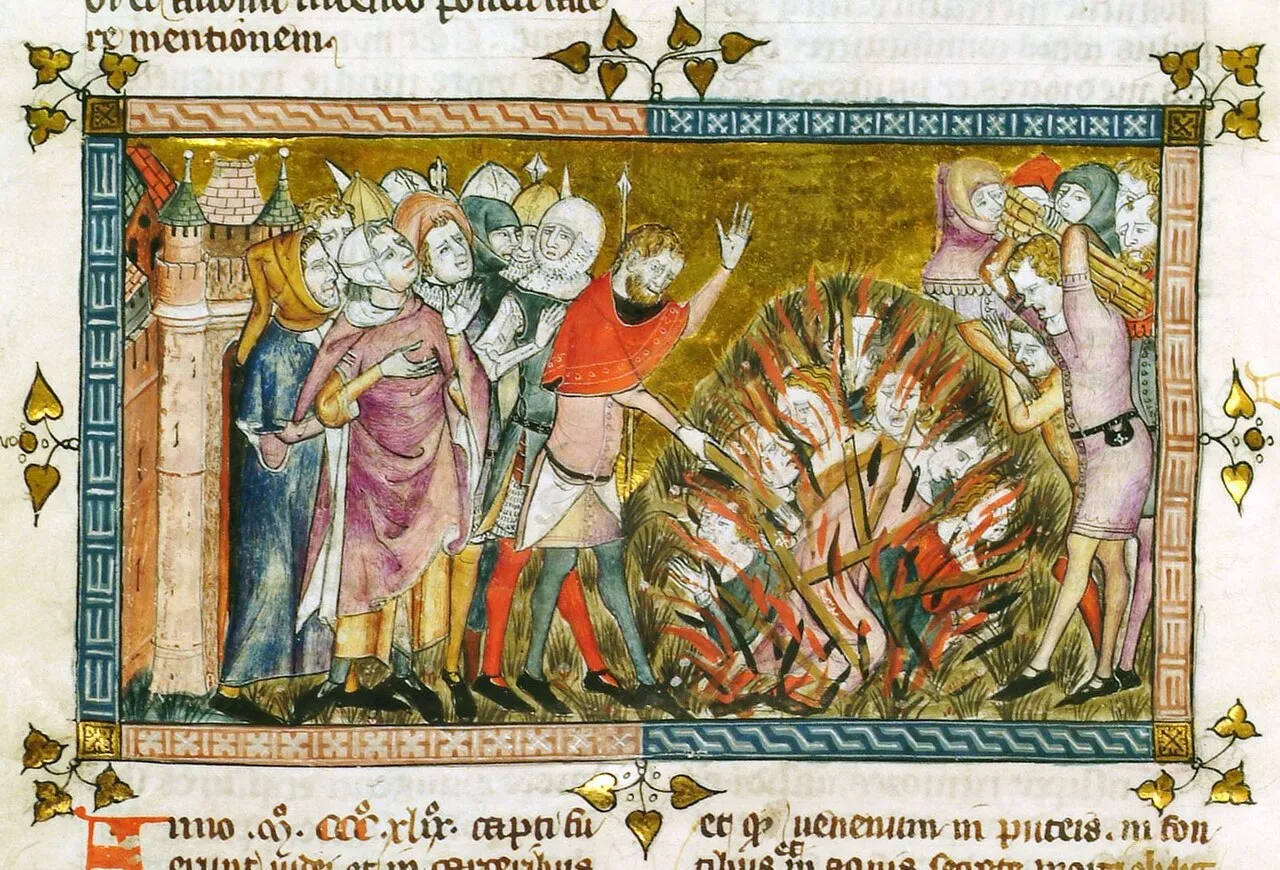 Jews burned in 1349, in the chronicle of Gilles Li Muisis, abbot of St Martin at Tournai, painted by Pierart dou Tielt about 1353Royal Library of Belgium, MS 13076-77, Wikimedia Commons, public domain
At Worms on 1 March more than 400 Jews die, many of them in their own houses, which they set on fire rather than accept baptism. At Erfurt the community is destroyed on 21 and 22 March. The accounts give from 100 to 3,000 dead, and the plague comes to Erfurt only in 1350. Before the killings a Jewish family hides its silver and gold under the wall of a cellar entrance. Archaeologists find it in 1998: 3,141 silver coins and 14 silver ingots, about 24 kg in all, and more than 700 pieces of goldsmiths’ work. Among them is a gold wedding ring engraved with the Hebrew words mazal tov, “good luck”. Its owner was probably Kalman of Wiehe, a Jewish moneychanger of the town.
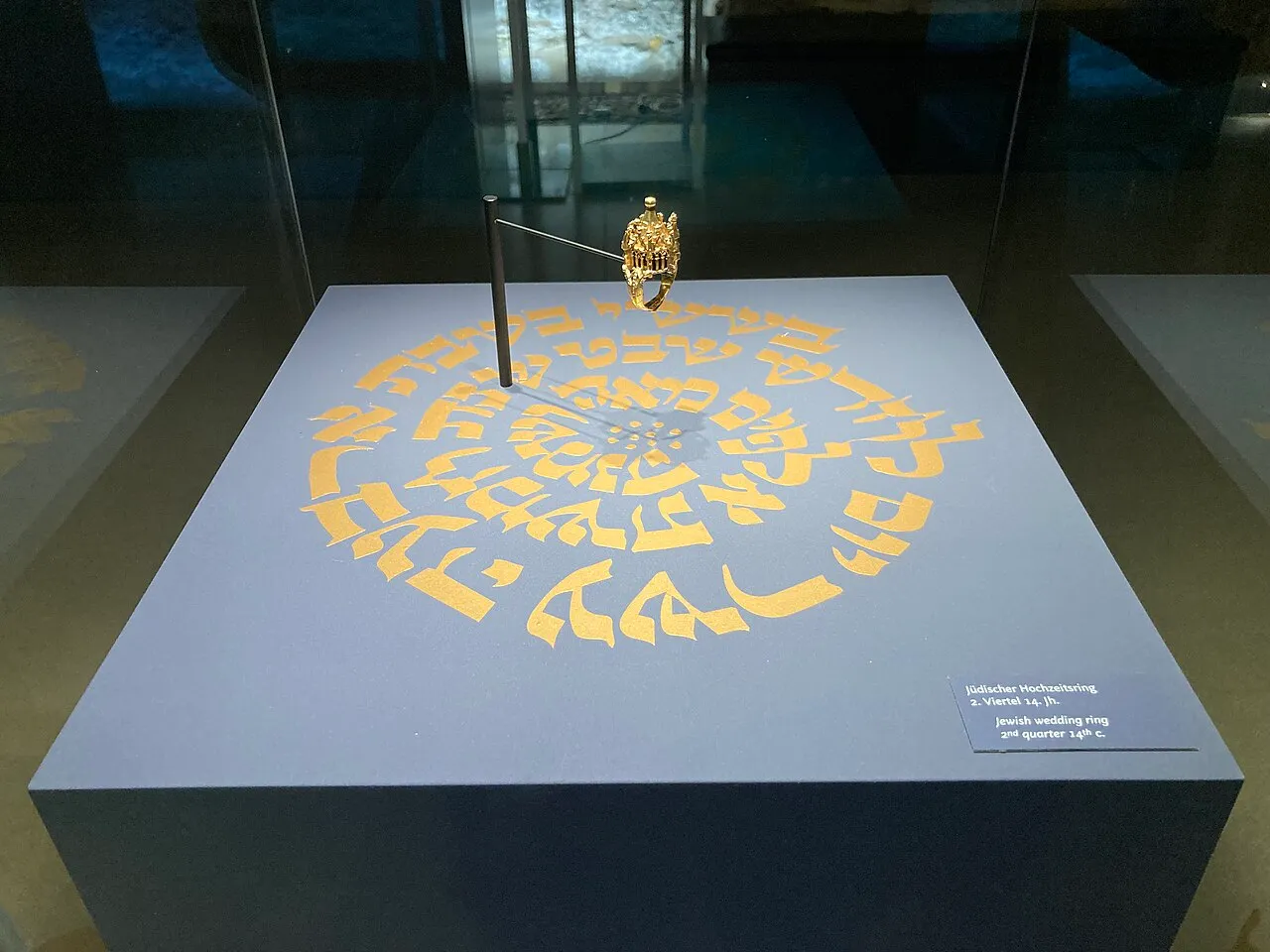 A Jewish wedding ring of the second quarter of the 14th century from the Erfurt treasure, in the Old Synagogue at ErfurtMarkus Köllner, Wikimedia Commons, CC BY-SA 4.0
Sources
- Fritsche Closener, Strassburgische Chronik (1362).
- Jacob Twinger von Königshofen, Chronicle of Strasbourg (about 1400), trans. in Jacob R. Marcus, The Jew in the Medieval World (1938).
- Germania Judaica, vol. 2, ed. Zvi Avneri (1968).
- Anna Foa, The Jews of Europe after the Black Death (2000).
- František Graus, Pest – Geissler – Judenmorde: Das 14. Jahrhundert als Krisenzeit (1987).
- City of Erfurt, “The Erfurt Treasure”, juedisches-leben.erfurt.de.
Prev: Milan and the places sparedNext: Vienna and the Danube, spring 1349