Autumn 1348 – December 1349
Bergen and Norway, autumn 1349
The Icelandic annals tell how the plague comes to Norway. Two Icelandic bishops, Orm of Hólar and Gyrd Ivarsson of Skálholt, are in Norway when it arrives, and the annals draw on what they saw. In the late summer of 1349, probably in August, a ship from England reaches Bergen. When its cargo is unloaded, the crew begin to die, then the people of the town, and from Bergen the plague spreads along the coast and up the valleys.
Oslo is struck before Bergen. The dates of the deaths there show the plague in the town by May or June 1349, although no witness describes it. Ole Jørgen Benedictow argues that it came to Oslo from England as early as the autumn of 1348 and lay quiet through the winter. In February 1349 an altar to St Sebastian, the protector against plague, is founded in Oslo cathedral.
In the autumn the plague reaches Trondheim, the seat of the archbishop of Nidaros. Archbishop Arne Einarsson dies with all but one of the canons of his cathedral. Every bishop of Norway except the bishop of Oslo dies, and in 1371 the archdiocese of Nidaros has 40 priests, against 300 before the plague. The last known victim, Bishop Guttorm Pålsson of Stavanger, dies on 7 January 1350.
The annals say that a third of the people died. Modern estimates run to 60 or 65 per cent. Of about 36,500 farms in Norway around 1300, about 16,000 are still worked in 1520, and the population does not return to its level of 1300 until the 17th century. In the folk tales the plague lives on as an old woman, Pesta, who goes from farm to farm with a rake and a broom. Where she rakes, some live. Where she sweeps, no one does.
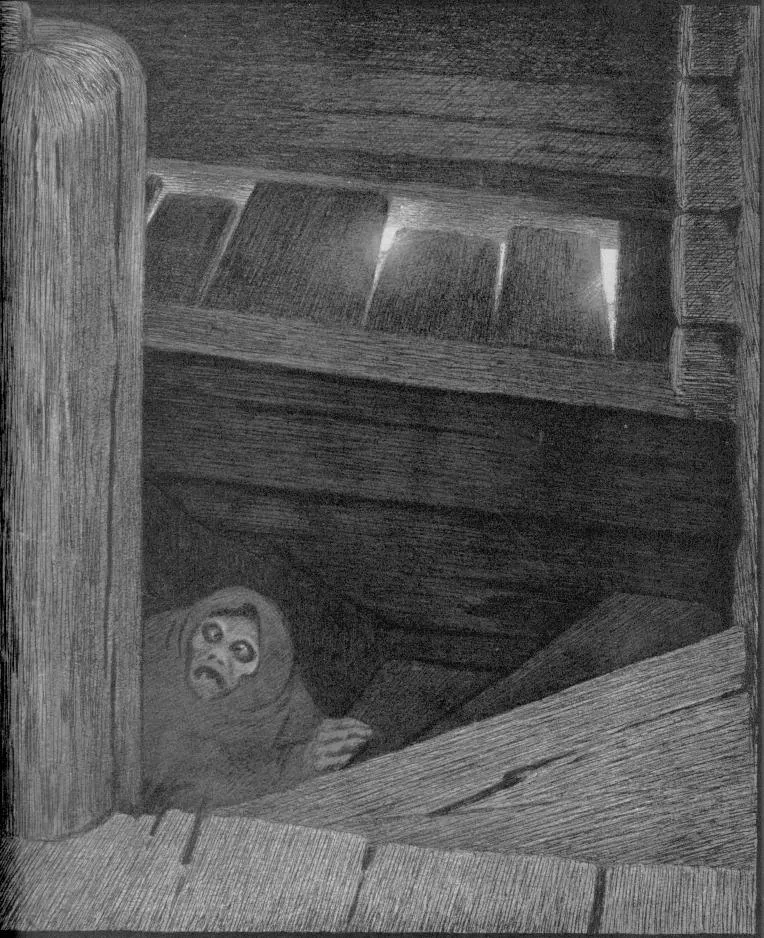 Pesta on the stairs, Theodor Kittelsen's drawing of 1896 of the plague as an old woman, from his book SvartedauenTheodor Kittelsen, National Museum of Norway, Wikimedia Commons, public domain
Sources
- Lögmannsannáll (Icelandic annals, 14th century), in Gustav Storm (ed.), Islandske Annaler indtil 1578 (1888).
- Ole J. Benedictow, Plague in the Late Medieval Nordic Countries (1992).
- Ole J. Benedictow, The Complete History of the Black Death (2021).
- “Arne Einarsson Vade”, Store norske leksikon.
Prev: The flagellants, summer – autumn 1349Next: Ibn Battuta goes home, 1348–1349