April – December 1350
Lübeck, Denmark and Sweden, 1350
In early summer 1350 the plague reaches the Baltic coast of Germany. Lübeck, the leading town of the Hanseatic merchants, and Hamburg have it by then, and Bremen later in the year. Bremen’s oldest book of citizens records 6,966 dead in the town’s four parishes. Ole Benedictow calls it the nearest thing to a count of the dead that any German town kept, although the list behind the total is lost.
Denmark has no eyewitness account of the plague. Historians trace it through wills and gifts for masses for the dead, which rise sharply in 1350. By that reckoning it is at Ribe from July to October 1350, at Copenhagen in August and September, and at Roskilde in September and October.
Sweden and Norway share a king, Magnus Eriksson. While the plague is killing his Norwegian subjects, probably in September 1349, he writes from Lödöse that “most of the people who lived in the lands West of our land are now dead”. He orders every Swede to go to mass, give alms, confess and fast on bread and water every Friday. The plague reaches Visby on Gotland by ship by July 1350 at the latest, and in July nine people are burned there after confessing under torture to spreading it with poison. From Gotland it crosses to central Sweden and reaches Stockholm in August. In the autumn it comes overland from Norway into the west of the kingdom.
Further east lies Prussia, the state of the Teutonic Order. The chronicle of the abbey of Oliwa near Gdańsk records the dying there, first at Elbląg (then Elbing) and then at Kaliningrad (then Königsberg) and Malbork (then Marienburg). Benedictow dates its arrival at Elbląg to July 1349, a year before Lübeck.
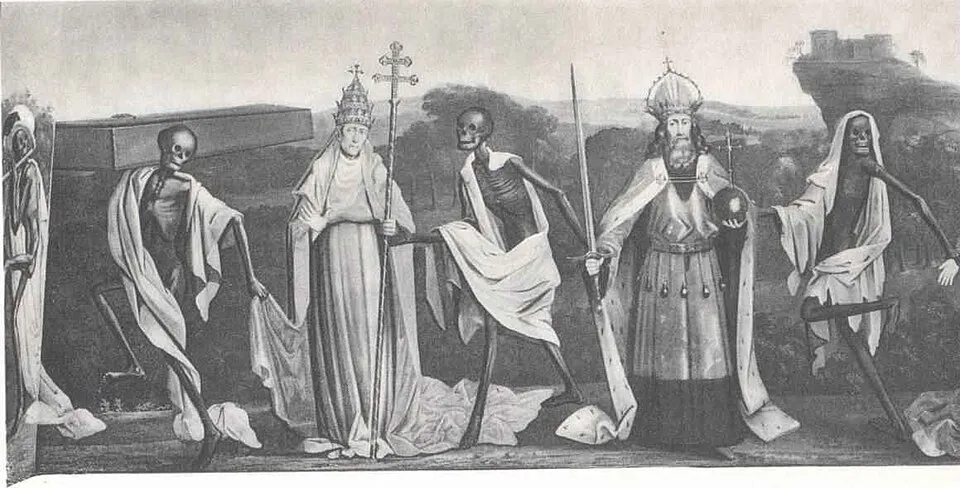 Death leads the pope and the emperor in the Dance of Death painted for St Mary’s Church in Lübeck in 1463, in the copy of 1701 that burned in 1942Wikimedia Commons, after Bernt Notke, Public domain (Totentanz Lübeck 1.jpg)
Sources
- Ole J. Benedictow, The Complete History of the Black Death (2021).
Prev: Alfonso XI at Gibraltar, March 1350Next: Pskov, Novgorod and Moscow, 1352–1353