Autumn 1347
Alexandria, autumn 1347
In the autumn of 1347 a ship sails into the harbour of Alexandria, the main port of the Mamluk sultanate of Egypt and Syria. The Cairo historian al-Maqrizi, writing in the 15th century, records that it carried 32 merchants and about 300 people in all, traders and slaves among them. Most of them died at sea. Four merchants, one slave and about 40 sailors reached the port alive, and they died in the city soon after.
The ship came from the north, from the Black Sea or Constantinople, on the sea lanes that bring the sultans their slaves. Every year Genoese and other ships carry boys bought on the steppe of the Golden Horde to Egypt, where they are trained as soldiers. The emirs who govern Egypt began their lives as such slaves.
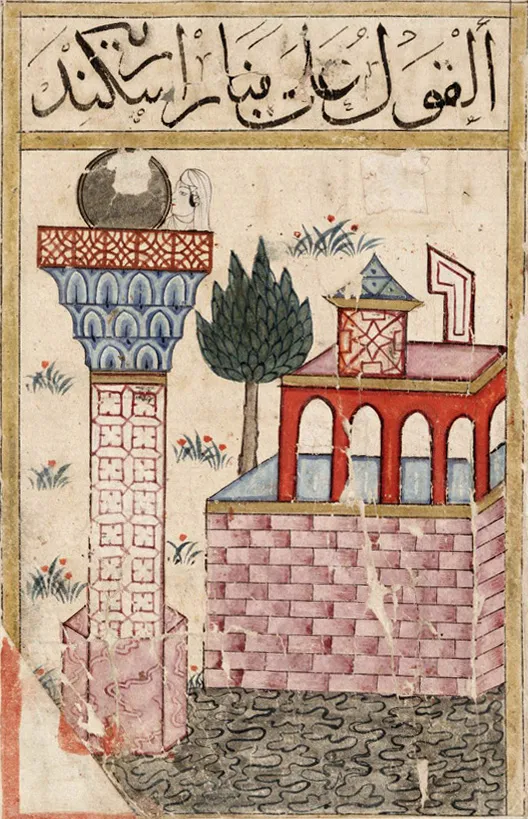 The lighthouse of Alexandria in the Book of Wonders, an Arabic manuscript of about 1400. Earthquakes had ruined the real lighthouse by the 1340s.Wikimedia Commons, Bodleian Library, MS. Bodl. Or. 133, public domain
From Alexandria the plague spreads into the Nile delta, along its canals and the two branches of the river, and up the Nile towards Cairo. By the spring of 1348 it has spread over northern Egypt. Ships on the same sea lanes probably carry it to Cyprus.
The plague comes to a Mamluk state that has just lost its strongest ruler. Al-Nasir Muhammad died in 1341, and in the six years since then six of his sons have sat on the throne, most of them puppets of the emirs. In December 1347 the emirs make his son Hasan sultan, a boy of about 12.
Sources
- Ahmad ibn Ali al-Maqrizi, Kitab al-suluk li-ma‘rifat duwal al-muluk (15th century), vol. 2, 772–773.
- Michael W. Dols, The Black Death in the Middle East (1977).
- Stuart J. Borsch, The Black Death in Egypt and England: A Comparative Study (2005).
- Ole J. Benedictow, The Complete History of the Black Death (2021).
Prev: Orhan’s lands, 1347Next: Messina, October 1347