15 to 19 October 1781
Yorktown: the surrender
On the night of 15 to 16 October 350 British troops under Robert Abercromby break into the allied lines and spike six guns before French troops drive them back. The guns are working again by morning. On the night of 16 October Cornwallis tries to ferry his army across the river to Gloucester Point, hoping to break out towards New York. One wave of boats crosses, and a squall stops the rest.
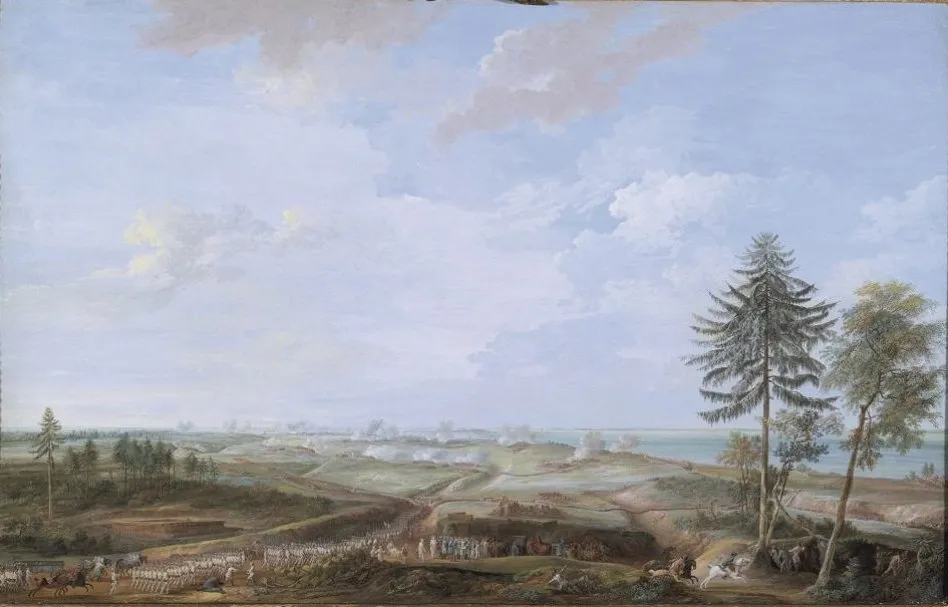 The siege of Yorktown, with the British army marching out between the French and American lines, painting by Louis Nicolas van BlarenbergheWikimedia Commons, Louis Nicolas van Blarenberghe, Public domain (Louis Nicolas van Blarenberghe - The siege of Yorktown (1781).jpg)
On the morning of 17 October a British drummer beats a parley and an officer comes out waving a white handkerchief. The terms are settled at the Moore House on 18 October. On 19 October the British march out between the French and American lines and lay down their arms, and the post at Gloucester surrenders too.
Cornwallis stays away, saying he is ill. His deputy Charles O’Hara offers his sword to Rochambeau, who points to Washington, and Washington directs him to Benjamin Lincoln. Between 7,400 and 7,700 soldiers are taken, with 214 guns and 24 transports.
Sources
- Jerome A. Greene, The Guns of Independence (2005).
- Brendan Morrissey, Yorktown 1781: The World Turned Upside Down (1997).
Prev: Yorktown: Redoubts 9 and 10Next: The Treaty of Paris