16 September to 8 October 1779
Savannah: the siege
D’Estaing begins landing troops below Savannah on 12 September and closes in by 16 September. He offers Augustine Prevost the chance to surrender, and Prevost asks for 24 hours. Through a misunderstanding over who was to stop them, the waterways from South Carolina are left unguarded, and John Maitland brings his men from Beaufort into the town hours before the truce ends. Prevost then refuses, although Benjamin Lincoln’s army has joined the French.
Captain James Moncrief of the Royal Engineers has built an entrenched line with redoubts on the plain outside the town, using 500 to 800 enslaved African Americans. The British scuttle the Rose in a narrow part of the channel, so the French fleet cannot support the attack.
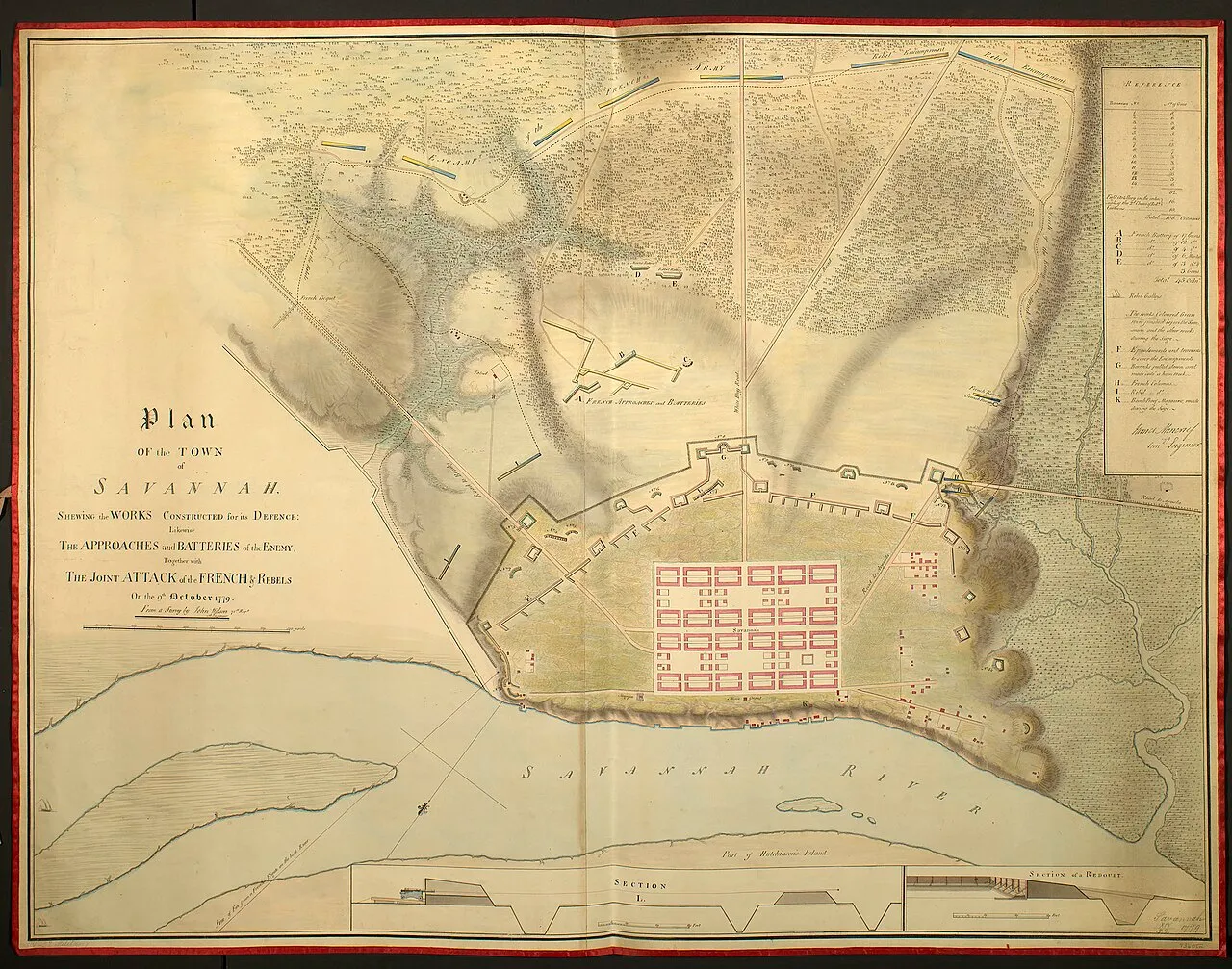 Plan of Savannah with the defence works and the works of the besiegers, 9 October 1779, drawn by James MoncriefWikimedia Commons, James Moncrief and John Wilson, Public domain (Savannah, 1779 RCIN 734052.jpg)
D’Estaing rejects an assault at first and lands guns from his ships. From 3 to 8 October they bombard the town rather than the entrenchments, and many civilians are killed. When the bombardment fails, d’Estaing decides to storm the works.
Sources
- Alexander A. Lawrence, Storm over Savannah (1951).
- Franklin B. Hough, The Siege of Savannah (1866).
Prev: The war moves south, and west to the OhioNext: Savannah: Spring Hill