1784 to 1787
The Confederation years
The Confederation Congress sits in New York from January 1785. It has no power to tax, so it cannot pay the war debt or the interest on it. It cannot regulate trade, so the states levy duties on each other, and Britain shuts its West Indian ports to American ships. Nine states must agree to anything that matters, and the delegates often fail to make a quorum.
Britain keeps its forts on the Great Lakes, and Spain closes the lower Mississippi to American boats. In September 1786 delegates from five states, meeting at Annapolis to discuss trade, call for a convention of all the states at Philadelphia the next May.
In the summer of 1786 farmers in western Massachusetts, pressed for debts and taxes payable in hard money, close the courts. On 25 January 1787 Daniel Shays leads about 1,500 of them against the federal armory at Springfield, where state militia drive them off with cannon fire. On 4 February an army raised with money from merchants scatters the rebels at Petersham. Congress has no money to raise troops of its own.
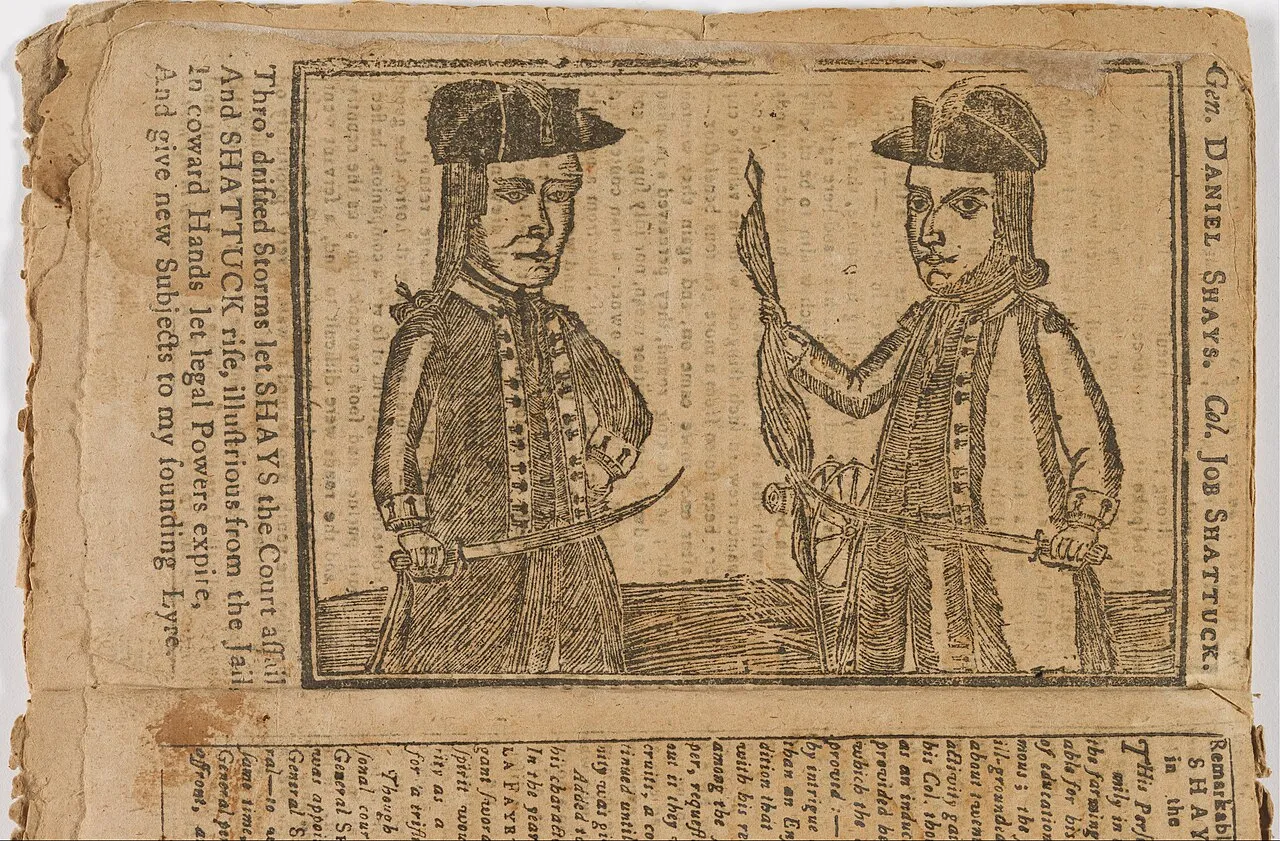 Daniel Shays and Job Shattuck, woodcut on the cover of Bickerstaff's Boston Almanack, 1787Wikimedia Commons, Unknown artist, Public domain (Unidentified Artist - Daniel Shays and Job Shattuck - Google Art Project.jpg)
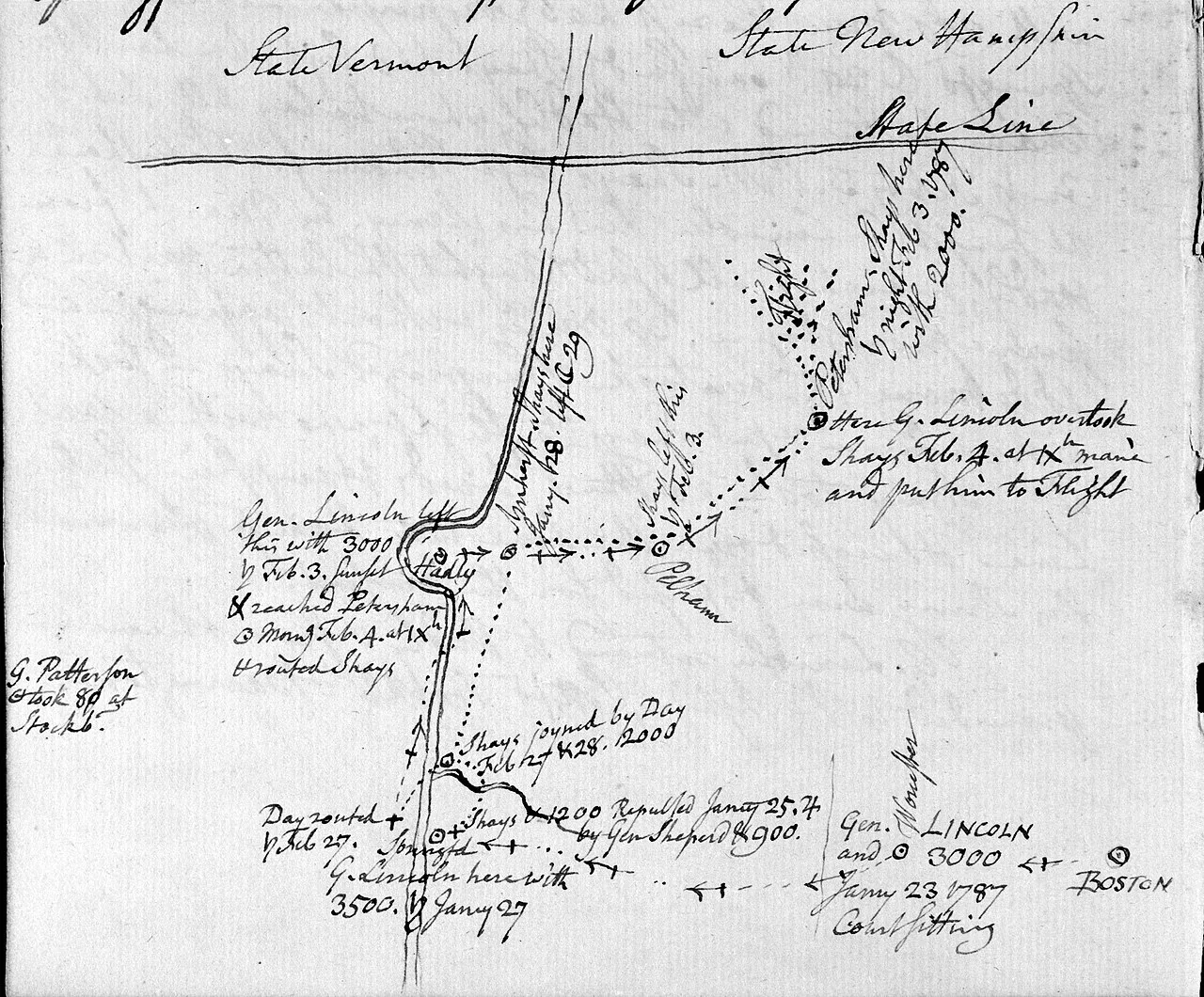 Ezra Stiles's map of the places of Shays' Rebellion in western Massachusetts, 1787Wikimedia Commons, Ezra Stiles (1727 – 1795), Public domain (ShaysRebellionMapByEzraStiles.jpg)
Sources
- Pauline Maier, Ratification: The People Debate the Constitution, 1787–1788 (2010).
- Gordon S. Wood, The Creation of the American Republic, 1776–1787 (1969).
- Richard B. Morris, The Forging of the Union, 1781–1789 (1987).
Prev: The Treaty of ParisNext: Springfield: the attack on the arsenal