1767 to 1770
The Townshend duties and the Boston Massacre
In 1767 Chancellor Townshend tries again with duties on glass, paint, paper, lead and tea, collected at the ports. The colonies answer with another boycott and with pamphlets arguing that Parliament may regulate trade but may not raise revenue in America. Boston is the centre of resistance. From 1 October 1768 four British regiments arrive to keep order in a town of about sixteen thousand.
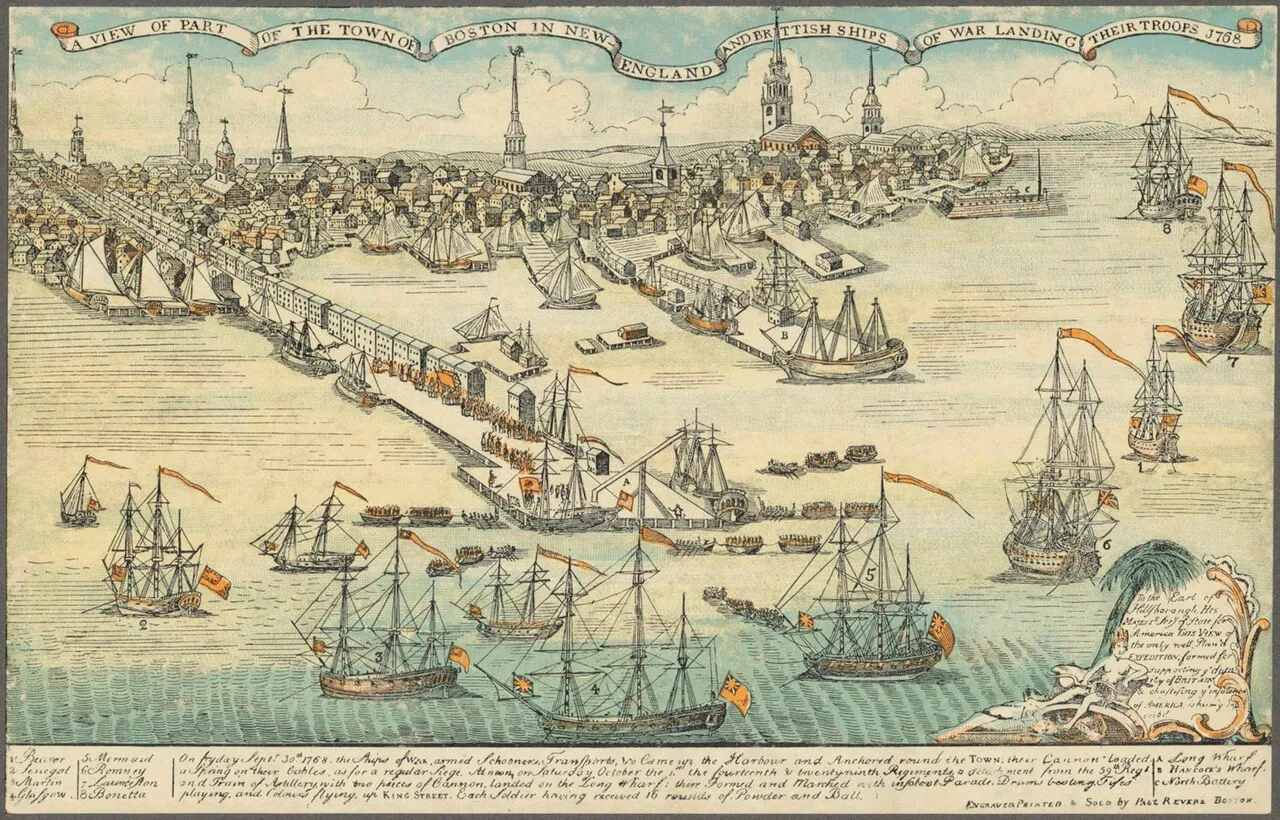 British troops landing at Boston in 1768, coloured reproduction of an engraving by Paul RevereWikimedia Commons, Paul Revere, Public domain (Boston 1768.jpg)
Soldiers and townspeople clash for a year and a half. On the evening of 5 March 1770 a crowd throws snowballs and stones at a sentry outside the Custom House. The soldiers sent to support him fire, and five men die. Henry Pelham’s engraving of the shooting, copied and sold by Paul Revere as “The Bloody Massacre”, circulates through the colonies.
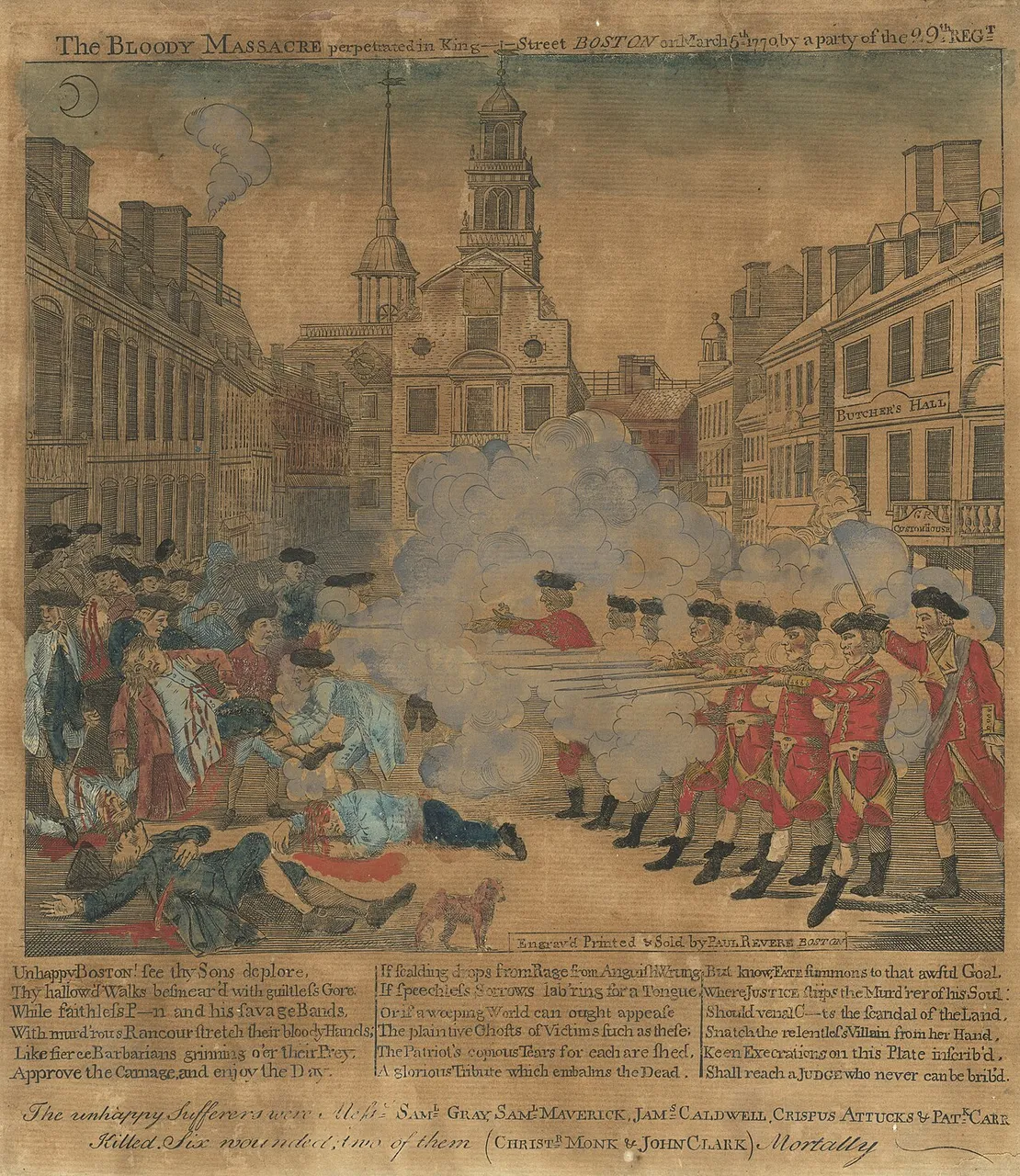 The Bloody Massacre in King Street, 5 March 1770, engraving by Paul Revere after Henry PelhamWikimedia Commons, Paul Revere, after Henry Pelham, CC0 (Paul Revere, after Henry Pelham, The Boston Massacre, 1770, NGA 11550.jpg)
On the same day in London, Lord North proposes to repeal the Townshend duties except the one on tea. The repeal becomes law on 12 April 1770.
Sources
- Robert Middlekauff, The Glorious Cause (2005).
- Gordon S. Wood, The American Revolution: A History (2002).
- Hiller B. Zobel, The Boston Massacre (1970).
Prev: The Sugar Act, the Stamp Act and the first congressNext: The Boston Tea Party