352–348 BC
Thessaly and Olynthus
South of Macedon, across the road into it, lies Thessaly, a land of plains famous for its horsemen. The Thessalian League is at war with the tyrants of Pherae, who are allied with the Phocians of central Greece and their general Onomarchus. The League calls in Philip. Onomarchus beats him in 353 BC, twice by Diodorus's account, but in spring 352 Philip returns, joins his army to the League's and takes the port of Pagasae.
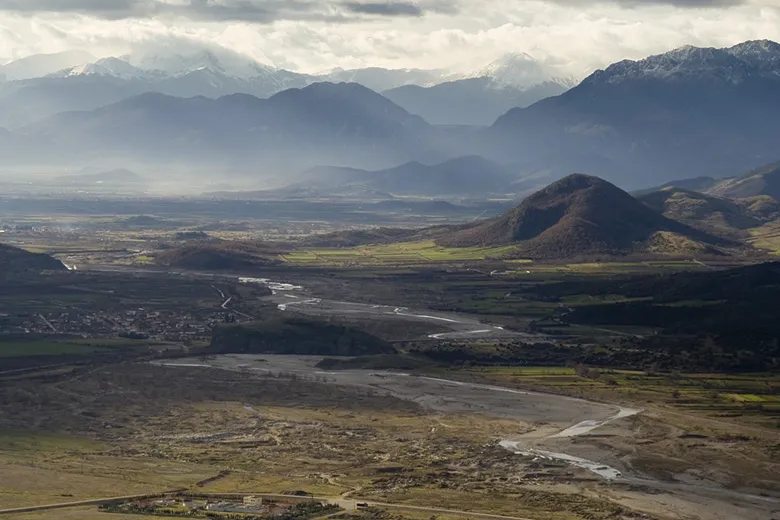 The plain of Thessaly and the river Peneus, photographed in 2007Wikimedia Commons, Evgeni Dinev, CC BY 2.0 (File:Thessaly Plain.jpg)
In early summer 352 BC the armies meet at the Crocus Field, probably, Ellis writes, on the coastal plain west of the Gulf of Pagasae. Diodorus gives Onomarchus 20,000 foot and 500 horse, and Philip and the Thessalians more than 20,000 foot and 3,000 horse. The cavalry decides the day. The Phocians are driven to the shore, where some try to swim out to Athenian ships. Diodorus counts more than 6,000 Phocians and mercenaries dead, Onomarchus among them, and 3,000 taken. The Thessalians then make Philip archon of their League, which gives him command of their forces and a share of their taxes.*
To the west lies Epirus, the kingdom of Olympias's family and Philip's ally. In 350 he brings her young brother, also named Alexander, to be raised at his court in Pella.
Olynthus goes the other way. Its people turn towards Athens and refuse to hand over two of Philip's half-brothers who have fled to them. In 349 BC he invades the Chalcidice, and in 348 he lays siege to Olynthus. Diodorus says Philip bribed two of its leading men and took the city through their treachery; it falls in the autumn. Philip sacks it and sells its people as slaves, and the Chalcidice becomes part of Macedon. By now the coast between the Strymon and Philippi is Macedonian too.
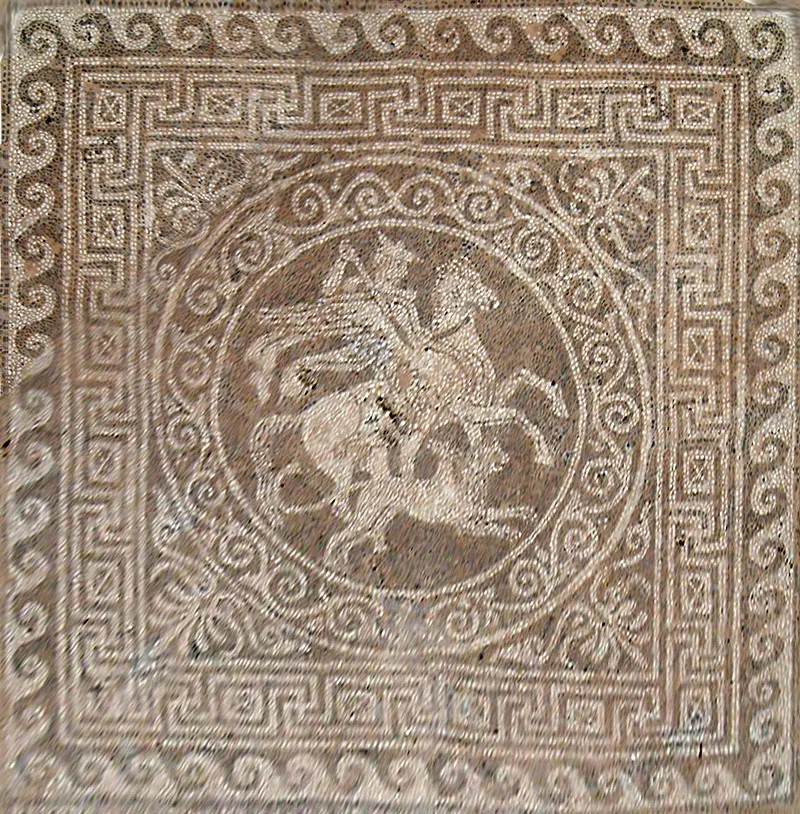 Pebble mosaic of Bellerophon from a house at OlynthusWikimedia Commons, Christaras A, CC BY-SA 2.5 (File:Olynthos-mosaic-floor.jpg)
Notes
* Ellis describes the archonship as an office held for life, with military command, and has the League grant Philip the proceeds of its harbour and market taxes. Bosworth calls its exact meaning uncertain, though he too has it give Philip control of the joint Thessalian forces and some revenue from taxes on their trade.
Sources
- Diodorus Siculus, Library of History, 16.35 and 16.52–53, tr. C. L. Sherman (1952).
- J. R. Ellis, "Macedon and North-West Greece", The Cambridge Ancient History VI (2nd ed., 1994), ch. 14.
- A. B. Bosworth, Conquest and Empire: The Reign of Alexander the Great (1988), ch. 1.
Prev: Amphipolis, Philippi and the gold of PangaeumNext: Thrace, and the young Alexander