312–305 BC
The Successors take the title of king
Antigonus has held Syria and Phoenicia since taking them from Ptolemy in 315 and 314 BC. In 312 BC Ptolemy, urged on by Seleucus, crosses the desert to Gaza. There they beat Antigonus's young son Demetrius.* Ptolemy then gives Seleucus 800 foot and about 200 horse by Diodorus's count**, and with them Seleucus marches through Mesopotamia and takes back Babylon, where he had been satrap.
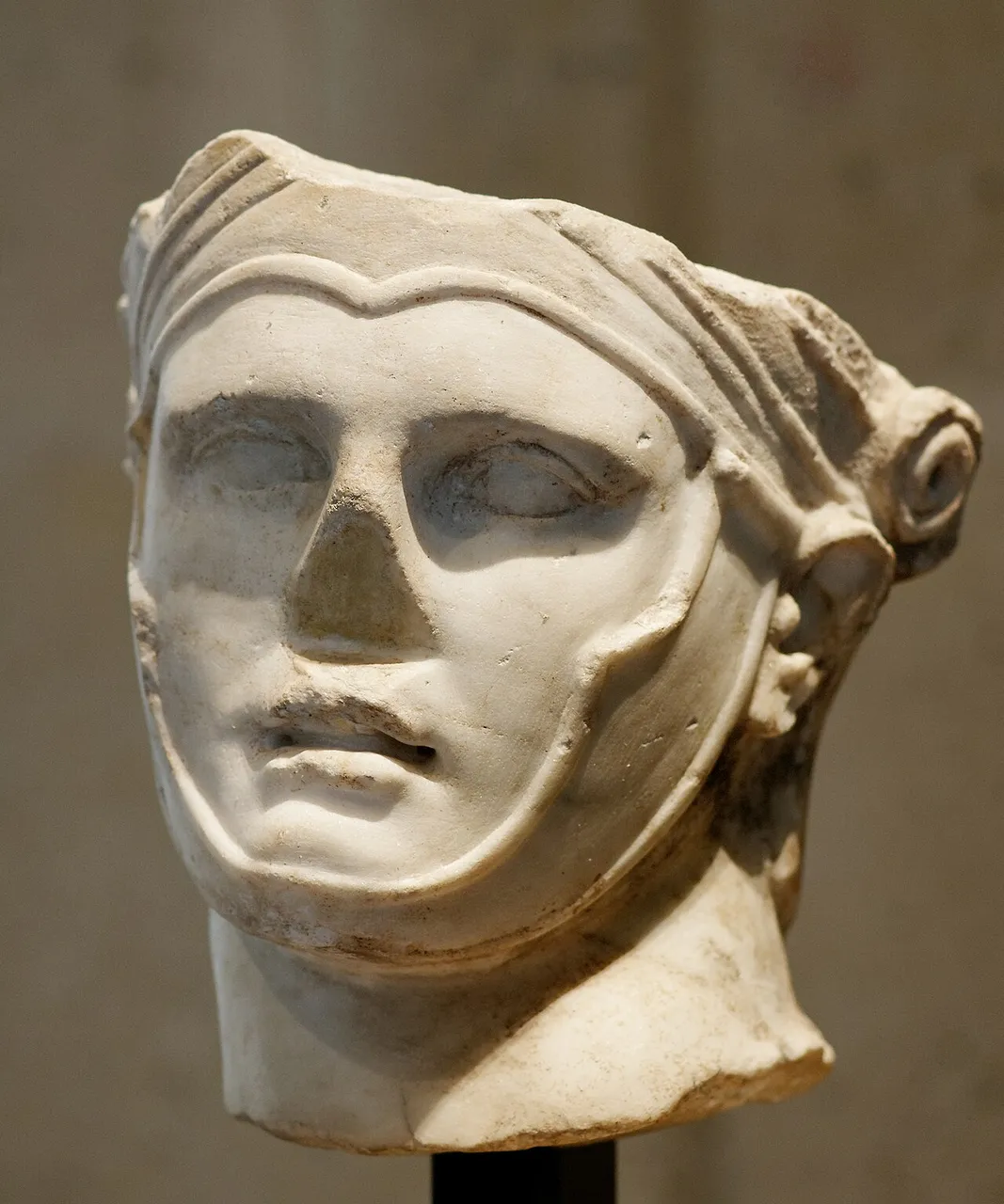 Portrait of Seleucus I Nicator, a Roman work after a Hellenistic model of the early 3rd century BC. Louvre, Ma 3597Marie-Lan Nguyen, CC BY 2.5, via Wikimedia Commons (File:Seleucos Nicator Louvre Ma3597 n3.jpg)
In 311 BC the generals make peace. Cassander is to be general of Europe until Alexander IV comes of age, Lysimachus keeps Thrace, Ptolemy Egypt and the cities next to it in Libya and Arabia, and Antigonus the first place in all Asia. After the peace Glaucias, Cassander's officer, who guards the boy, kills Alexander IV and his mother Roxana in secret on his master's orders.*** With no heir left, each general holds his land, in Diodorus's words, "as if it were a kingdom won by the spear".
Seleucus goes east towards India, and by 306 or 305 BC he holds the upper satrapies of Iran as well as Babylonia. At a date that is not known he makes peace with Chandragupta, founder of the Mauryan Empire in India, and in Bosworth's words cedes him the eastern satrapies for 500 elephants; Hammond and Walbank name the lands as Gandhara, eastern Arachosia and Gedrosia. Antigonus founds Antigonia on the Orontes, placed, Diodorus says, to watch Babylon and the upper satrapies.
In 306 BC Demetrius sails from Athens to Cyprus and defeats Ptolemy's fleet off Salamis. At the news Antigonus takes the diadem and the title of king, and gives the title to Demetrius too. Ptolemy follows in 305 BC, and the others soon after.
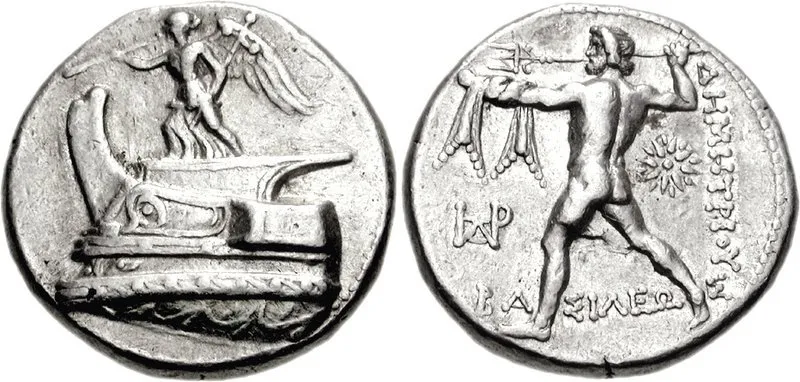 Silver tetradrachm of Demetrius Poliorcetes, struck at Ephesus about 301–295 BC: Nike on the prow of a galley, blowing a trumpetCNG coins, CC BY-SA 3.0, via Wikimedia Commons (File:Tetradrachm, 301-295, Demetrius Poliorketes - Macedonia.jpg)
On the map the routes are approximate, and so is the line between the kingdom of Antigonus and Seleucus's lands.
Notes
* Plutarch makes Demetrius twenty-two at Gaza. Diodorus gives him that age two years earlier, in 314 BC, as Geer notes.
** Appian, as Geer notes, gives 1,000 foot and 300 horse.
*** Diodorus tells the murder together with the peace of 311 BC. Hammond and Walbank date it to 309 BC at the earliest, probably the late summer, and say it was kept hidden for some time, perhaps for years.
Sources
- Diodorus Siculus, Library of History, book 19, 80–105, and book 20, 45–53, tr. R. M. Geer (Loeb, 1954).
- Plutarch, Life of Demetrius, 5–7 and 15–18, tr. B. Perrin (Loeb, 1920).
- N. G. L. Hammond and F. W. Walbank, A History of Macedonia, vol. III: 336–167 B.C. (1988), chs. VII and XI.
- A. B. Bosworth, The Legacy of Alexander: Politics, Warfare and Propaganda under the Successors (2002), chs. 4 and 6.
Prev: Eumenes and Antigonus: the war for AsiaNext: Ipsus and the partition