December 331 – January 330 BC
The Uxian defile and the Persian Gate
In late December 331 BC Alexander leaves Susa for Persis, the homeland of the Persian kings. Snow may close the passes of the Zagros, but Bosworth holds that he took the risk because a wait until spring would have given the Persians time to build a stronger defence.
The army crosses the Pasitigris (today the Karun) into the land of the Uxians. The Uxians of the plain, ruled by a Persian satrap, submit. The Uxians of the mountains are subject to no one, and they demand the toll that the Great King used to pay them for passage. Alexander falls on their villages by night, races to the Uxian defile ahead of them, and sends Craterus, one of his phalanx commanders, to hold the heights behind it. The fleeing Uxians run into Craterus’s men. According to Arrian, they keep their land for a yearly tribute of 100 horses, 500 oxen and 30,000 sheep. The place is uncertain; Bosworth puts it near the head of the Karun.
Near the border of Persis Alexander divides the army. Parmenion takes the baggage, the Thessalian horse, the Greek allies and the other heavy troops by the carriage road, the longer and easier way towards Persepolis. Alexander takes the Macedonians, the Companion cavalry and the light troops straight through the mountains. At the Persian Gate, a narrow gorge on the direct road, Ariobarzanes, the satrap of Persis, has built a wall across the pass and holds the heights on both sides with a large army.*
Where the Gate lies is disputed. The map draws it at Bosworth’s site, a gorge above the open ground of Mullah Susan, so the drawing of the battle, and of Parmenion’s road, is a reconstruction.**
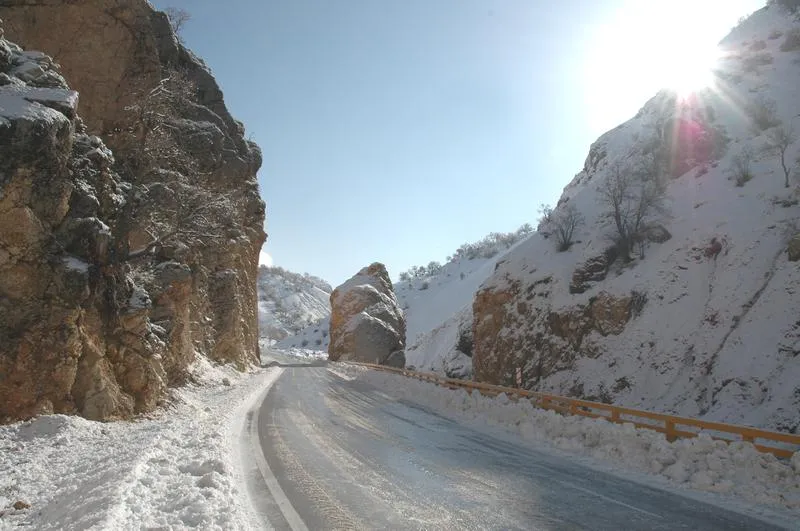 A gorge photographed by Jona Lendering as the place of the Persian Gate, uploaded in 2007; it shows the site Lendering holds, the Tang-e Meyran, not the one the map drawsWikimedia Commons, Jona Lendering, Public domain (File:2persian gate wall.JPG)
Notes
* Arrian gives Ariobarzanes 40,000 infantry and 700 horsemen, Diodorus 25,000 infantry and 300 horsemen, and Curtius 25,000 infantry.
** Bosworth, following the archaeologist Stein, puts the Gate in the Tang-i Mohammad Reza above Mullah Susan; he notes that Stein had called it the Tang-i Khas, a gorge that in fact lies about 10 km further west. The historians Speck and Lendering put it in the Tang-e Meyran, north-east of Yasuj, and Lendering dates the battle to about 20 January 330 BC. The Iranian linguist Hemati places it between Kopan and Yasuj.
Sources
- Arrian, Anabasis of Alexander, book 3, 17 to 18.
- Curtius, History of Alexander, book 5, 3.
- A. B. Bosworth, A Historical Commentary on Arrian’s History of Alexander, volume 1 (1980).
- A. B. Bosworth, Conquest and Empire: The Reign of Alexander the Great (1988).
- Diodorus Siculus, Library of History, book 17, 68 (tr. C. B. Welles).
- Jona Lendering, Persian Gate (330 BCE), after Henry Speck (Livius.org).
Prev: Babylon and Susa open their gatesNext: The assault in the defile