January – May 330 BC
Persepolis taken and burned
With the Persian Gate forced in January 330 BC, Persis lies open. Tiridates, who commands the citadel of Persepolis, writes to offer Alexander the city and its treasury. Alexander rides ahead at speed, crosses the river Araxes on a bridge his men have built, and reaches Persepolis before the guards can loot the treasury.
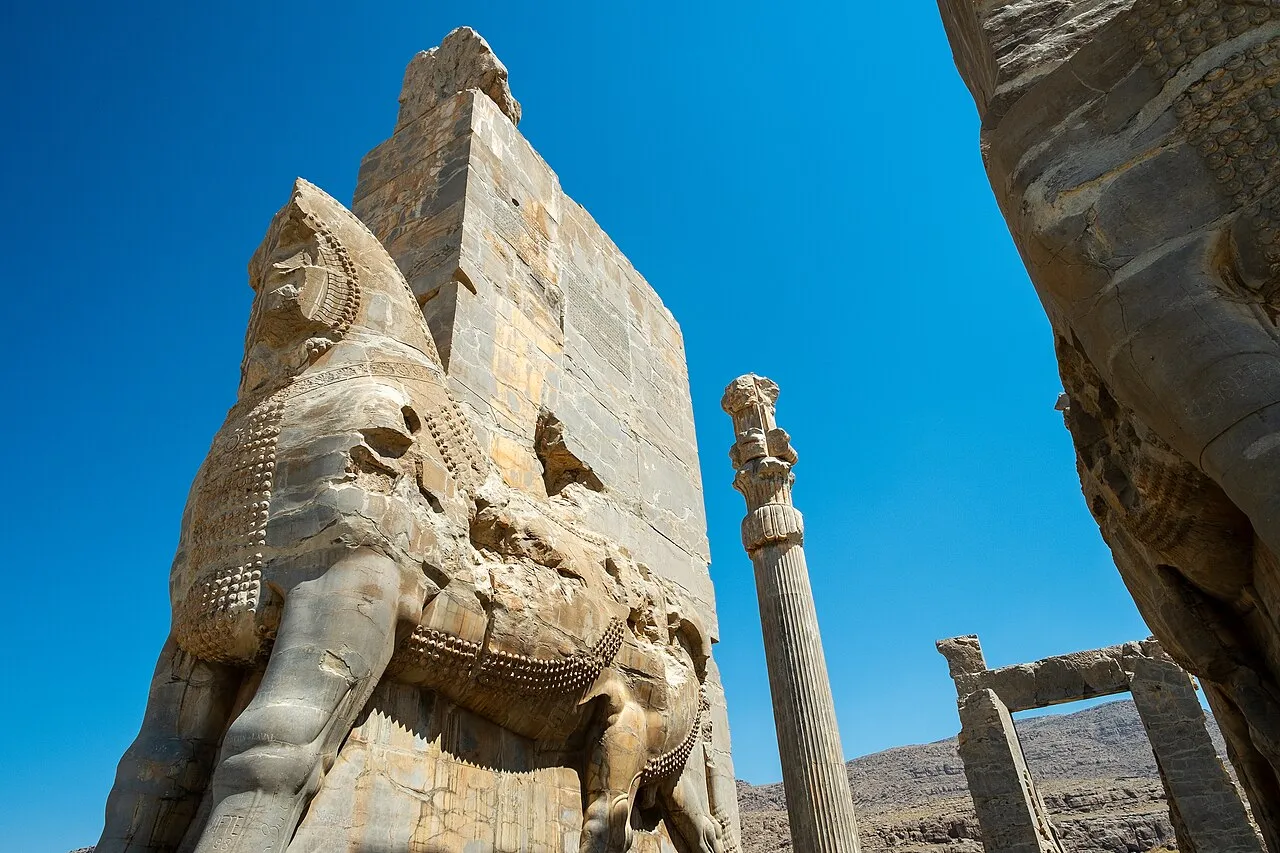 The Gate of All Nations at Persepolis, photographed in 2013Wikimedia Commons, Skot, CC BY-SA 4.0 (File:Persepolis – Gate of All Nations 02.jpg)
Babylon and Susa were spared, but Persepolis is treated as a captured city. It was the city of Darius I and of Xerxes, who burned Athens. Diodorus says that Alexander called it the most hateful city in Asia and let his soldiers loot it, sparing only the palaces. The soldiers kill the men and drag the women off as slaves. Bosworth calls the sack “coldly calculated”: it rewarded the soldiers and was presented as the Greeks’ revenge on Xerxes.
Diodorus puts the treasury at 120,000 talents, and Curtius gives the same figure from the same tradition. Alexander also takes the treasury of Cyrus the Great, the founder of the Persian Empire, at Pasargadae. According to Diodorus, he sends for mules from Babylon, Mesopotamia and Susa and for 3,000 pack camels, to carry part of the treasure with the army and the rest to Susa.
The army stays about four months, waiting for the snows to clear. In May 330 BC, before it leaves, the palace burns, and the sources disagree on how and why.*
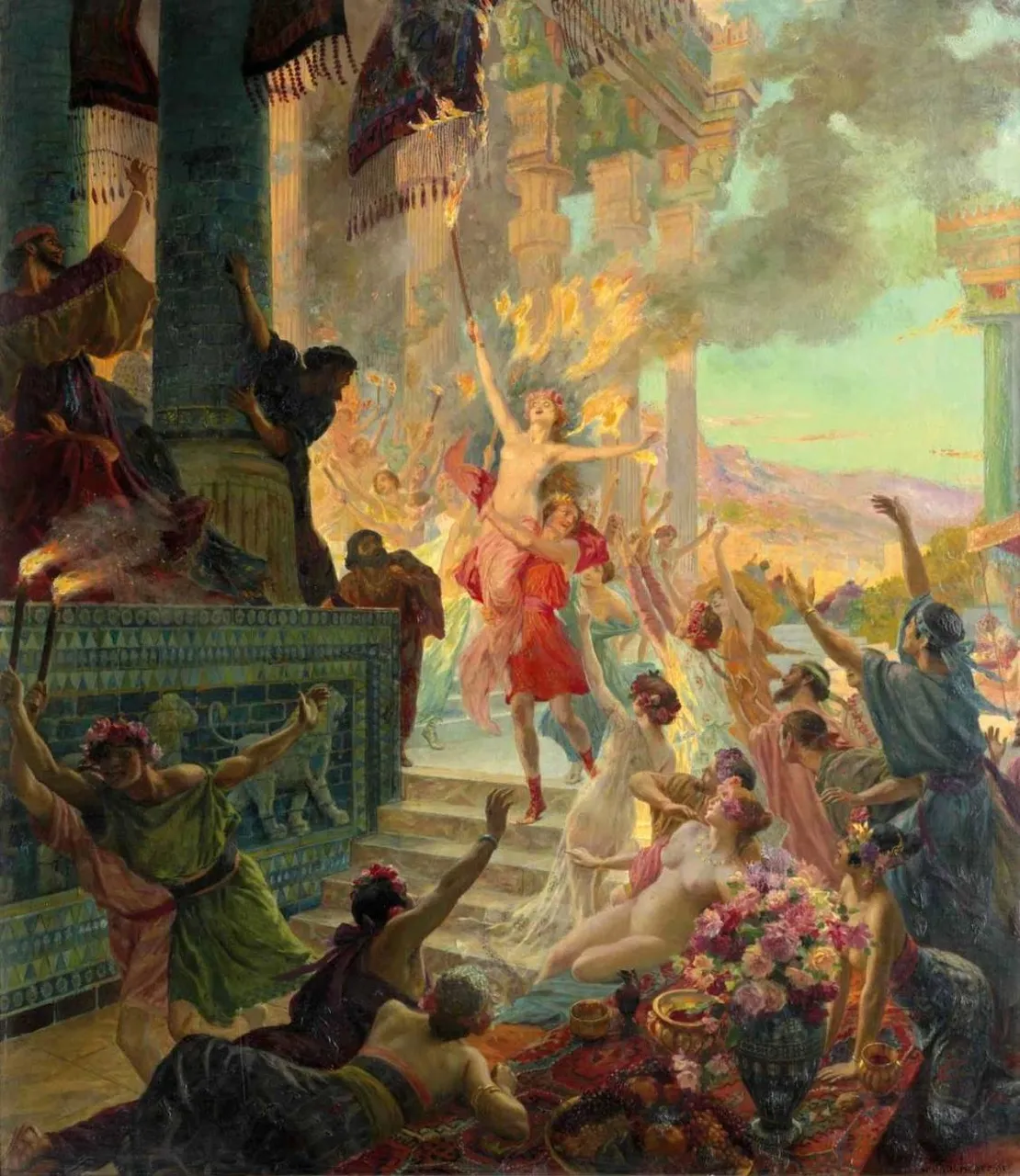 The burning of Persepolis, painted by Georges-Antoine Rochegrosse in 1890Wikimedia Commons, Georges-Antoine Rochegrosse, Public domain (File:Georges-Antoine Rochegrosse Incendie de Persepolis 1890.jpg)
Persis is now Alexander’s. Darius III waits at Ecbatana in Media, and Alexander marches north to find him.
Notes
* Arrian writes that Alexander burned the palace on purpose, to avenge the Persian invasion of Greece, although Parmenion warned him that it was now his own and that its burning would not win over the people of Asia. In Diodorus and Plutarch the fire begins at a drunken feast: Thaïs, an Athenian courtesan, urges the guests to burn the palace of the king who burned Athens, and after Alexander she throws the first torch. Plutarch adds that others call the fire planned, and that Alexander soon regretted it. The historian San José Campos reads the excavations as evidence of a planned fire, started in the buildings of Xerxes at the very end of the stay.
Sources
- Arrian, Anabasis of Alexander, book 3, 18.
- Diodorus, Library of History, book 17, 69 to 72.
- A. B. Bosworth, Conquest and Empire: The Reign of Alexander the Great (1988).
- Christian San José Campos, Alexander the Great in Persepolis, Karanos 4 (2021).
- Plutarch, Life of Alexander, 37 to 38 (tr. B. Perrin).
- Quintus Curtius Rufus, History of Alexander, book 5, 6 (tr. J. C. Rolfe).
Prev: The dawn attack from behindNext: Agis III and the war for Megalopolis