Summer 335 BC
Pelium
In the summer of 335 BC, on the march home from the Danube, Alexander is among the Agrianians of the upper Strymon, allies of Macedon, when news comes from the west. Cleitus, son of Bardylis, an Illyrian king, probably of the Dardani north of Macedon, has revolted, and Glaucias, king of the Taulantians, has joined him. Bosworth judges that Alexander cannot leave his western provinces open to these old enemies of Macedon.
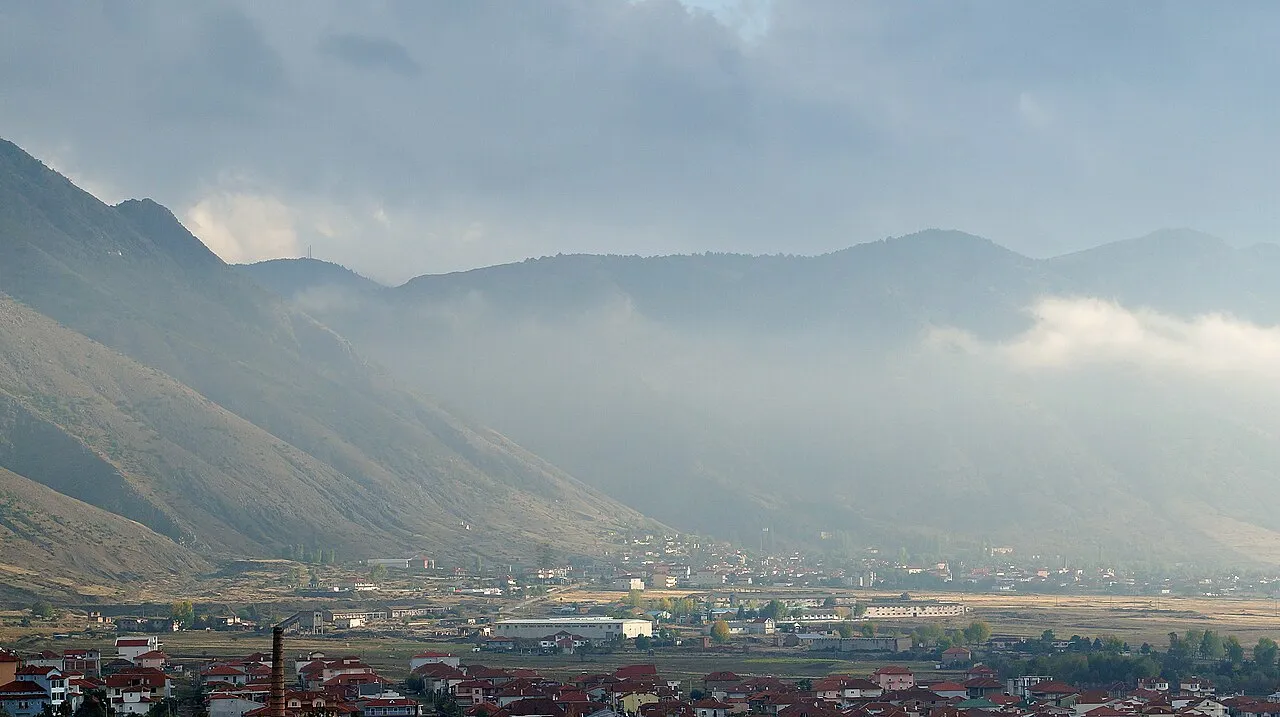 The Morava mountains and the village of Drenovë seen from Korçë, in south-east Albania, photographed in 2013Wikimedia Commons, Albinfo, CC BY-SA 3.0 (File:Morava Drenova.jpg)
Cleitus has seized Pelium,* the strongest town of the district, and Alexander follows the valley of the Erigon west to besiege it. He drives the Illyrians off the hills into the town and begins to wall it in. Next day Glaucias comes up with a large army and takes the heights around the plain. Alexander can neither press the siege nor send out foragers safely, and his one way out is a narrow road between a river and a steep mountain, wide enough, Arrian says, for four men abreast.
He draws up the phalanx 120 ranks deep and drills it in silence in full view of the enemy, raising and lowering the pikes and wheeling the whole block to right and left. When it suddenly advances with a war cry, the Illyrians abandon the ridges, and the army crosses the river under cover of its catapults and archers without losing a man.
A few days later** Alexander learns that the Illyrians are camped with no rampart and no sentries. He crosses back by night with his archers, the Agrianians and the battalions of two of his commanders, Perdiccas and Coenus, and routs the camp. Cleitus takes refuge in Pelium at first, then burns the town and goes west to join Glaucias among the Taulantians.
The site of Pelium and the lines of march on the map are approximate.
Notes
* Where Pelium stood is disputed. Hammond identifies it with the hill-fort of Goricë, on the Illyrian side of the Wolf’s Pass in today’s south-east Albania, and the map follows him. Bosworth finds Arrian’s details too vague to identify the site; he puts it on the Macedonian border and looks for it near the plain of Florina, in Lyncestis.
** Arrian puts the night attack three days after the river crossing, Bosworth two.
Sources
- Arrian, Anabasis of Alexander, book 1, 5 to 6.
- A. B. Bosworth, Conquest and Empire: The Reign of Alexander the Great (1988), ch. 2.
- A. B. Bosworth, A Historical Commentary on Arrian's History of Alexander I (1980), on book 1, 5 to 6.
- N. G. L. Hammond and F. W. Walbank, A History of Macedonia III (1988), part one, ch. II.
Prev: To the DanubeNext: The fall of Thebes