Spring to summer 324 BC
The Opis mutiny
In spring 324 BC Alexander leaves Susa. He sails with his guards down the river and along the coast to the Tigris, while Hephaestion marches the infantry overland. They meet near the estuary and go up the river together, and Alexander breaks down the weirs the Persians had built across it to stop ships. By midsummer he reaches Opis, a town on the Tigris somewhat north of Babylon, whose exact site is uncertain. The lines of these marches on the map are approximate.
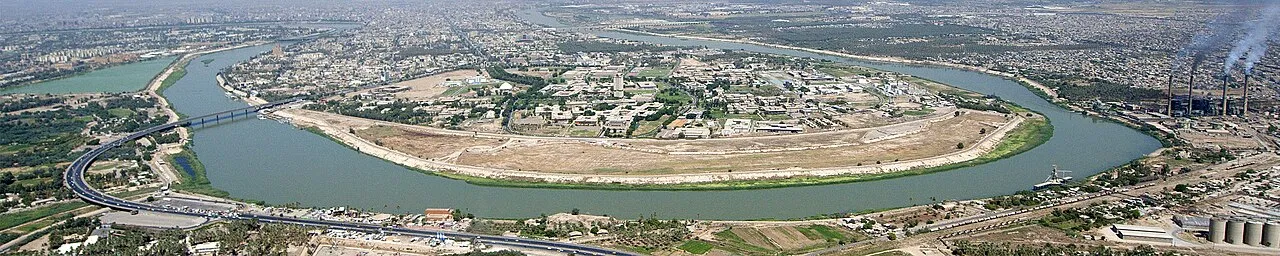 The Tigris flowing through Baghdad, seen from the air in 2016Wikimedia Commons, Dominique A. Pineiro, U.S. Department of Defense, CC BY 2.0 (File:Tigris River in Baghdad (2016).jpg)
At Opis* Alexander announces that he will send home the Macedonians too old or badly wounded to serve. The army has long resented his Persian dress, the Iranian Epigoni and the foreign horsemen placed among the Companion cavalry. The soldiers shout that he should send them all home and go on fighting with his father Ammon, mocking his claim to be the god's son. Alexander points out thirteen ringleaders and has them executed. He shuts himself in the palace, and on the third day gives commands, and Macedonian unit names, to Persians. The Macedonians give in: they throw down their weapons at the palace gates and beg pardon, and he comes out in tears and forgives them.
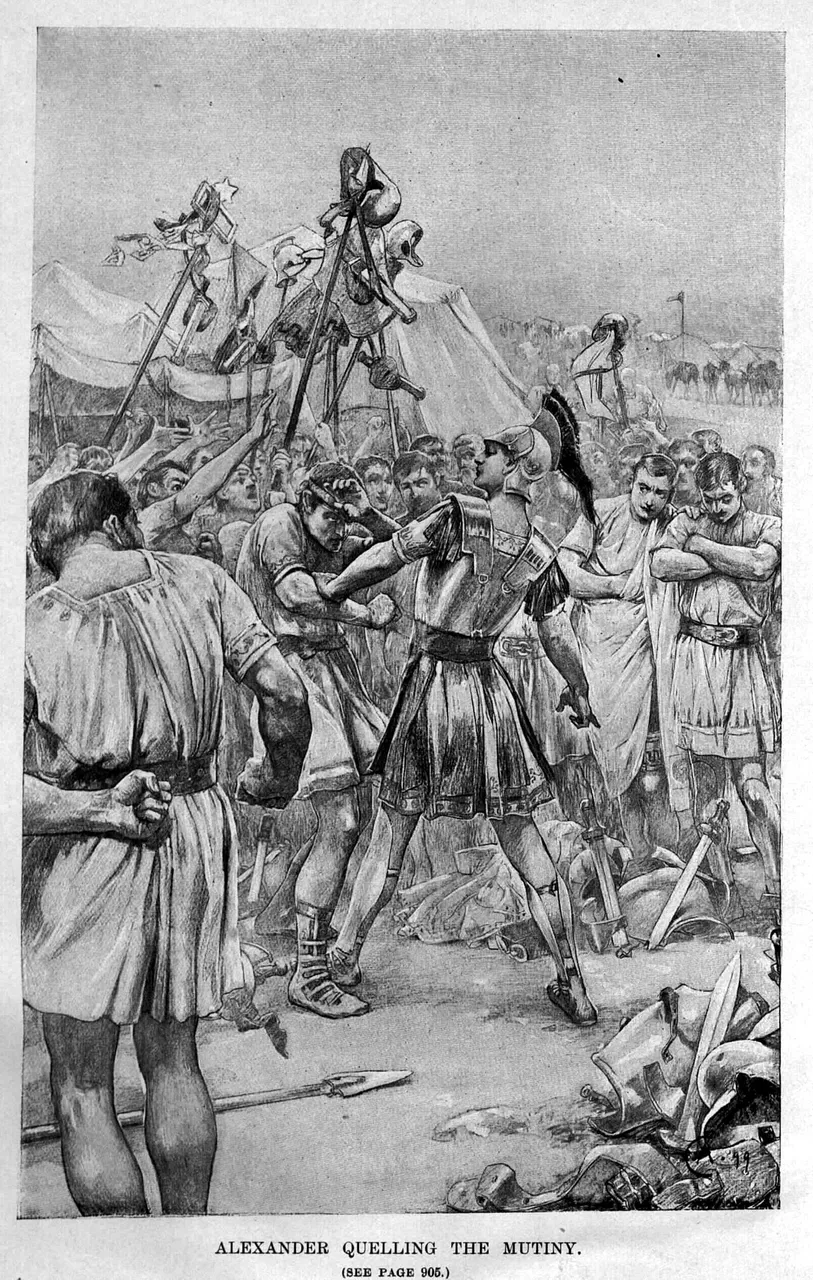 Alexander quelling a mutiny, a drawing by André Castaigne, 1898–1899Wikimedia Commons, André Castaigne, Public domain (File:Alexander quelling the Opis mutiny by Andre Castaigne (1898-1899).jpg)
At a feast of reconciliation, the Macedonians seated nearest him and the Persians next, he prays above all for harmony and partnership in rule between the two peoples. The common account, Arrian says, put the guests at 9,000.
About 10,000 veterans now go home under Craterus, each with a talent beyond his pay. Craterus is to take over Macedon from Antipater, who must bring fresh troops to Asia. Bosworth writes that Craterus went first to Cilicia to oversee arms for a Mediterranean war, and was still there when Alexander died, so the veterans' line on the map ends there.
Notes
* The place is Arrian's. Diodorus tells the same mutiny without naming Opis and places it before the king leaves Susa.
Sources
- Arrian, Anabasis of Alexander, book 7, 7 to 12, tr. E. J. Chinnock.
- Plutarch, Life of Alexander, 71, tr. Bernadotte Perrin (Loeb, 1919).
- Diodorus of Sicily, Library of History, book 17, 108 to 109, tr. C. Bradford Welles (Loeb, 1963).
- A. B. Bosworth, Conquest and Empire: The Reign of Alexander the Great (1988), ch. 2, XIX.
Prev: From Carmania to Susa: the purges and the Susa weddingsNext: Hephaestion dies at Ecbatana