Early 330 BC
Agis III and the war for Megalopolis
Greece has not stayed quiet behind Alexander. Sparta had never joined the League of Corinth, and its king, Agis III, had taken Persia’s side. With Persian ships and money and 8,000 Greek mercenaries who had escaped from Issus, he had fought on Crete since 332 BC.
In summer 331 BC, while Alexander marched on Gaugamela, Antipater, who governs Macedon and Greece for him, was drawn north. In Diodorus’s account Memnon, Alexander’s governor in Thrace, revolted, and Antipater had to lead the whole Macedonian army into Thrace against him; Bosworth suspects that Diodorus garbled a rising that the governor could not put down. Sparta called on the Greeks to fight for their freedom, and Agis brought his army over from Crete. Bosworth lists the allies who joined him: Elis, the Achaeans except Pellene, and the Arcadian cities except Megalopolis. Athens, favoured by Alexander, stayed out. Diodorus counts their army at not less than 20,000 infantry and about 2,000 cavalry. Agis laid siege to Megalopolis, but he could neither storm it nor starve it.
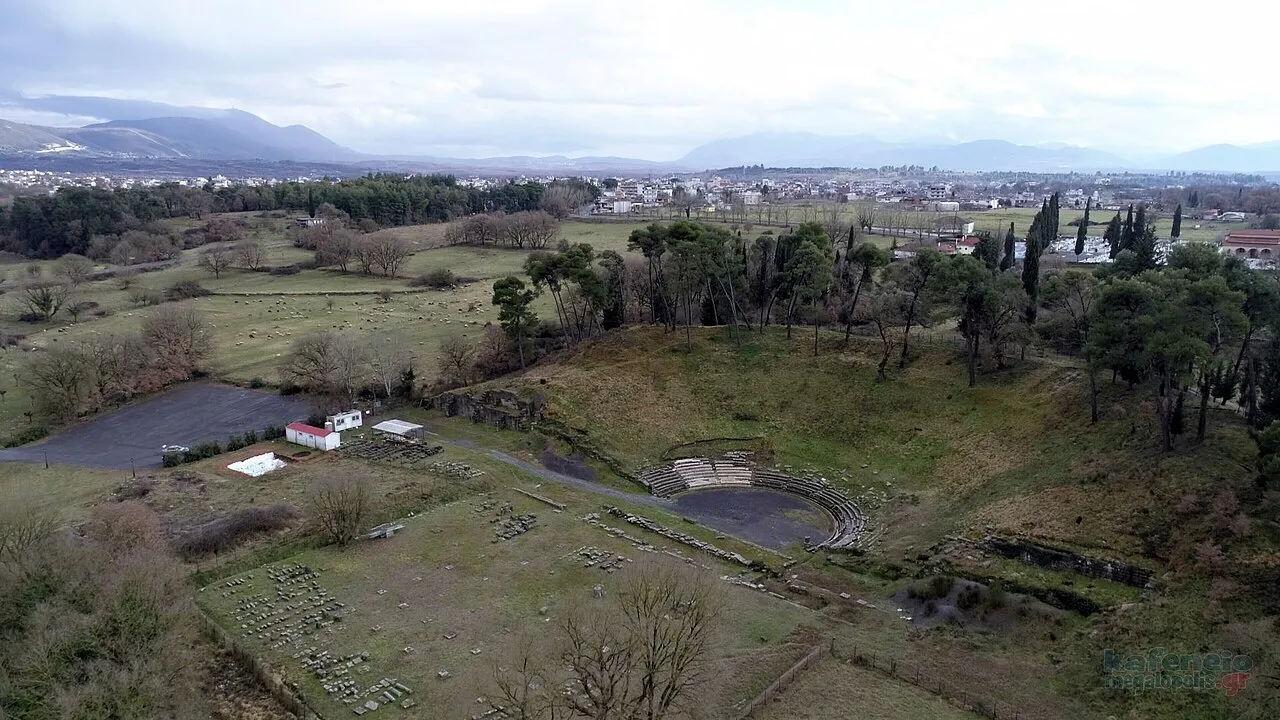 The ancient theatre of Megalopolis, winter 2017Wikimedia Commons, Alebpan, CC BY 4.0 (File:Ancient-theatre-megalopolis-2017.jpg)
Antipater settles with the Thracians on what terms he can and marches south, gathering loyal Greeks until his army numbers not less than 40,000. Probably in early 330 BC, while Alexander is at Persepolis,* the armies meet in hilly ground near the city. Agis, wounded and carried from the field, dies fighting when the enemy overtakes him. More than 5,300 Spartans and allies are killed, by Diodorus’s count; Curtius gives 5,300.**
Antipater refers the defeated states to the council of the League at Corinth. The council punishes Sparta’s allies but leaves the fate of Sparta, never a member, to Alexander. Antipater takes fifty leading Spartans as hostages, and Spartan envoys go to Asia to ask Alexander’s pardon. The two marches on the map are approximate.
Notes
* Bosworth dates Antipater’s march south probably to early spring 330 BC, and Badian the battle to early 330, and this page follows them. Welles, after Curtius, puts the battle rather before than after Gaugamela, and San José Campos, with most recent historians in his view, in autumn 331 BC.
** On Antipater’s side Diodorus counts 3,500 dead, Curtius not more than 1,000.
Sources
- Diodorus, Library of History, book 17, 48, 62 to 63 and 73 (tr. C. B. Welles, with his notes).
- Curtius, History of Alexander, book 6, 1.
- A. B. Bosworth, Conquest and Empire: The Reign of Alexander the Great (1988).
- Ernst Badian, Darius III, Encyclopaedia Iranica.
- Christian San José Campos, Alexander the Great in Persepolis, Karanos 4 (2021).
Prev: Persepolis taken and burnedNext: The pursuit and death of Darius