336–335 BC
Rivals removed, the League renewed
In 336 BC Philip, king of Macedon, is murdered at Aegae, and his son Alexander, about twenty, is acclaimed king.
Alexander has his rivals killed.* Amyntas, son of Perdiccas, a nephew of Philip, is accused of plotting and put to death. Attalus, a Macedonian noble, commands the advance force in Asia jointly with Parmenion and has been in touch with Alexander’s enemies in Athens. Alexander sends his friend Hecataeus to arrest or kill him. Parmenion will not back Attalus, and Hecataeus has him murdered. The historian A. B. Bosworth sees the speed as necessary: Alexander could not take his army out of Macedon while anyone at home could still claim the throne.
In Greece, Athens celebrates Philip’s death, and the Thebans vote to drive the Macedonian garrison out of their citadel, the Cadmeia. In the Peloponnese, Diodorus adds, Argos, Elis and Sparta look to free themselves from Macedon. Before he can leave for Asia, Alexander must hold the Greeks to the League of Corinth, the alliance through which his father led them.
In the winter of 336–335 BC he marches south. The Thessalians hold the vale of Tempe, the main road into Thessaly. In Bosworth’s account the army follows the coast instead and climbs Mount Ossa by steps cut into the rock, coming down behind them. The Thessalian League then votes Alexander his father’s leadership, and at Thermopylae the Amphictyons, a council of the Greek peoples, do the same. At Corinth the delegates of the League give him the command in the war against the Persian Empire that they had given Philip.** Only Sparta refuses; in Arrian the Spartans answer that their custom is “not to follow others but to lead them”.
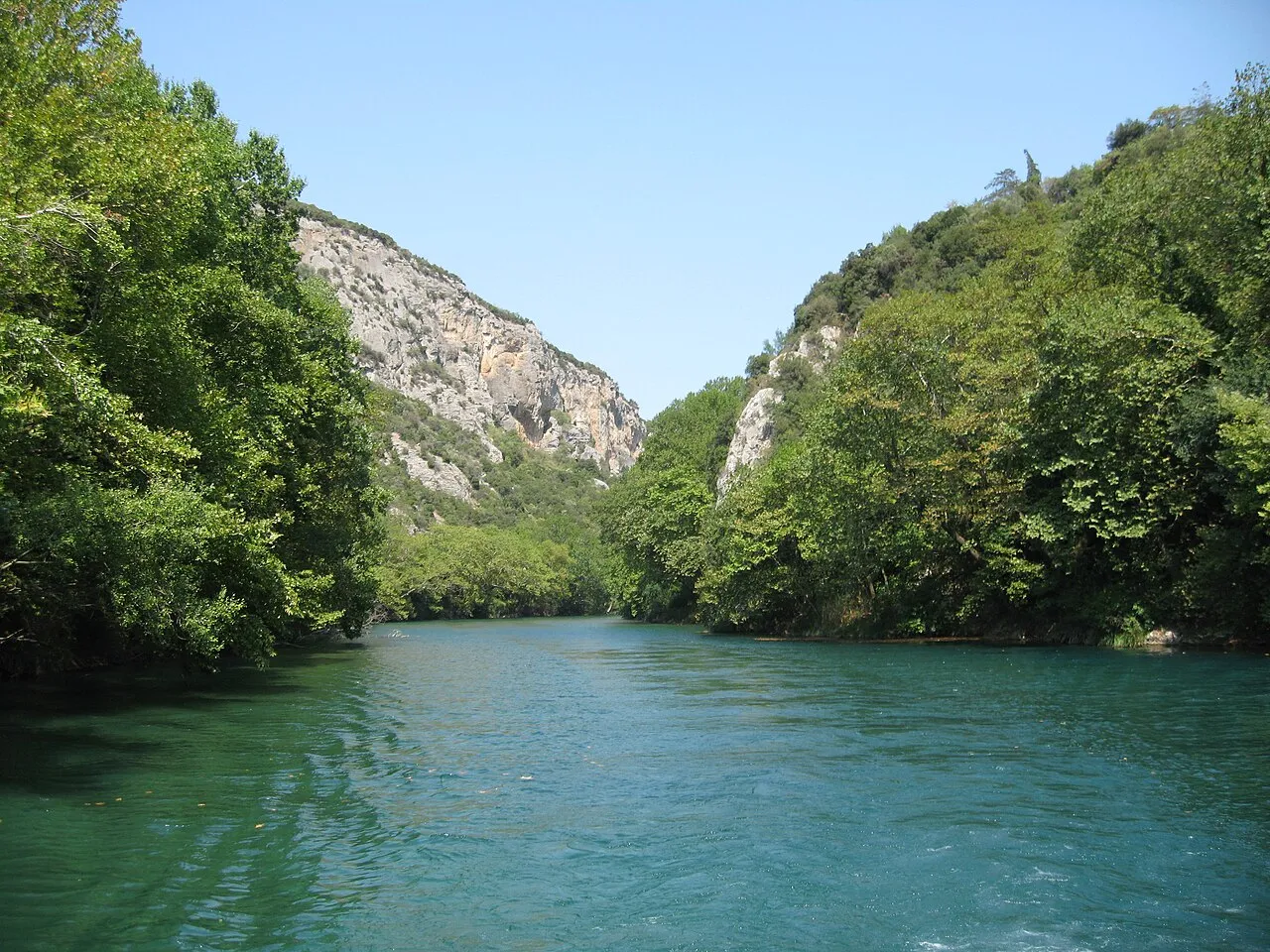 The river Peneus in the vale of Tempe, photographed in 2008Wikimedia Commons, Filos96, CC BY-SA 3.0 (File:Pineios River (Thessaly) through the Vale of Tempe.JPG)
Alexander is back in Macedon before the spring. The line of his march on the map is approximate.
Notes
* When each man died is disputed. In Bosworth’s reading Amyntas was probably killed before Alexander’s march south that winter, and by the summer of 335 BC at the latest, and Attalus died within months of Philip. Hammond, citing Diodorus, puts Hecataeus’s killing of Attalus in the autumn of 335 BC, and the execution of Amyntas just before the army left for Asia in 334 BC.
** Arrian and Diodorus place this vote in the winter of 336–335 BC, before the campaigns in the north and the fall of Thebes, and the map follows them. Plutarch tells of an assembly at the Isthmus of Corinth that votes the war on Persia and proclaims Alexander its leader after Thebes has been destroyed.
Sources
- Arrian, Anabasis of Alexander, book 1, 1.
- Diodorus Siculus, Library of History, book 17, 2 to 5.
- Plutarch, Life of Alexander, 14.
- A. B. Bosworth, Conquest and Empire: The Reign of Alexander the Great (1988), ch. 2 and part II, A.I.
- N. G. L. Hammond and F. W. Walbank, A History of Macedonia III (1988), part one, ch. I.
Prev: The Persian Empire of Darius IIINext: To the Danube