Autumn 333 BC
Darius behind the lines
In autumn 333 BC Alexander moves east along the coast of Cilicia. At Mallus he learns that Darius III is camped at Sochi, beyond the Amanus mountains. He leaves his sick at Issus and crosses the Pillar of Jonah, a spur of the mountains that runs down to the sea, to camp near Myriandrus, a town whose site is not known. There, with the sea on one side and the mountains on the other, he waits.*
Darius does not wait for long. The historian A. B. Bosworth points out that his army lives on supplies brought by land, and the harvest is long over. Arrian adds that his courtiers tell him Alexander is afraid to fight. Darius leads his army north round the mountains, by a road that Alexander is not watching. In Bosworth's reconstruction it runs through the Bahçe Pass and down by the Amanian Gates. The routes on the map are approximate. The Persians come down behind Alexander at Issus, where, Arrian writes, they mutilate and kill the Macedonian sick, and the next day they advance to the Pinarus. Which stream was the Pinarus has never been settled, and Bosworth thinks that it may never be known. He suggests the Kuru Çay, where the map places it.
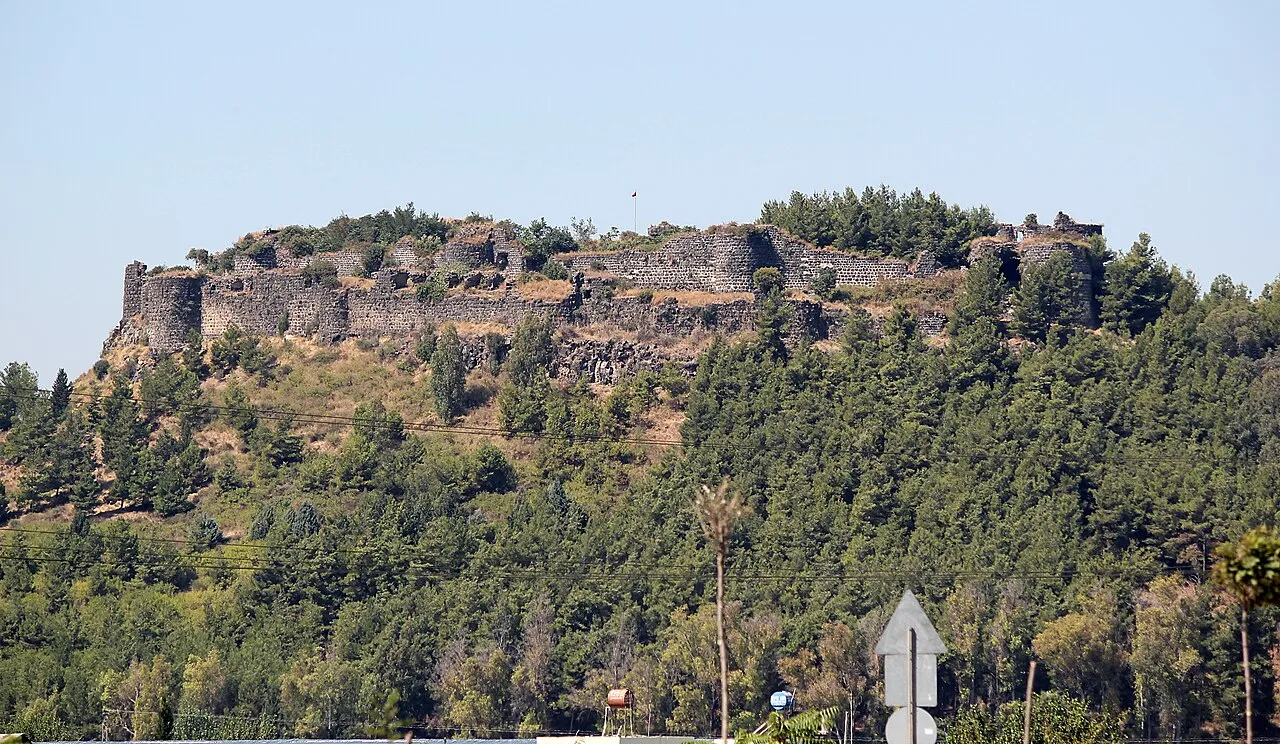 The crusader castle of Toprakkale near Osmaniye, photographed in 2011. Bosworth leads Darius's road through the narrows of ToprakkaleWikimedia Commons, Klaus-Peter Simon, CC BY-SA 3.0 (File:ToprakkaleOsmaniye.jpg)
Alexander sends a ship back to check the news. When it is confirmed, he marches his army north again by night. The Persian army now stands between him and Cilicia.
Darius brings far more men than Alexander; how many more is disputed.**
Notes
* Arrian has Alexander eager to fight and held in his camp only by an autumn storm. Curtius says that his plan was defensive: to meet the Persians in the coastal narrows, where their numbers would count for little. Bosworth largely accepts Curtius and sees an element of defensive strategy on both sides, Darius keeping to the open plain that suited his numbers and Alexander to the narrows.
** Arrian passes on a report that Darius had about 600,000 fighting men. Diodorus gives more than 400,000 foot and at least 100,000 horse. Callisthenes, a Greek historian with Alexander's army, counted 30,000 cavalry and 30,000 Greek mercenaries. Bosworth holds that the totals are beyond any educated guess, though the 30,000 mercenaries may be near the truth. For Alexander, Callisthenes gave 40,000 foot and 4,500 horse at the crossing into Asia, with 5,000 foot and 800 horse more before Cilicia. His figure is reported by Polybius. It is higher than Arrian's count of the army that crossed, not much above 30,000 foot and more than 5,000 horse, and than Diodorus's, about 32,000 foot and 4,500 horse, though Diodorus's totals and his list of contingents do not quite agree.
Sources
- Arrian, Anabasis of Alexander, book 1, 11, and book 2, 5 to 8.
- Quintus Curtius Rufus, History of Alexander, book 3, 7 to 8.
- Diodorus Siculus, Library of History, book 17, 17 and 31.
- Polybius, Histories, book 12, 17 to 22.
- A. B. Bosworth, Conquest and Empire: The Reign of Alexander the Great (1988).
- A. B. Bosworth, A Historical Commentary on Arrian's History of Alexander, vol. I (1980).
Prev: Through the Cilician GatesNext: The lines on the Pinarus