302–301 BC
Ipsus and the partition
In 302 BC Cassander, Lysimachus, Seleucus and Ptolemy join against King Antigonus, fearing, as Diodorus tells it, that he will take their kingdoms too. Cassander holds the passes into Thessaly against Antigonus's son Demetrius until Antigonus calls him over to Asia in the autumn. Lysimachus, with some of Cassander's troops, crosses into Asia in early summer and avoids battle with Antigonus, who comes up from Syria, until winter. Just before winter Seleucus reaches Cappadocia from the upper satrapies with 480 elephants, by Diodorus's count. Ptolemy invades Syria but, on a false report of his allies' defeat, goes back to Egypt, leaving garrisons behind, and misses the battle.
The armies meet at Ipsus in Phrygia in 301 BC. In Plutarch's account Demetrius routs the cavalry of Antiochus, son of Seleucus, but chases him too far. Seleucus's elephants block Demetrius's way back, and Seleucus rides round Antigonus's phalanx, now without cavalry, until much of it comes over to him. Antigonus waits for his son to the last and falls under a shower of javelins.
The victors carve up his kingdom "as if it had been a great carcass", in Plutarch's words. Lysimachus receives Asia Minor up to the Taurus, Cappadocia with it, though in Tarn's account partly in name only: Pontus and Bithynia stay independent, and many Greek cities still side with Demetrius. Seleucus adds Syria and Mesopotamia, so that his lands reach, on paper, from the Mediterranean to the Hindu Kush and the Jaxartes, though Tarn notes that Tyre and Sidon are still Demetrius's. Ptolemy keeps Coele-Syria* and refuses Seleucus's claim to it. Cassander keeps Macedon, and his brother Pleistarchus receives a share of his own south of the Taurus**, which the map leaves out.
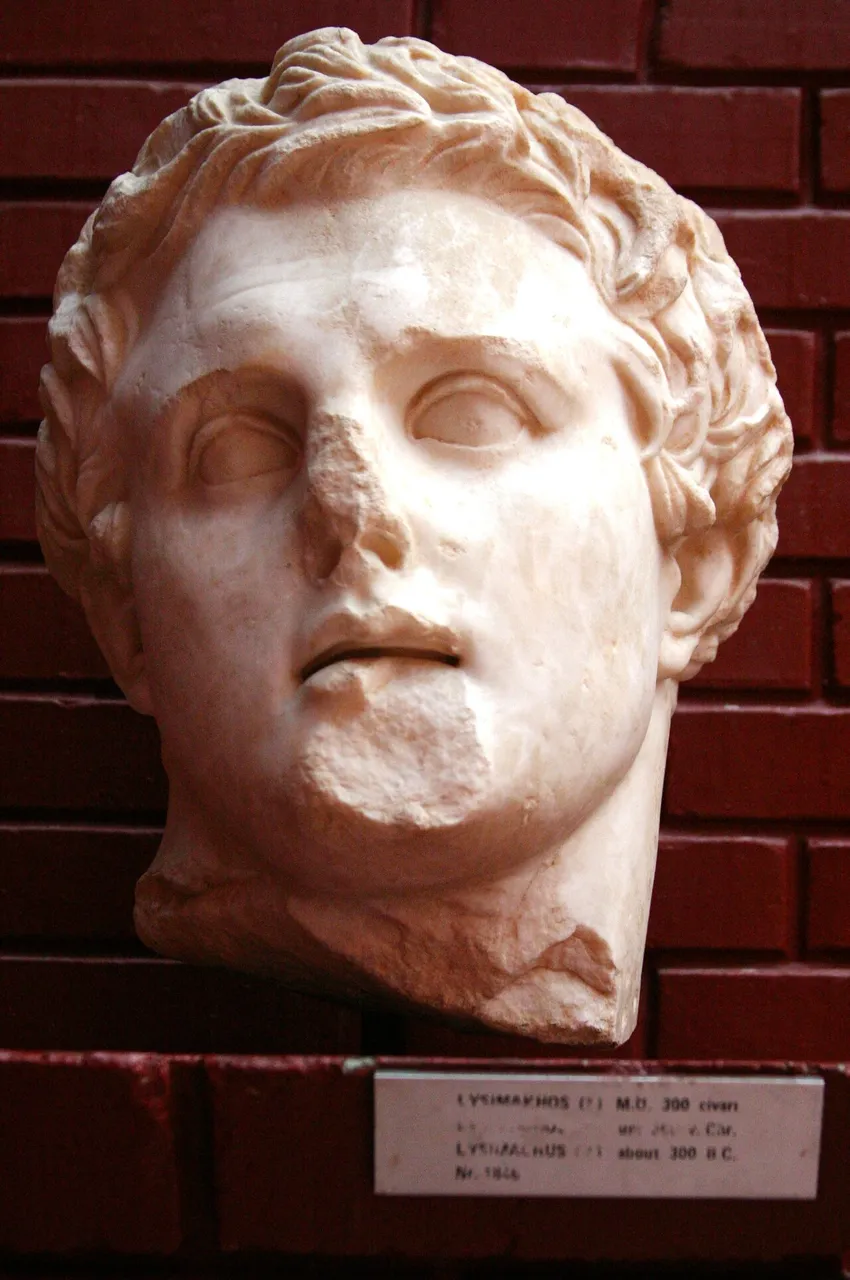 Marble bust of Lysimachus, Ephesus MuseumJosé Luiz, CC BY-SA 3.0, via Wikimedia Commons (File:Lisymachus, marble - Ephesus Museum.JPG)
On the map four armies converge on Phrygia by approximate routes, and Antigonus's kingdom is divided.
Notes
* How far north Ptolemy held is disputed. Tarn says he had occupied Syria south of Damascus and the Lebanon; Bosworth says he occupied the land as far as Sidon in the winter of 302–301 BC.
** Bosworth places Pleistarchus's share in a small area of Cilicia. Tarn makes it a kingdom with its capital at Heraclea by Latmus, in Caria.
Sources
- Plutarch, Life of Demetrius, 28–30, tr. B. Perrin (Loeb, 1920).
- Diodorus Siculus, Library of History, book 21, 1 and 5, tr. F. R. Walton (Loeb, 1957).
- N. G. L. Hammond and F. W. Walbank, A History of Macedonia, vol. III: 336–167 B.C. (1988), chs. VII and IX.
- W. W. Tarn, "The New Hellenistic Kingdoms", in The Cambridge Ancient History, vol. VII (1928), ch. III, 1.
- A. B. Bosworth, The Legacy of Alexander: Politics, Warfare and Propaganda under the Successors (2002), ch. 7.
Prev: The Successors take the title of kingNext: The Alexandrias, the koine and the legend