May 326 BC
Porus at the Hydaspes
From Taxila Alexander marches to the Hydaspes and makes camp on its bank. Directly opposite, on the far side, Porus has camped with his army and elephants. Arrian says the river was rising with the melting snows and the rains, and the horses would never land in the face of the elephants. So Alexander moves troops up and down the bank, gathers grain as if to wait for low water in winter, and night after night has his cavalry raise a clamour along the river, until Porus stops answering the noise.
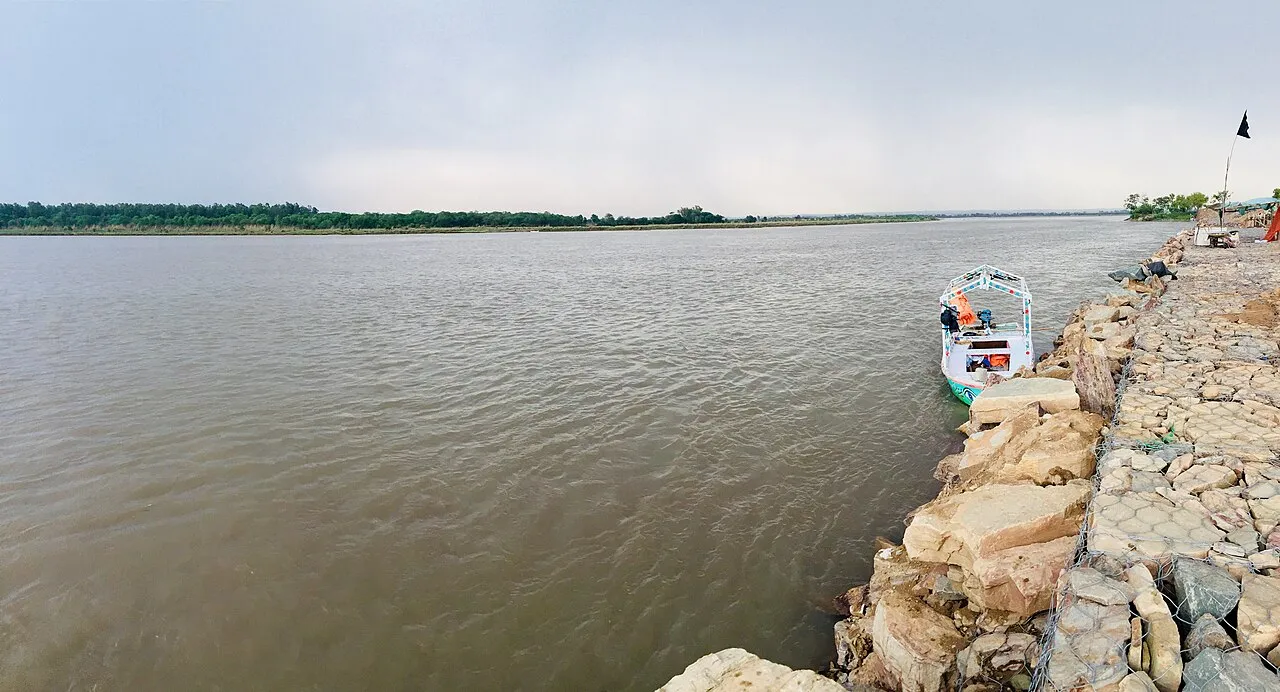 The Jhelum, the ancient Hydaspes, in Punjab, photographed in 2018Wikimedia Commons, Bilal Mohy Ud Din, CC BY-SA 4.0 (File:Beauty of Jhelum River.jpg)
In 326 BC, in April or May by Arrian's dating,* he strikes. Craterus stays at the main camp, and three phalanx commanders, Meleager, Attalus, son of Andromenes, and Gorgias, wait with the mercenaries along the bank. Alexander marches upstream, out of sight of the river, to a wooded headland and island 150 stades away. After a night of thunderstorms, towards dawn, his men cross on boats and on hides stuffed with hay. They land first on a second island they took for the far bank and ford the last channel breast-deep. Arrian puts the force at about 6,000 foot and 5,000 horse. Alexander's cavalry routs Porus's son, who is killed, and then beats Porus himself on his own bank. Porus is wounded and taken, and Alexander leaves him his kingdom and adds more land to it. The battle pages tell each stage.
Alexander founds two cities on opposite banks of the river: Nicaea, "Victory", and Bucephala,** named for his horse Bucephalus, who dies after the battle.***
Where all this happened is disputed. The map draws Stein's sites as a reconstruction: the camp at Haranpur and the crossing at Jalalpur, about 30 km upstream.****
Notes
* Arrian dates the battle to the Athenian month Munychion, April to May 326 BC, but also says the rivers were in flood because it was the season of the summer solstice. Bosworth keeps May, with its spring thunderstorms, and thinks Arrian may have taken his source's word on the solstice floods for the date of the battle. Diodorus places the battle in the Athenian year that began in July 326 BC, and his translator Welles, after Fontana, takes this to mean about July.
** Arrian is usually read as putting Nicaea on the battlefield and Bucephala where the crossing began, and the map follows him. Bosworth's narrative puts Bucephala at the base camp, and his Commentary holds that Arrian's wording makes it practically impossible to tell which city stood on which bank. Tarn reverses them, with Bucephala on the battlefield.
*** Arrian and Onesicritus (in Plutarch) say the horse died of toil and old age, at about thirty, an age Bosworth calls a gross exaggeration. Most writers, Plutarch says, blamed wounds, and Diodorus has him die in the battle.
**** Smith and Breloer placed the camp at the town of Jhelum, and Breloer put the crossing near Fort Mangla. Bosworth finds both readings weak. He thinks the river then ran further east and the battle lay in the plain of Gujrat, and that only finding Nicaea or Bucephala will settle it.
Sources
- Arrian, Anabasis of Alexander, book 5, 9 to 19.
- Diodorus Siculus, Library of History, book 17, 87 to 89.
- Plutarch, Life of Alexander, 60 to 61.
- A. B. Bosworth, Conquest and Empire: The Reign of Alexander the Great (1988), ch. 2.XV.
- A. B. Bosworth, A Historical Commentary on Arrian’s History of Alexander, vol. 2 (1995), on 5.8 to 19.
- W. W. Tarn, Alexander the Great, vol. I: Narrative (1948).
Prev: Taxila, an ally beyond the IndusNext: The crossing in the storm