Spring 334 BC
The crossing of the Hellespont
In spring 334 BC Alexander sets out for the war against Persia that the League of Corinth voted to avenge the burning of Greek temples. Since the destruction of Thebes, Greece is quiet. He leaves Antipater, his father's general, to govern Macedon and Greece, and leads an army of at least 30,000 foot soldiers and 4,000 horsemen* past Amphipolis and east along the Thracian coast. Twenty days after leaving home it reaches Sestos on the Hellespont, a march that Bosworth puts at a little over 500 km. The road on the map is approximate, and so are the borders on every map of this chapter.
Across the strait the Macedonians have only a foothold. The advance force that Philip sent into Asia in 336 BC was driven back in 335 BC by Memnon of Rhodes, a Greek commander in Persian service, and by the satraps. By spring 334 BC it holds only the crossing points on the Asian shore, Abydus among them. Parmenion, Philip's senior general, now ferries the cavalry and most of the infantry from Sestos to Abydus in 160 warships and many cargo ships.
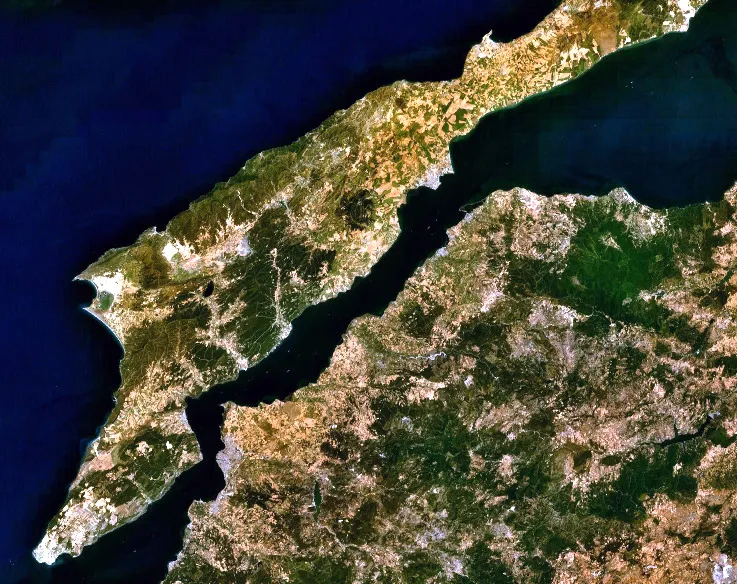 The Hellespont, today the Dardanelles, between the Gallipoli peninsula and Asia, in a Landsat 7 satellite imageWikimedia Commons, NASA, Public domain (File:Dardanelles landsat.jpg)
Alexander crosses further south, at the mouth of the strait, to the Troad. Diodorus writes that he throws his spear from the ship into the shore and leaps out first, to show that he takes Asia from the gods as spear-won land; Arrian too has him first ashore, in full armour. He goes up to Troy and honours the tombs of Achilles and the heroes of the Trojan War. In the temple of Athena, Arrian's account goes on, he dedicates his own armour and takes in exchange arms kept there since that war, which were later carried before him into his battles. Then he rejoins the army on the Asian shore.
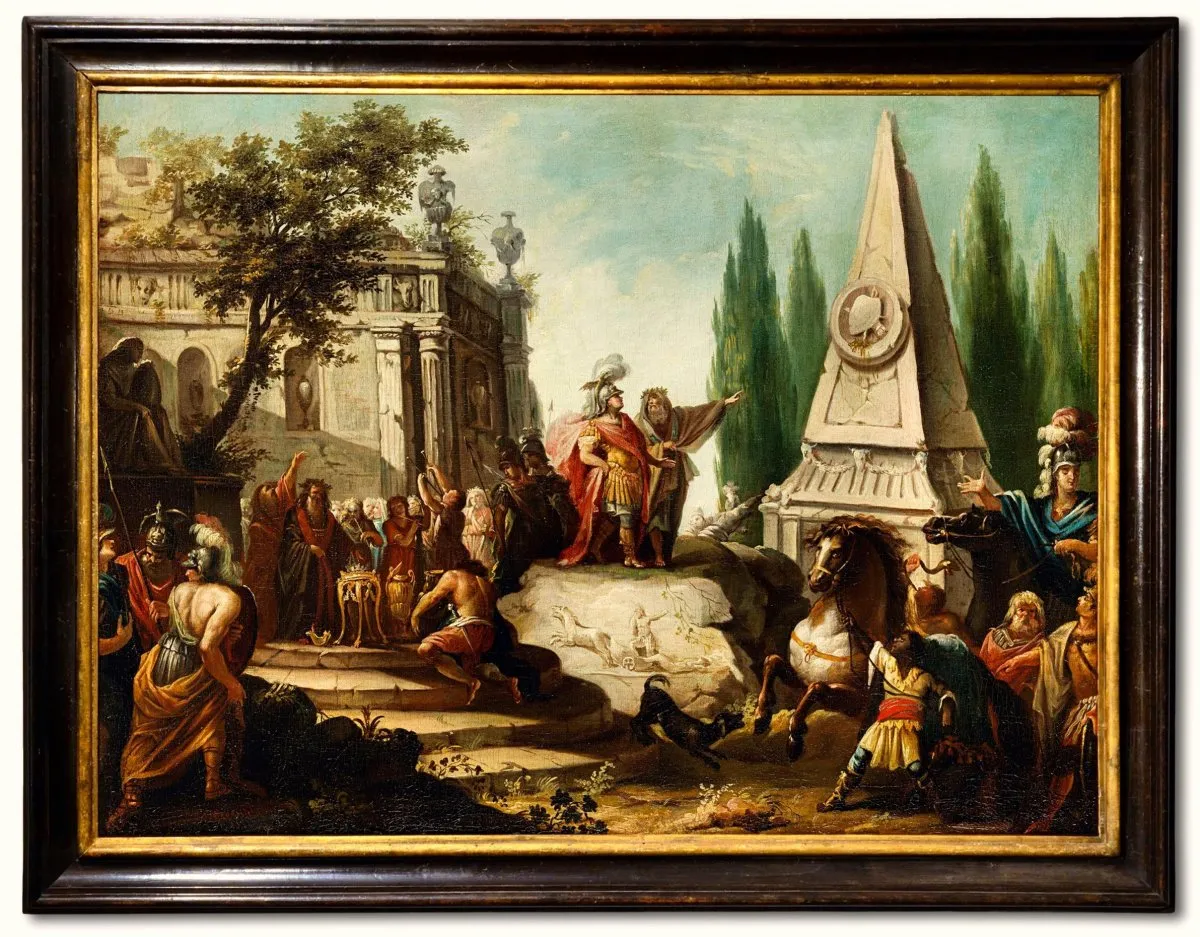 Alexander the Great at the tomb of Achilles, painted by Johann Heinrich Schönfeld in 1672Wikimedia Commons, Johann Heinrich Schönfeld, Public domain (File:Alexander the Great at Achilles' Tomb - Johann Heinrich Schönfeld1672.jpg)
Notes
* Arrian gives not much above 30,000 foot soldiers and more than 5,000 horsemen. Diodorus gives about 32,000 foot and 4,500 horse, though his totals and his list of contingents do not quite agree (the manuscripts' total reads 30,000 foot, and the cavalry contingents add up to 5,100), and says that 12,000 foot and 1,500 horse stay in Europe with Antipater. Plutarch reports that the counts of earlier writers run from 30,000 foot and 4,000 horse to 43,000 foot and 5,000 horse.
Sources
- Arrian, Anabasis of Alexander, book 1, 11 to 12 (tr. E. J. Chinnock).
- Diodorus Siculus, Library of History, book 17, 17 (tr. C. B. Welles).
- Plutarch, Life of Alexander, 15 (tr. B. Perrin).
- A. B. Bosworth, Conquest and Empire: The Reign of Alexander the Great (1988), ch. 2.II, 2.III and C.I.
- Pierre Briant, "Alexander the Great", Encyclopaedia Iranica (1985).
Prev: The fall of ThebesNext: The march to the Granicus