338–336 BC
Hegemon of Greece, and death at Aegae
After Chaeronea Philip settles Greece one city at a time. He garrisons Corinth, as he has Thebes. Only Sparta refuses him; Philip invades its land, Laconia, and gives its border districts to its neighbours.
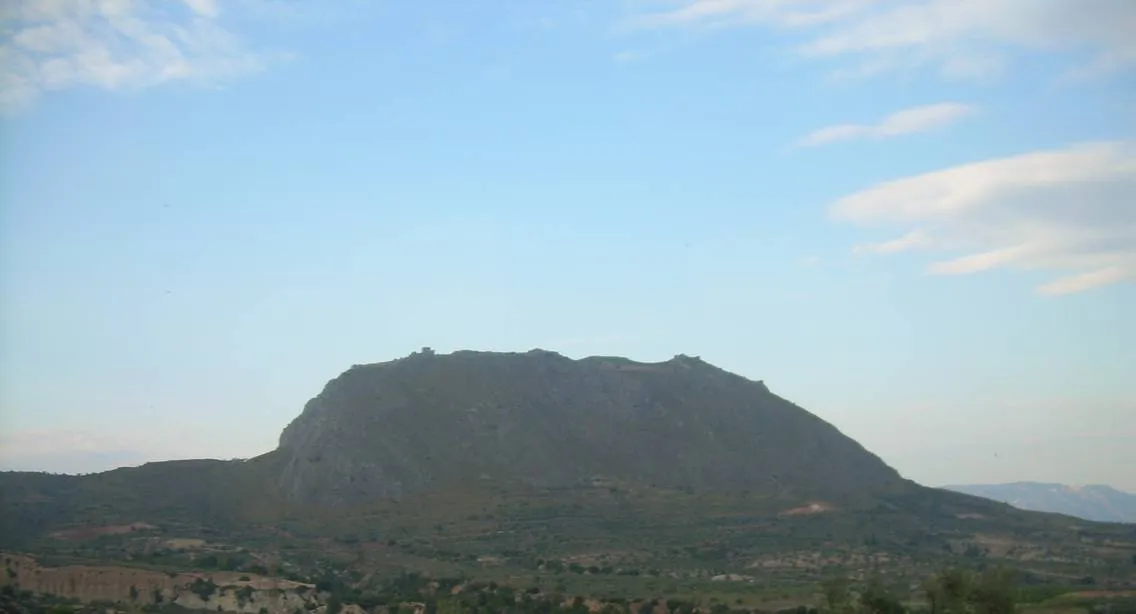 Acrocorinth, the citadel of Corinth, photographed in 2007Wikimedia Commons, FocalPoint, CC BY-SA 3.0 (File:Acrocorinth view.jpg)
Early in 337 BC delegates of the Greek states meet at Corinth, all except the Spartans. They swear a common peace: no member may make war on another or overthrow its government, and a council of all members will enforce it. Historians call this union the League of Corinth. Its council elects Philip hegemon, its leader, and votes for war on the Persian Empire to punish the burning of Greek temples 150 years before.
In spring 336 BC Philip's generals Parmenion and Attalus lead the first troops of that war into Asia: 10,000 Macedonians and mercenaries, by Ellis's figure. They land at Abydus, on the Asian shore of the Hellespont, and move south down the coast of Asia Minor. In many Greek cities along it, partisans of Macedon throw out the governments that served Persia. The sources do not say how far south the force had got by the autumn, and its route on the map is approximate.
In October 336 BC, the probable month by Ellis's reckoning, Philip holds a festival at Aegae, the old royal capital, for the wedding of his daughter Cleopatra to Alexander of Epirus, Olympias's brother. On the morning of the games, with his guards ordered to keep their distance, Philip comes to the theatre.* Pausanias, a young noble from Orestis in his bodyguard, rushes at him and stabs him dead. The guards catch the assassin as he runs for his horses and kill him.
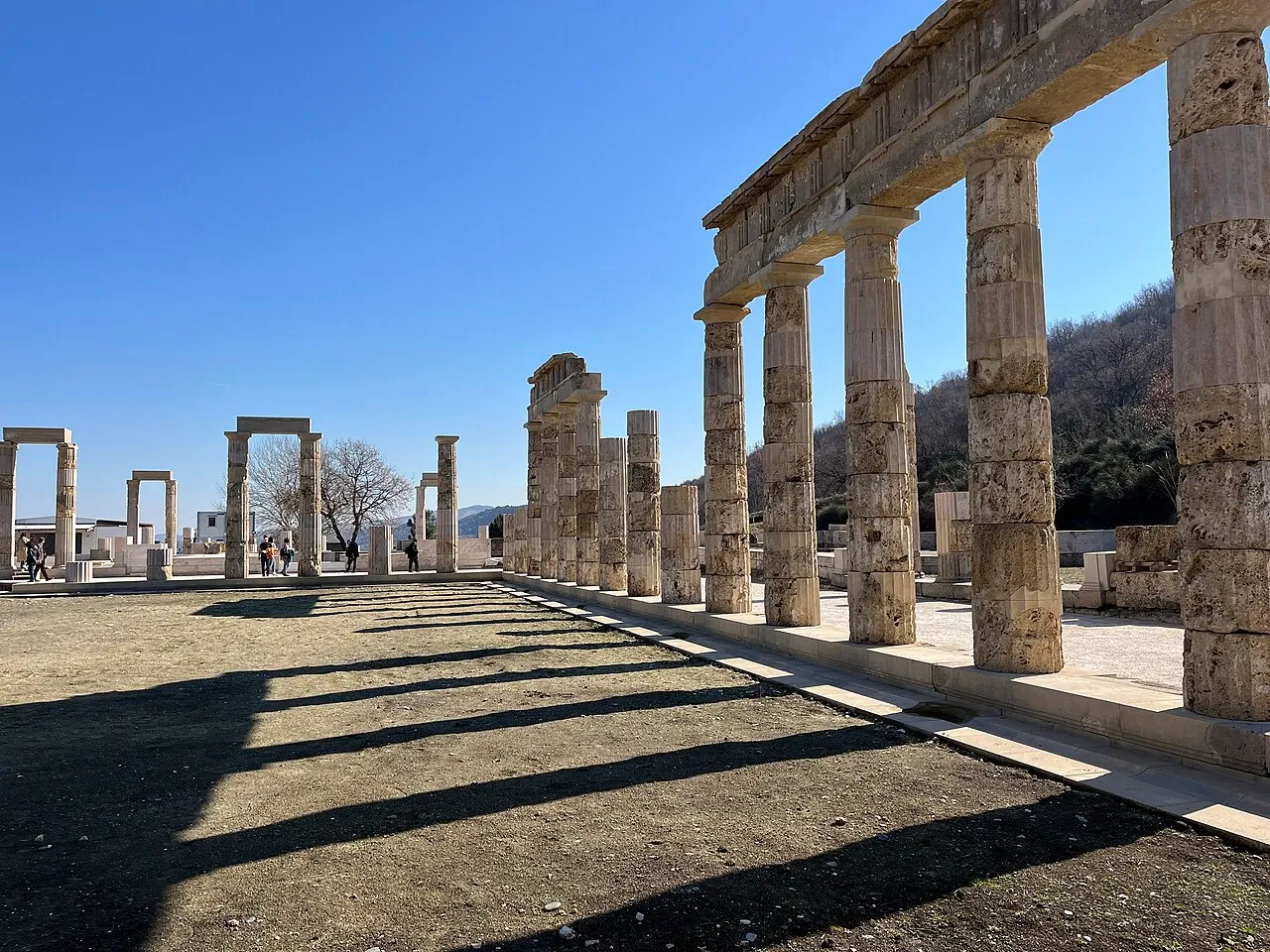 The palace of Aegae, photographed in 2024Wikimedia Commons, Αννίτα Μπάνου, CC BY-SA 4.0 (File:Ανάκτορο Αιγών.jpg)
Why Pausanias did it is disputed.** Philip's general Antipater presents Alexander, about twenty, to the army, which acclaims him king.
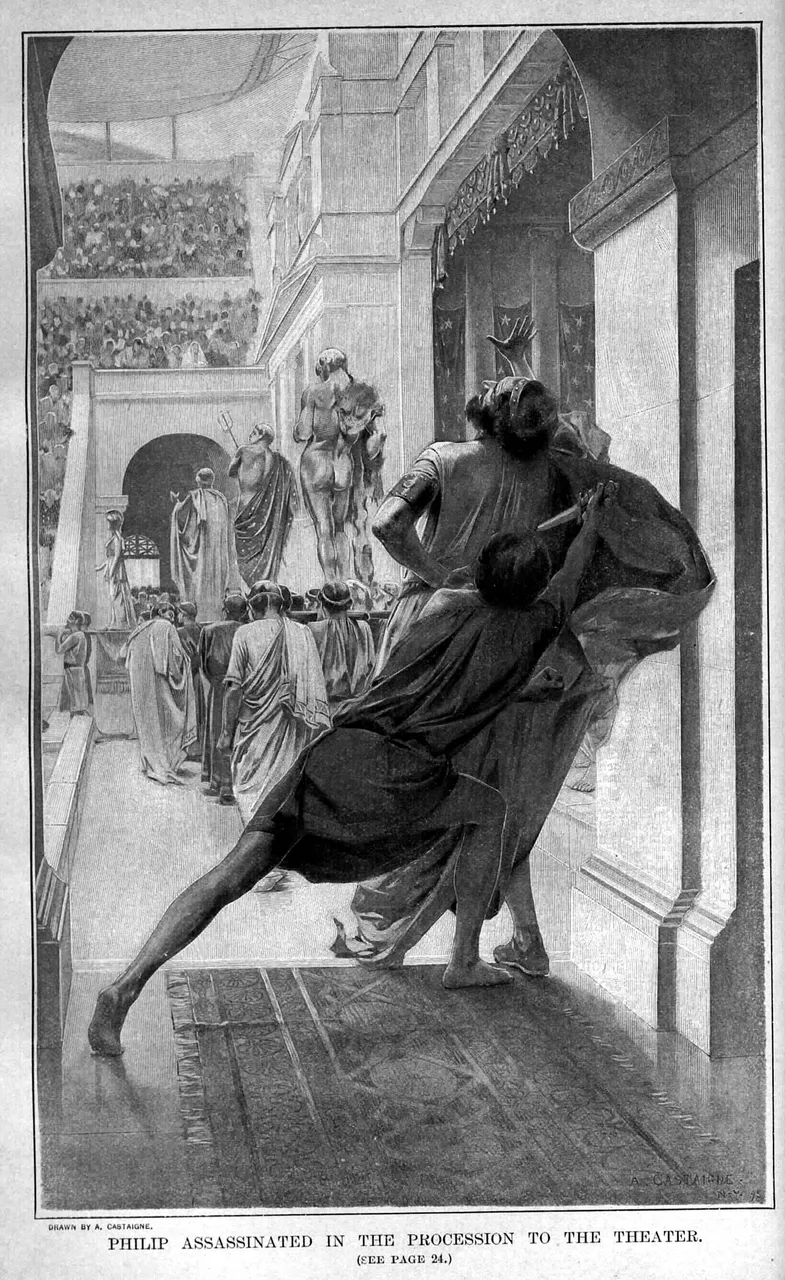 Pausanias stabs Philip as he enters the theatre at Aegae, illustration by André Castaigne, 1898–1899Wikimedia Commons, André Castaigne, Public domain (File:Pausanius assassinates Philip during the procession into the theatre by Andre Castaigne (1898-1899).jpg)
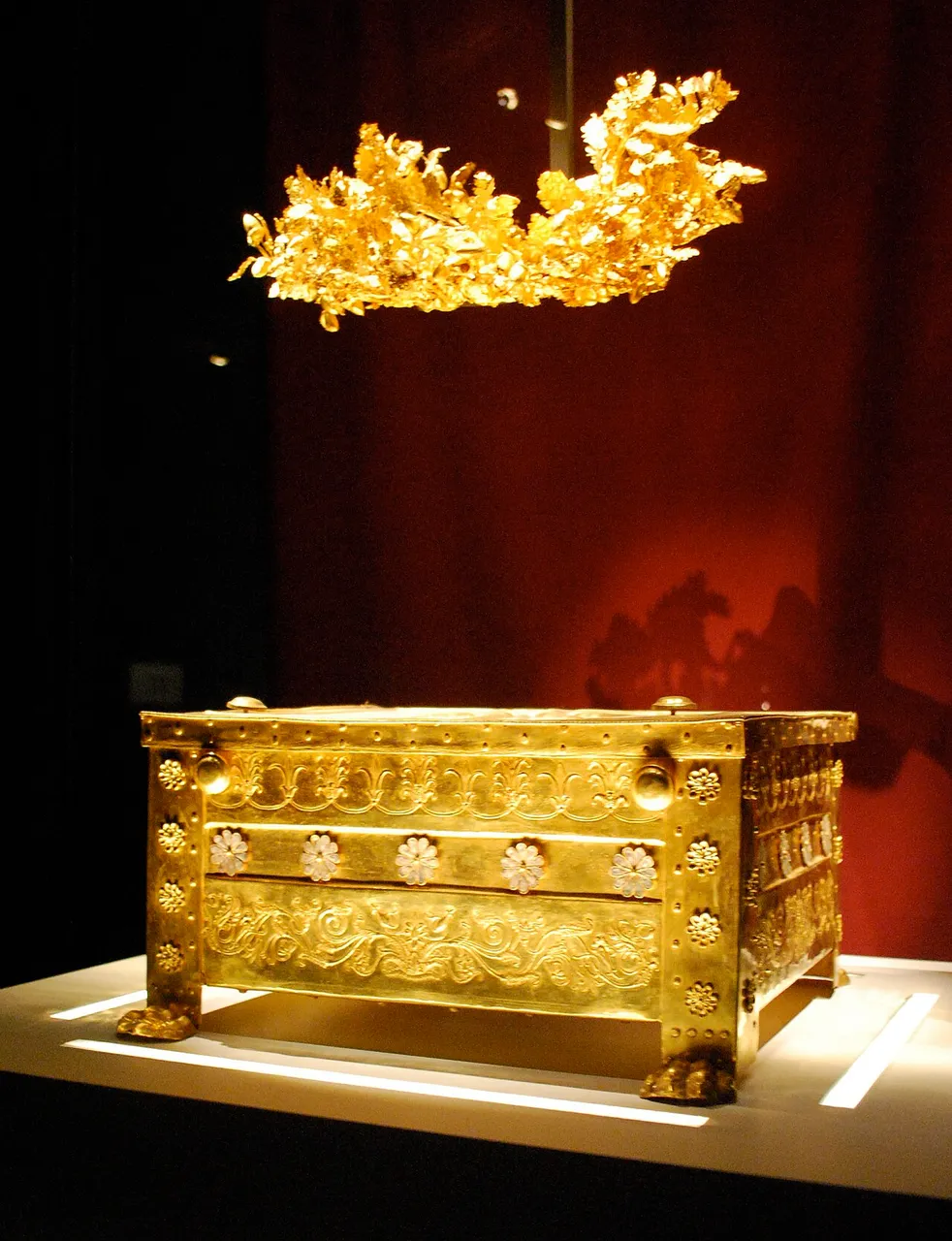 The gold larnax from the Great Tumulus at Vergina, ancient Aegae, held to have contained the remains of Philip IIWikimedia Commons, Sarah Murray, CC BY-SA 2.0 (File:Philip II larnax vergina greece.jpg)
Notes
* Justin and Ellis have Philip entering with his son on one side and his new son-in-law on the other; Justin places the stabbing in a narrow passage on the way. In Diodorus Philip sends his friends into the theatre ahead of him and is alone at its entrance when Pausanias strikes.
** Diodorus says that Attalus, a kinsman of Philip's latest wife and one of the generals of the advance force, had Pausanias brutally abused, and that Philip, who needed Attalus, would not punish him; so Pausanias turned his anger on the king. Justin tells the same grudge and adds the belief that Olympias set Pausanias on and that Alexander knew of the plot. Ellis writes that the murder seemed inexplicable at the time, and that explanations multiplied.
Sources
- Diodorus Siculus, Library of History, 16.89–95, tr. C. Bradford Welles (1963).
- J. R. Ellis, "Macedonian Hegemony Created", The Cambridge Ancient History VI (2nd ed., 1994), ch. 15.
- Justin, Epitome of Pompeius Trogus, 9.5–7, tr. J. S. Watson (1853).
- Arrian, Anabasis of Alexander, 1.1, tr. E. J. Chinnock (1884).
Prev: ChaeroneaNext: The Persian Empire of Darius III