May 334 BC
The march to the Granicus
After his visit to Troy, Alexander leads the army east along the Hellespont in May 334 BC, then inland, with scouts riding ahead to find the Persian army.
The satraps of Asia Minor have gathered their cavalry and their Greek mercenaries* near Zeleia, in Hellespontine Phrygia. Their commanders, none of whom is over the others, include Arsites, satrap of Hellespontine Phrygia, Spithridates, satrap of Lydia, Arsames, and Memnon of Rhodes, a Greek in Persian service. At their council Memnon advises against a battle with the stronger Macedonian infantry. They should burn the fodder and the crops, so that the invaders cannot feed themselves, and, Diodorus adds, carry the war across the sea to Macedon. Arsites refuses to let a single house of his province be burned. Arrian says the Persians distrust Memnon, suspecting him of dragging out the war to win honours from the king, and side with Arsites. The satraps march west from Zeleia and wait for Alexander on the far bank of the Granicus.
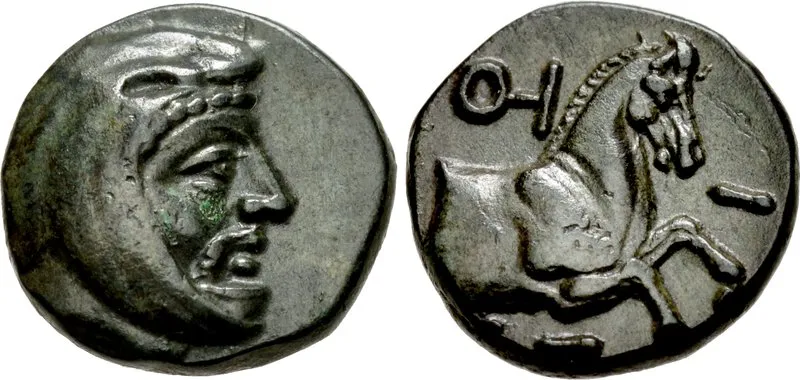 A coin of Spithridates, satrap of Lydia and Ionia, with the head of Heracles and a forepart of a horse; struck about 334 BCWikimedia Commons, CNG Coins, CC BY-SA 3.0 (File:IONIA, Achaemenid Period. Spithridates. Satrap of Sparda (Lydia and Ionia), circa 334 BC.jpg)
The armies meet at the river.** In Arrian and Plutarch, Alexander arrives late in the day. Parmenion, his senior general, advises him to camp and cross at dawn, but Alexander answers that after crossing the Hellespont he will not be held up by a brook. The pages that follow tell the battle as Arrian does.
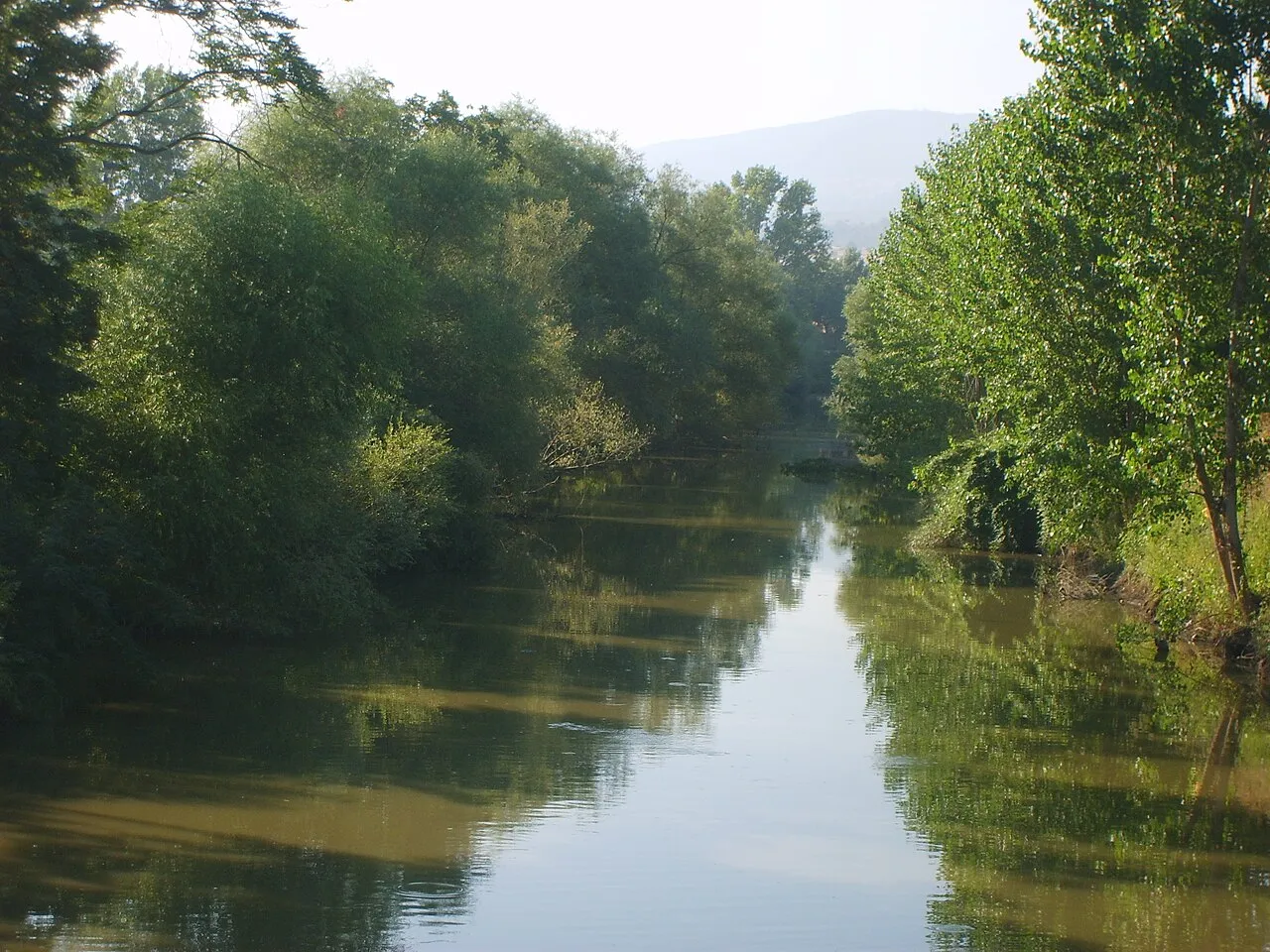 The Granicus, today the Biga Çayı, photographed in 2007Wikimedia Commons, Danbury, CC BY-SA 3.0 (File:Granicus River.jpg)
Notes
* Arrian gives the satraps about 20,000 horsemen and nearly as many Greek mercenaries. Diodorus gives more than 10,000 horsemen and at least 100,000 foot soldiers.
** In Arrian and Plutarch, Alexander forces the crossing that evening against Persian horsemen lined along the steep bank, with the Greek mercenaries on the higher ground behind them. In Diodorus, he crosses at dawn before the Persians can stop him and fights their cavalry on the far side. The historian A. B. Bosworth judged Diodorus's version the more plausible in 1980. In 1988 he held that the weight of evidence favours Arrian and Plutarch on the hour of the attack, but called Arrian's cavalry drawn up at the water's edge "a military absurdity" and wrote that the facts of the fight are "probably lost for ever".
Sources
- Arrian, Anabasis of Alexander, book 1, 12 to 16 (tr. E. J. Chinnock).
- Diodorus Siculus, Library of History, book 17, 18 to 21 (tr. C. B. Welles).
- Plutarch, Life of Alexander, 16 (tr. B. Perrin).
- A. B. Bosworth, Conquest and Empire: The Reign of Alexander the Great (1988), ch. 2.III.
- A. B. Bosworth, A Historical Commentary on Arrian's History of Alexander, vol. I (1980), on 1.13 to 16.
Prev: The crossing of the HellespontNext: The vanguard in the river