Spring to summer 333 BC
Gordium, and Memnon's war at sea
From Celaenae Alexander marches north across the Phrygian plateau to Gordium, the old seat of the Phrygian kings, in spring 333 BC. Bosworth reckons that the march takes at least a month. At Gordium Parmenion joins him with his column, and the newly married men come back from Macedon with new troops, among them 3,000 Macedonian foot soldiers and 300 horsemen. The army is united again.
In the citadel stands an ancient wagon dedicated to Zeus. A cord made from the bark of the cornel tree binds its yoke to the pole, knotted so that no end shows, and a local prophecy promises the rule of Asia to whoever can undo it. Alexander frees the yoke, though the writers disagree on how he does it.* That night there is thunder and lightning, which is taken as a sign that the prophecy has come true.
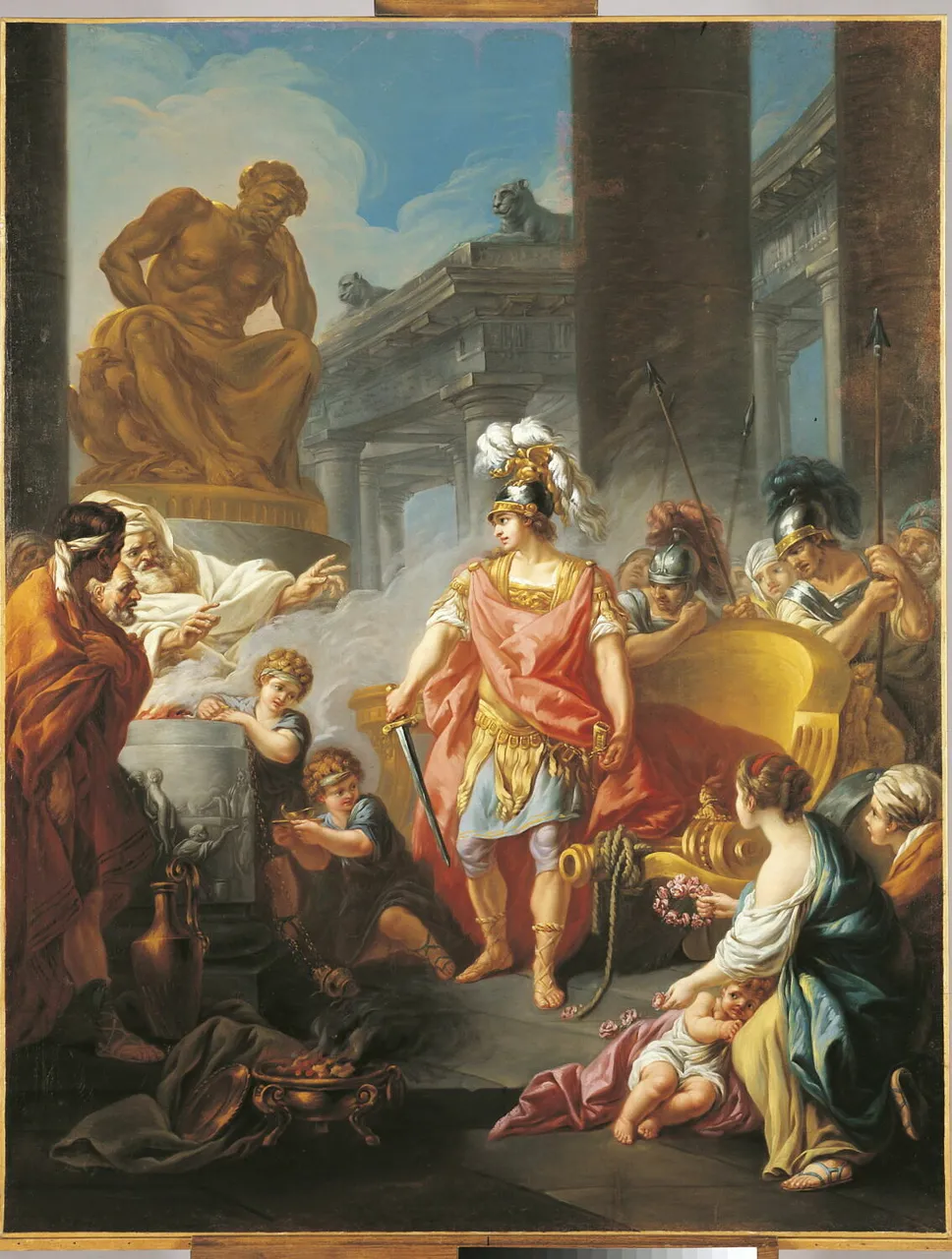 Alexander and the Gordian knot, painted by Jean-François Godefroy in 1767Wikimedia Commons, Jean François Godefroy, Public domain (File:Jean-François Godefroy Alexandre et le noeud gordien.JPG)
Behind Alexander, Memnon of Rhodes, the Greek whom Darius has made commander of the whole fleet and the coast, carries the war to the islands. Arrian says that he means to move the war into Macedon and Greece. His fleet has been based on Cos since the siege of Halicarnassus. In spring 333 BC Chios is betrayed to him, and on Lesbos the towns of Antissa, Methymna, Pyrrha and Eressus go over to him. Mytilene holds out, and Memnon blockades it by land and sea. In summer 333 BC he falls ill and dies, and Mytilene passes to the Persians.** Pharnabazus, Memnon's nephew, takes over the command with Autophradates, and the two carry on the war at sea. When Alexander leads his army out of Gordium early in the summer, he holds western Asia Minor, but the Persian fleet still holds the Aegean behind him.
Notes
* Plutarch says that most writers have Alexander cut through the cord with his sword. Aristobulus, who served with Alexander and wrote a history of him, says instead that he took out the wooden peg through the pole that held the fastening together, and then slid the yoke off. Arrian gives both stories and will not say which is true.
** Diodorus says that Memnon storms Mytilene only after a long siege, before his death. Arrian says that the city holds out until after Memnon's death and then surrenders on terms to Pharnabazus and Autophradates.
Sources
- Arrian, Anabasis of Alexander, book 1, 29, and book 2, 1 to 3 (tr. E. J. Chinnock).
- Diodorus Siculus, Library of History, book 17, 29 (tr. C. B. Welles).
- Plutarch, Life of Alexander, 18 (tr. B. Perrin).
- A. B. Bosworth, Conquest and Empire: The Reign of Alexander the Great (1988), ch. 2.V.
Prev: The winter march through Lycia and PamphyliaNext: Through the Cilician Gates