Late summer and autumn 325 BC
The march through the Gedrosian desert
In summer 325 BC Alexander leaves Patala, near the head of the Indus delta, and leads his army west. His fleet stays behind under the admiral Nearchus until the monsoon winds drop, and Craterus has already gone with part of the army by Arachosia and Drangiana.
He crosses the desert beyond the river Arabius in one night and conquers the independent people of Ora, around today's Las Bela. He leaves his bodyguard Leonnatus there to hold the land and gather food for the fleet, and turns into Gedrosia (today the Makran).
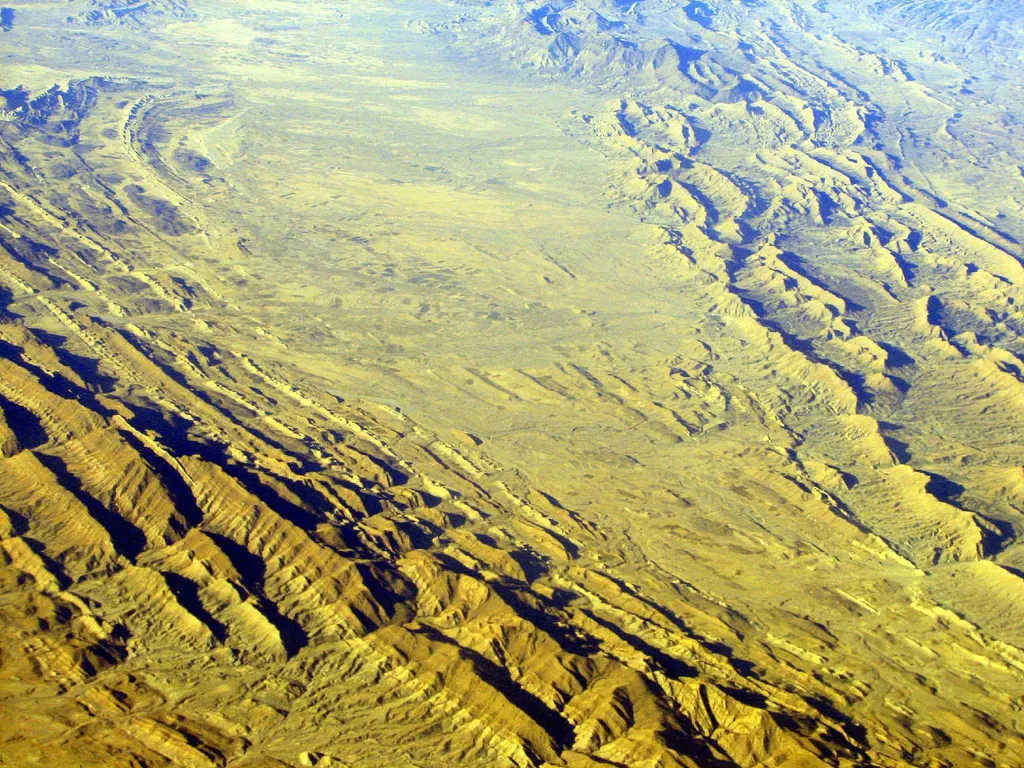 The Makran range in Pakistan seen from the air, photographed in 2007Wikimedia Commons, CanonS2, CC BY-SA 2.0 (File:Centralmakran.jpg)
Nearchus, as Arrian reports him, says that Alexander knew the danger. Legend told that Semiramis, a queen of Assyria, and Cyrus the Great had each lost almost a whole army in this desert, and Alexander wanted to outdo them. He also meant to bring supplies to the coast for the fleet. The historian Donald Engels sees a march planned around the fleet, which was to carry the army's grain, and wrecked when the monsoon held the fleet in the Indus for three months.
The army marches mostly by night, short of water. The soldiers kill the pack animals for food, and a flash flood in the night drowns most of the women and children who follow the army. When the guides lose the way, Alexander rides ahead, finds the sea and digs fresh water from the shingle. The army marches seven days along the Gedrosian coast, then turns inland and reaches Pura, the capital of Gedrosia, perhaps today's Iranshahr, sixty days after leaving Ora. Where the army suffered most is disputed.* The route and the empire's borders on this chapter's maps are approximate.
The losses were heavy, and their scale is disputed.** With Ora and Gedrosia, the empire now reaches along the coast west of the Indus.
Notes
* Engels puts the worst suffering in the Kolwa valley, before the army reached the sea. Bosworth thinks that valley could still feed it, and that the hardship grew along the shore and beyond.
** Plutarch says that Alexander brought back not a quarter of an army that had once counted 120,000 foot and 15,000 horse. Engels also thinks that about a quarter of the land army came through. Bosworth calls Plutarch's starting figure exaggerated: at least 18,000 Macedonian infantry later reached Opis, about half of them with Craterus, and the camp followers and animals suffered more than the fighting men.
Sources
- Arrian, Anabasis of Alexander, book 6, 21 to 26, tr. E. J. Chinnock.
- Plutarch, Life of Alexander, 66, tr. Bernadotte Perrin (Loeb, 1919).
- A. B. Bosworth, Conquest and Empire: The Reign of Alexander the Great (1988), ch. 2, XVII.
- Donald W. Engels, Alexander the Great and the Logistics of the Macedonian Army (1978), ch. 5 and appendix 3.
Prev: Patala and the OceanNext: Nearchus's voyage and the reckoning in Carmania