May – July or August 330 BC
The pursuit and death of Darius
In May 330 BC Alexander leaves Persepolis and marches north into Media to catch Darius III. According to Arrian, Darius had meant to wait at Ecbatana if Alexander stayed in the south, and to fall back east towards Bactria if he came, laying the land waste behind him. His new levies have not come, so he leaves Ecbatana with about 3,000 horse, 6,000 foot and 7,000 talents and heads for the Caspian Gates.
Parmenion is sent to hold Ecbatana and bring the treasure of Persis there. The Thessalian horse and the other Greek allies are paid off with a bonus and sent home, and those who wish to stay are hired as mercenaries.*
Alexander pushes on with his fastest troops, turning north-east before Ecbatana as the map draws it.** After a forced march he reaches Rhagae (today Rey), rests five days, and passes the undefended Caspian Gates. There he learns that Darius has been arrested by Bessus, the satrap of Bactria, with Nabarzanes, commander of the king’s cavalry, and Barsaentes, satrap of Arachosia. In Bosworth’s view the eastern satraps would not let Alexander capture Darius and show him off as a subject king.
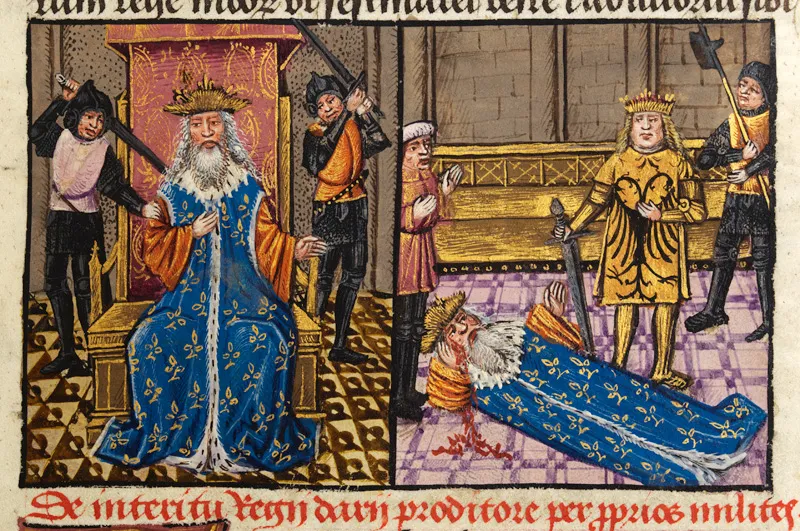 The murder of Darius by his own generals, and Alexander at the side of the dying king, in a Flemish manuscript of the late 15th centuryWikimedia Commons, unknown Flemish artist, CC0 (File:Murder of Darius and Alexander at the side of the dying king.jpg)
Alexander rides hard with his cavalry and picked infantry, and for the last stage puts 500 foot soldiers on horses and cuts across the waterless desert. At dawn he overtakes the Persian column a little short of Hecatompylus. When he comes near, Darius’s captors stab him, leave him in his wagon and flee with 600 horsemen. Darius dies before Alexander sees him. Arrian dates his death to July 330 BC*** and gives his age as about 50. Alexander sends the body to Persis for burial in the royal tombs. Bessus escapes to Bactria, where the next chapter follows. The lines of march on the map are approximate.
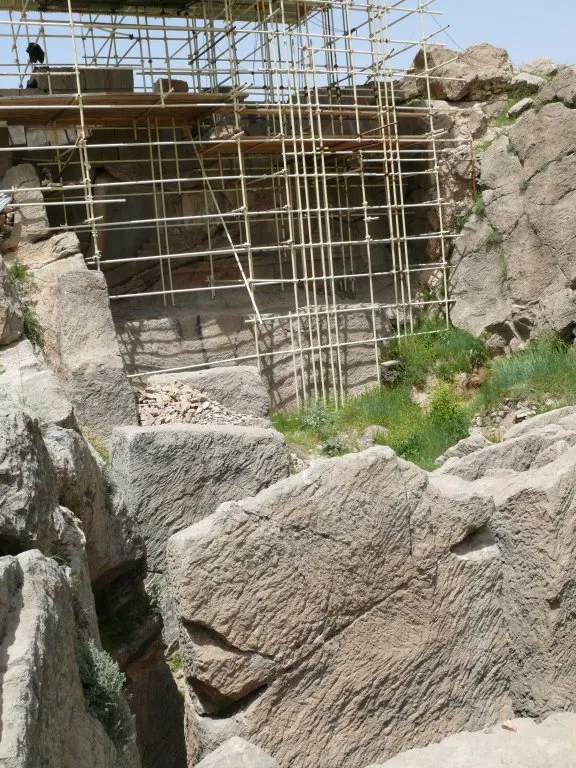 The unfinished tomb at Persepolis, thought to have been meant for Darius III, who was not buried in it; photographed in 2007Wikimedia Commons, Pentocelo, Public domain (File:Persepolis Unachieved Tomb.jpg)
Notes
* When this happens is disputed. Arrian places it at Ecbatana before the chase, and Plutarch when Alexander heard that Darius had been arrested. Diodorus and Curtius place it after Darius’s death, at Hecatompylus in Curtius, and Bosworth follows them. Arrian, Plutarch and Bosworth give the bonus as 2,000 talents; Diodorus gives a talent to each horseman and ten minas to each foot soldier.
** Arrian has Alexander enter Ecbatana; Bosworth thinks he turned north-east before reaching it, near today’s Sultanabad. Arrian has him reach Rhagae on the eleventh day of the march, Bosworth after ten days.
*** Arrian dates the death to the Athenian month Hecatombaeon, which is July 330 BC, and Briant gives July. Bosworth finds the march from Persis too long for that and inclines to place the death in August 330 BC.
Sources
- Arrian, Anabasis of Alexander, book 3, 19 to 22.
- Diodorus, Library of History, book 17, 73 to 74.
- Plutarch, Life of Alexander, 42 to 43.
- A. B. Bosworth, Conquest and Empire: The Reign of Alexander the Great (1988).
- Quintus Curtius Rufus, History of Alexander, book 6, 2 (tr. J. C. Rolfe).
- A. B. Bosworth, A Historical Commentary on Arrian's History of Alexander, vol. I (1980), on 3.22.
- Pierre Briant, From Cyrus to Alexander: A History of the Persian Empire (2002).
Prev: Agis III and the war for MegalopolisNext: Hyrcania, Areia and the fall of Parmenion