June 323 BC
Two kings and a regent
Alexander dies at Babylon between the evenings of 10 and 11 June 323 BC, and leaves no grown heir. His Bactrian wife Roxana is pregnant. His half-brother Arrhidaeus, a son of Philip II, is in the city, but a mental illness leaves him unable to rule on his own. The leading officers and the Companion cavalry decide to wait for Roxana's child. The infantry of the phalanx hail Arrhidaeus as king. For a time the cavalry camps outside the city, close to open fighting with the infantry.
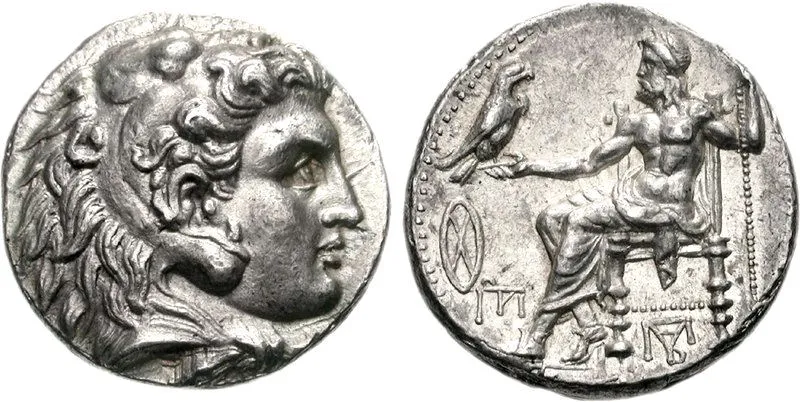 Silver tetradrachm of Philip III Arrhidaeus, struck at Babylon under Perdiccas about 323–320 BC: the head of Heracles in a lion skin, and Zeus enthronedCNG coins, CC BY-SA 3.0, via Wikimedia Commons (File:Philip III Arrhidaios Babylon mint struck under Perdikkas circa 323 320 BC.jpg)
The army makes Arrhidaeus king under the name Philip III and keeps a share of the kingdom for Roxana's child, if it is a son. Perdiccas, the general to whom the dying Alexander gave his ring, becomes regent. Antipater keeps Macedon and Greece.
Perdiccas shares out the satrapies among the generals, who are to obey the king and him. Ptolemy receives Egypt, and Laomedon Syria. Philotas, satrap of Cilicia, receives Cilicia, and Peithon Media. Antigonus gets Pamphylia, Lycia and Greater Phrygia, and Eumenes Cappadocia and Paphlagonia, lands Alexander, Diodorus says, never conquered. Leonnatus takes Hellespontine Phrygia, and Lysimachus Thrace. The satraps of the east keep their posts, and Taxiles and Porus their kingdoms on the Indus and the Hydaspes. Roxana gives birth to a boy, probably in August 323 BC by Hammond and Walbank's dating, and as Alexander IV he becomes king alongside his uncle.
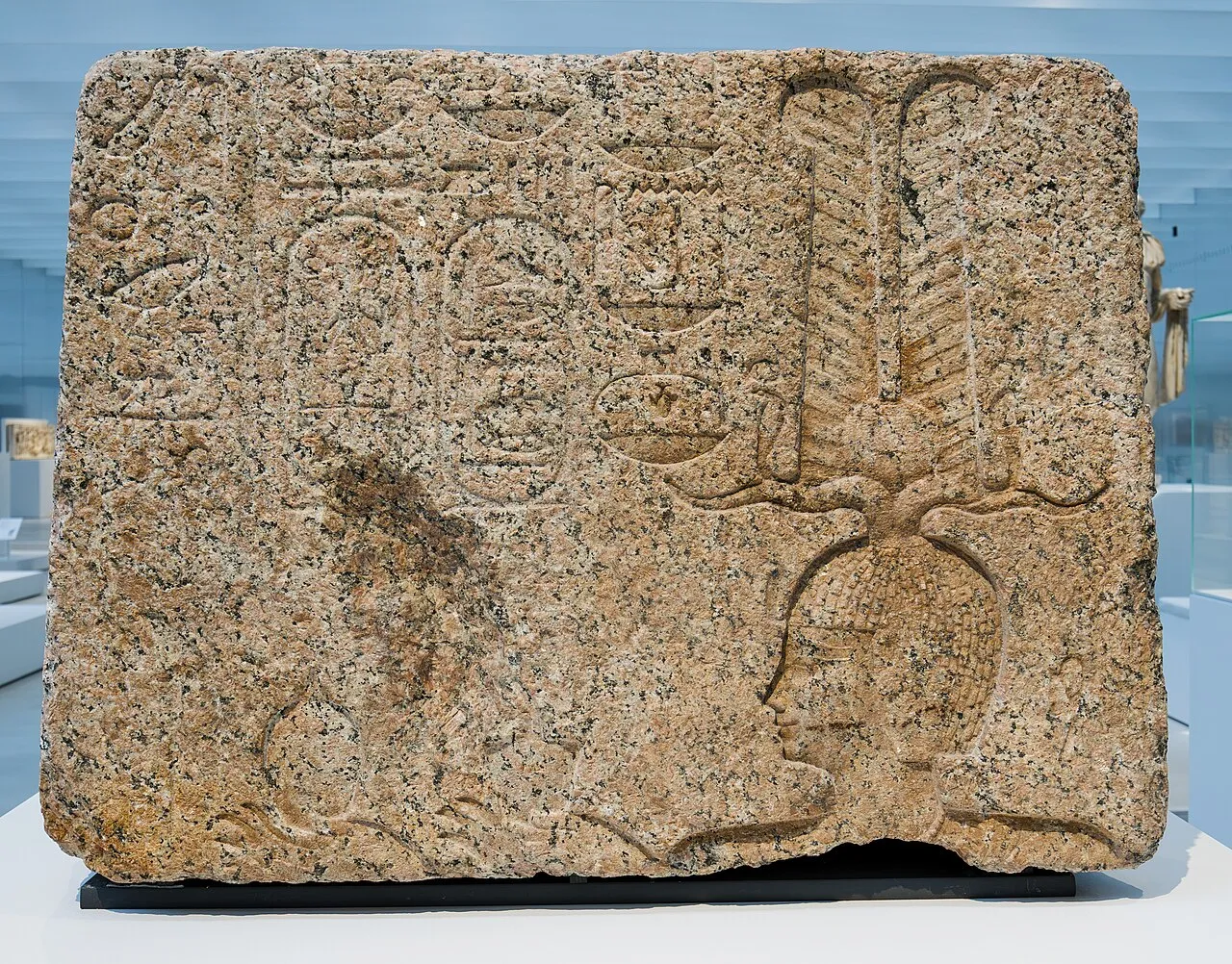 Egyptian wall relief showing King Alexander IV, son of Alexander the Great, made about 317–310 BC. Louvre, E 10970JackyM59, CC BY-SA 4.0, via Wikimedia Commons (File:Relief mural - Alexandre IV Aegos (Louvre E 10970).jpg)
No king is able to rule, the army is split between a half-brother and an unborn child, and each general has a province and an army of his own. On the map the empire belongs to the two kings, and the lands of Ptolemy, Antigonus, Eumenes and Lysimachus are cut out of it. The borders on this chapter's maps, drawn from the sources' lists of lands, are approximate.
Sources
- Diodorus Siculus, Library of History, book 18, 1–3, tr. R. M. Geer (Loeb, 1947).
- Justin, Epitome of the Philippic History of Pompeius Trogus, book 13, 2–4, tr. J. S. Watson (1853).
- A. B. Bosworth, The Legacy of Alexander: Politics, Warfare and Propaganda under the Successors (2002), ch. 2.
- N. G. L. Hammond and F. W. Walbank, A History of Macedonia, vol. III: 336–167 B.C. (1988), ch. V.
Prev: Babylon: the last plans and the death of AlexanderNext: The Lamian War