Winter 327–326 BC
The rock of Aornos
After the fall of Massaga, in winter 327–326 BC, the people of the Swat country flee to the rock of Aornos. A local story said that even Heracles had failed to take it. Arrian doubts the tale, but he says it made Alexander want the rock all the more. A single steep path led to the top.*
Where the rock stood is disputed, and the map draws Stein's Pir Sar, a spur above a bend of the Indus, as a reconstruction.**
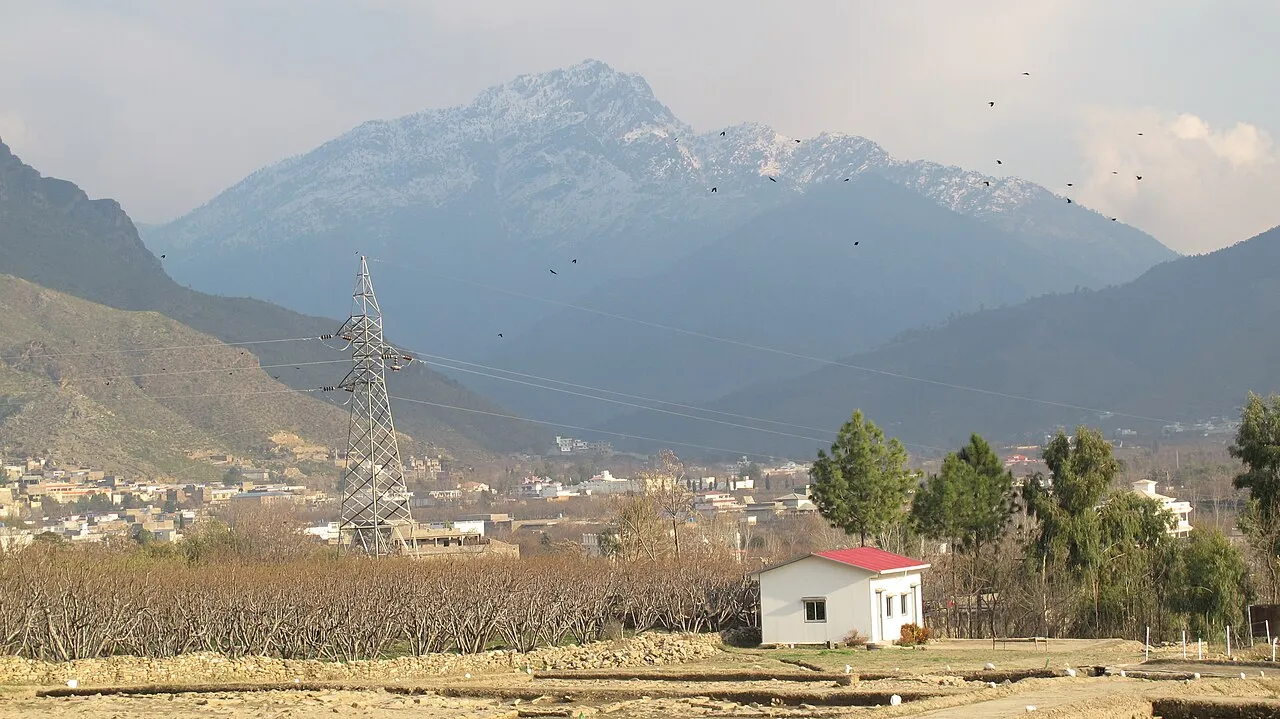 Mount Ilam (Elam Hill), one of the proposed sites of Aornos, seen from Barikot Ghundai in 2012Wikimedia Commons, Tan Afridi, CC BY-SA 3.0 (File:View Elam Hill from Barikot Ghundai.JPG)
Alexander leaves garrisons in the towns behind him, and Craterus gathers grain for a long siege. Guided by local men, Ptolemy, one of Alexander's bodyguards, seizes a ridge near the summit and holds it until Alexander fights his way up to him. The army then builds a mound of stakes and earth across the ravine, so that arrows and catapults can reach the defenders. On the fourth day they offer to surrender. They abandon the rock by night, and Alexander takes it.***
Meanwhile Hephaestion and Perdiccas have reached the Indus and bridged it. Alexander makes Nicanor, one of the Companions, satrap of the land west of the river, and the Cophen valley is now Macedonian. Across the bridge lies the kingdom of Taxila.
Notes
* Arrian gives the rock a circuit of about 200 stades and a height of 11 stades at its lowest point. Diodorus makes the circuit 100 furlongs and the height 16.
** Stein placed Aornos at Pir Sar, and Bosworth finds his case decisive, because Diodorus and Eratosthenes put the Indus at the rock's foot. Tucci and Eggermont argue for Mount Ilam, just south of the Swat towns of Bazira and Ora.
*** Arrian says the defenders meant to stall and scatter in the dark, so Alexander let them start, climbed the rock with 700 bodyguards and hypaspists, and fell on them; many were killed in the flight or fell from the cliffs. Diodorus says Alexander withdrew his guard from the path on purpose and let them leave, taking the rock without a fight.
Sources
- Arrian, Anabasis of Alexander, book 4, 28 to 30.
- Diodorus Siculus, Library of History, book 17, 85 to 86.
- A. B. Bosworth, Conquest and Empire: The Reign of Alexander the Great (1988), ch. 2.XIV.
- A. B. Bosworth, A Historical Commentary on Arrian’s History of Alexander, vol. 2 (1995), on 4.28 to 30.
Prev: Down the Cophen valleyNext: Taxila, an ally beyond the Indus