357–356 BC
Amphipolis, Philippi and the gold of Pangaeum
With the Illyrians beaten, Philip turns east. Amphipolis, a Greek city on the lower Strymon, is hostile to him, and Athens has long wanted it back. In 357 BC Athens's allies rise against it in the Social War, and the Athenians have no force to spare. In the late autumn or winter Philip brings up siege engines, breaks the wall with his rams and takes the city. Diodorus notes how well it is placed for reaching into Thrace.
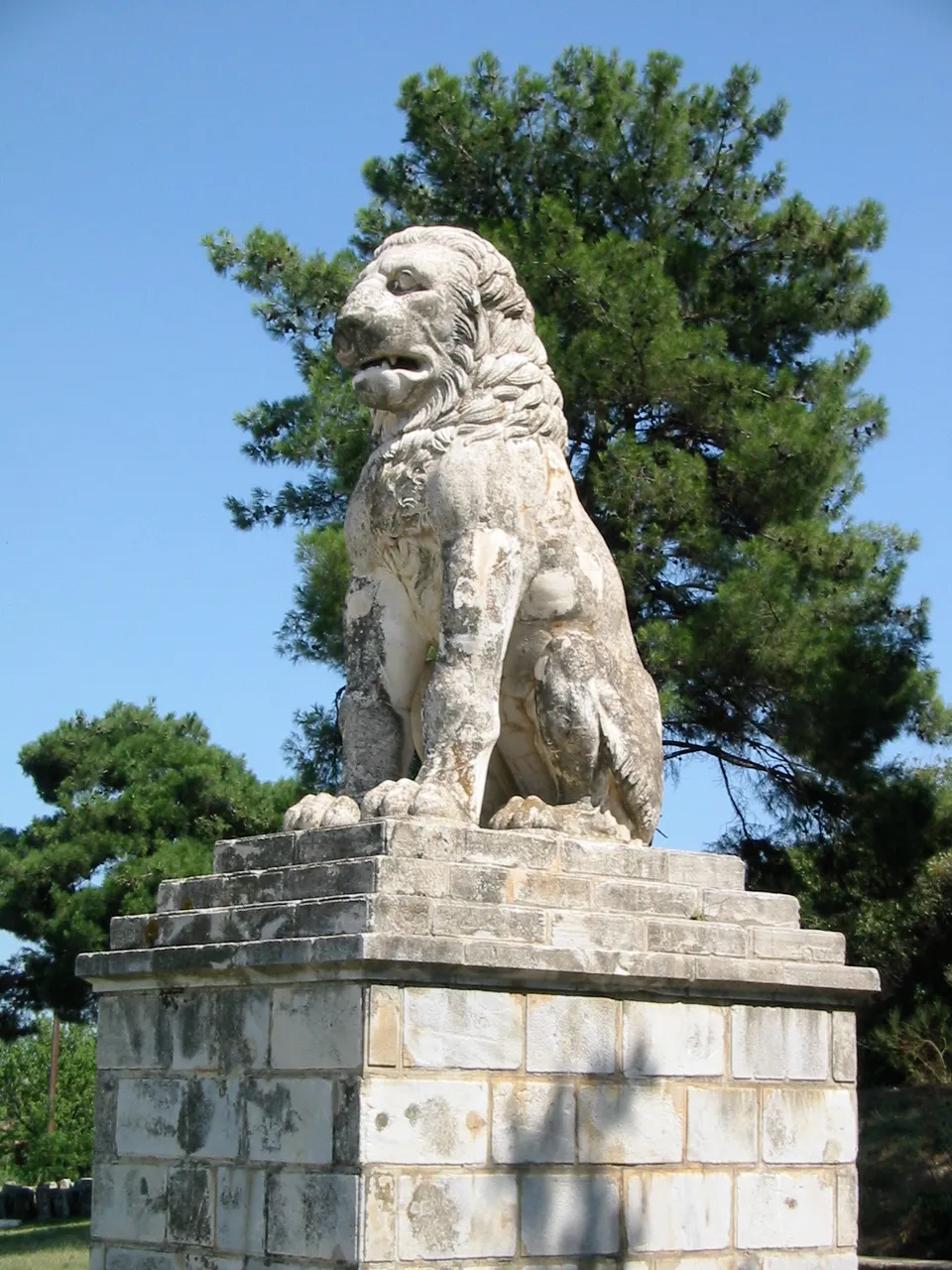 The Lion of Amphipolis, photographed in 2002Wikimedia Commons, Kkonstan, CC BY 3.0 (File:Amphipolis Lion.jpg)
To keep the Chalcidian League friendly, Philip allies with its leading city, Olynthus, and promises to win Potidaea for it. In 356 he besieges Potidaea, sells its people as slaves and hands the town to the Olynthians. The Chalcidice stays theirs.
East of Amphipolis lie the mining villages of Crenides. When a Thracian king marches on them, their people ask Philip for help. He drives the king off, and the villages become a single walled town with Macedonian settlers and a new name, Philippi, after its founder. Philip and Alexander will go on to found many such colonies; Ellis makes Philippi the first. For now it stays outside the kingdom, an outpost beyond the frontier. In its land are the gold mines of Mount Pangaeum, whose output, Diodorus says, Philip raised to more than 1,000 talents; Ellis puts the royalties at 1,000 talents a year. With the gold he strikes coins, hires mercenaries and, Diodorus says, bribes men in the Greek cities to work for him.
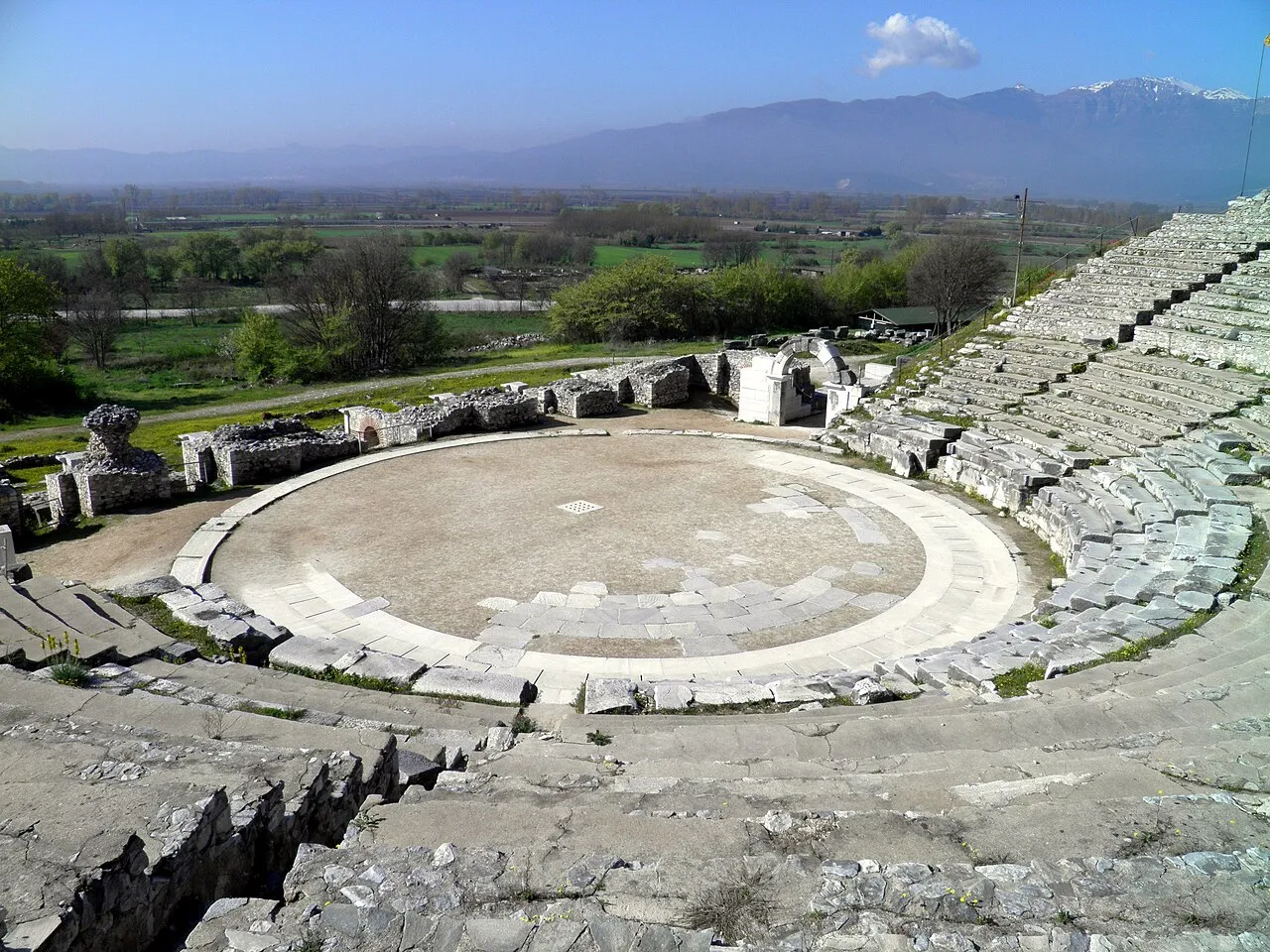 The theatre of Philippi, built under Philip II in the 4th century BC and rebuilt by the Romans; photographed in 2012Wikimedia Commons, Carole Raddato, CC BY-SA 2.0 (File:Ancient Theatre, built by Philip II in the 4th century BC and later reconstructed by the Romans, Philippi (7272297822).jpg)
In the month the Athenians call Hecatombaeon, about July 356 BC, Philip's wife Olympias, a princess of the Molossians of Epirus, bears him a son, Alexander.*
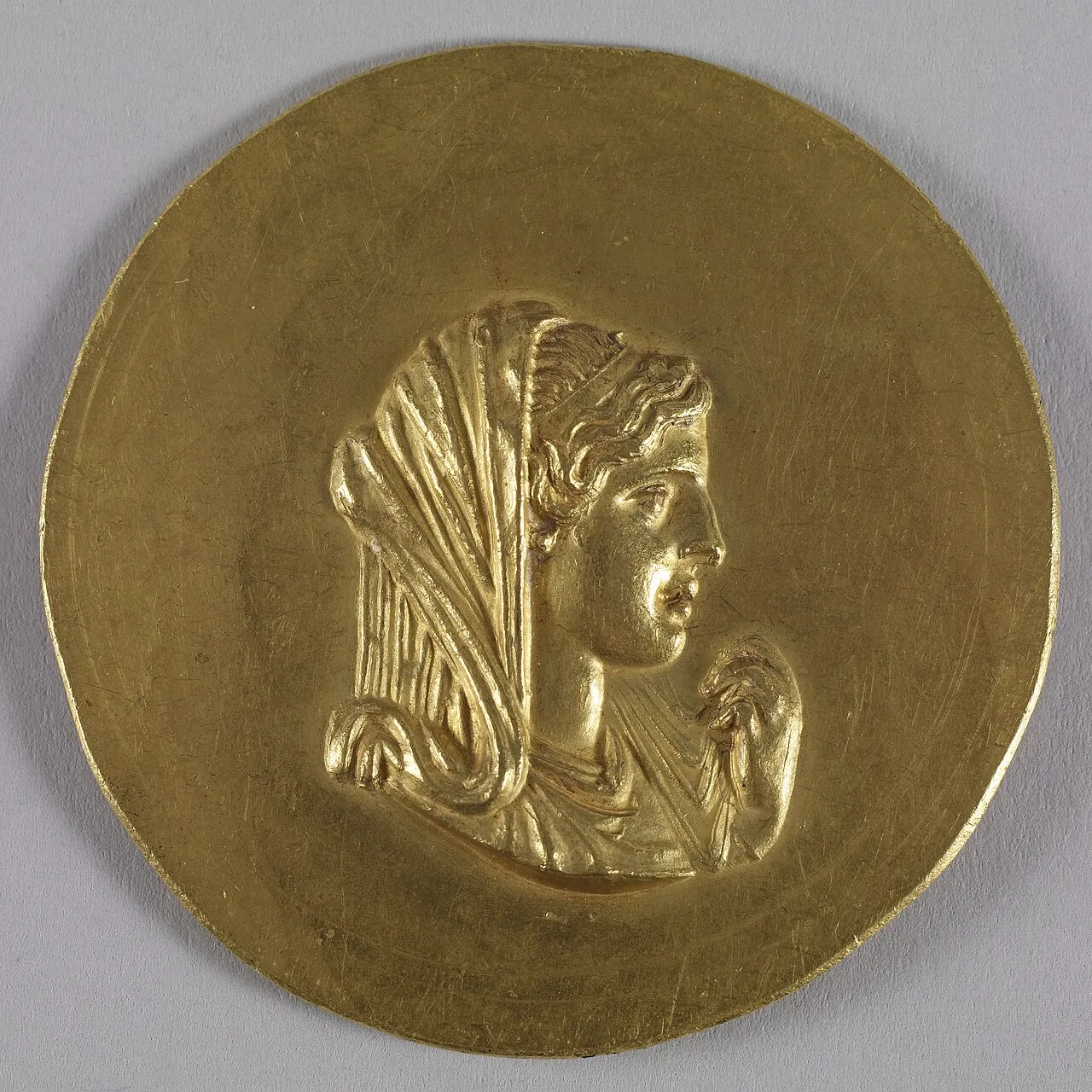 Olympias on a Roman gold medallion made about AD 215–243, found at Aboukir in Egypt, Walters Art MuseumWikimedia Commons, Walters Art Museum, Public domain (File:Roman - Medallion with Olympias - Walters 592 - Obverse.jpg)
Notes
* Plutarch tells that three messages reached Philip at once, just after he took Potidaea: his general Parmenion had beaten the Illyrians, his racehorse had won at Olympia, and his son was born. Ellis writes that "there must be some licence here", since the birth fell in July, the Olympic games in August or September, and Potidaea surrendered only in the autumn.
Sources
- Diodorus Siculus, Library of History, 16.8, tr. C. L. Sherman (1952).
- J. R. Ellis, "Macedon and North-West Greece", The Cambridge Ancient History VI (2nd ed., 1994), ch. 14.
- Plutarch, Life of Alexander, 2–3, tr. B. Perrin (1919).
Prev: Philip takes a kingdom in dangerNext: Thessaly and Olynthus