Early 331 BC
Alexandria and Siwa
Early in 331 BC Alexander sails down the Nile from Memphis to Canopus, near the river's western mouth, and round Lake Mareotis. On the strip of land between the lake and the sea, opposite the island of Pharos, he finds a site that he foresees will prosper, Arrian writes. There he marks out a city, its walls, its market place and its temples, and it takes his name: Alexandria.*
Alexander now sets out to consult Ammon, a god whom the Greeks took for a form of Zeus, at his oracle in the oasis of Siwa. Arrian says that Perseus and Heracles, from whom Alexander traced his descent, had consulted it, and that Alexander wished to follow them. He goes about 290 km west along the coast to Paraetonium and then south across the desert. When the wind covers the tracks and even the guides lose the way, two creatures go ahead and lead the column, a sign of the god's help in Arrian's eyes.** The routes on the map are approximate.
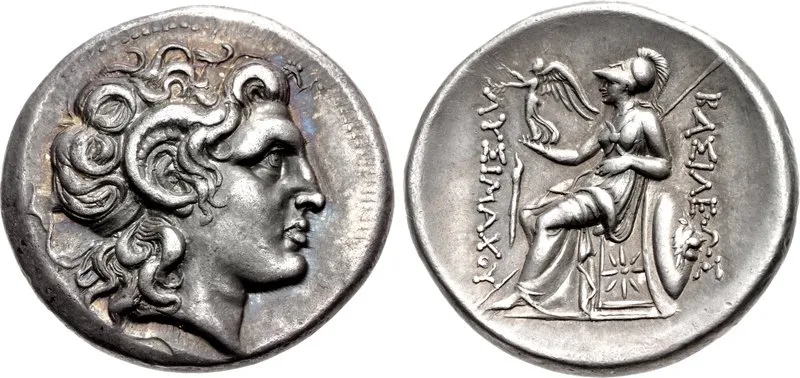 Silver tetradrachm of Lysimachus with the head of the deified Alexander wearing the horn of Ammon, struck at Lampsacus in 297–281 BCWikimedia Commons, CNG Coins, CC BY-SA 3.0 (File:Lysimachus coin, Alexander depiction, 297-282 B.C., Thrace.jpg)
At Siwa Alexander alone goes into the temple to consult the god. What he asked is not known. Ptolemy, son of Lagus, and Aristobulus, who both served with him and later wrote the histories that Arrian follows, say only that he was satisfied with the answers. Plutarch quotes a letter to his mother in which Alexander speaks of secret replies that he will tell her alone.
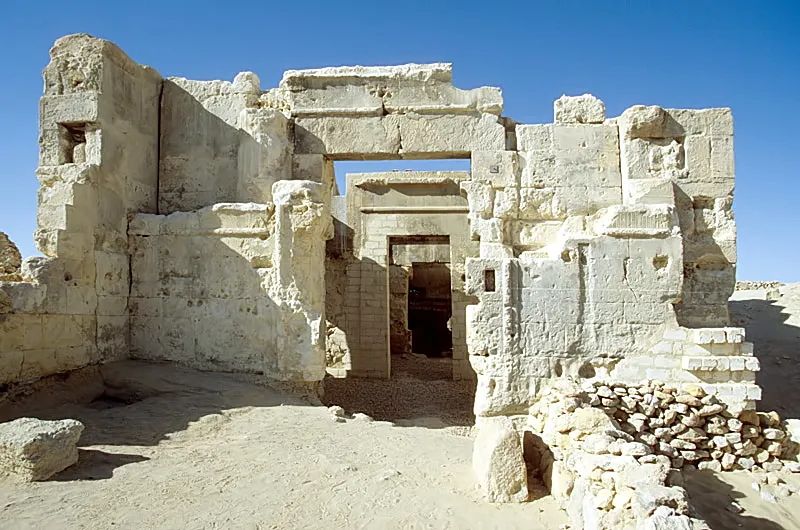 The temple of Amun at Aghurmi in the oasis of Siwa, photographed in 2001Wikimedia Commons, Roland Unger, CC BY-SA 3.0 (File:SiwaAghurmiTemple.jpg)
Alexander then returns to Memphis, where he sacrifices to Zeus the King and settles the government of Egypt. The map draws his road back along the coast.***
Notes
* This page follows Arrian, who puts the founding before the journey to Siwa. Diodorus puts it after. The historian A. B. Bosworth thinks that Alexander chose the site on the way out and marked its bounds on his return.
** In the account of Aristobulus two ravens fly in front of the army. In that of Ptolemy, son of Lagus, two snakes go ahead of it, making a sound, and lead it to the oracle and back. Arrian calls the account of Aristobulus the one generally accepted.
*** Aristobulus says that Alexander went back the way he came, along the coast, and Bosworth holds that the weight of evidence supports him. Ptolemy says that he took another road, straight to Memphis.
Sources
- Arrian, Anabasis of Alexander, book 3, 1 to 5.
- Diodorus Siculus, Library of History, book 17, 49 to 52.
- A. B. Bosworth, Conquest and Empire: The Reign of Alexander the Great (1988).
- Plutarch, Life of Alexander, 26 to 27.
Prev: Egypt opens its gatesNext: Darius's last offer and the road to Gaugamela